On September 2, 2026, NEC Corporation (NEC) and Mitsubishi Heavy Industries signed a memorandum of understanding for a strategic partnership aimed at strengthening Japan’s defense industrial base and establishing data and AI sovereignty. Amid rising geopolitical tensions, the two companies will accelerate joint development in the fields of operational planning, command and control systems, and unmanned assets, aiming to secure a technological advantage.
- Overview of the Partnership and Data & AI Sovereignty Targeted by Both Companies
- Dramatic Shifts in the Security Environment and Rising Defense Demand
- The Utilization and Domestic Production of AI in Command and Control Systems
- Mitsubishi Heavy Industries Takes on UAV AI and Domestic Autonomous Technology
- Transforming Defense Manufacturing Operations and Productivity Improvement
- Future Developments and Key Points of the Defense Industry Supporting National Security
Overview of the Partnership and Data & AI Sovereignty Targeted by Both Companies
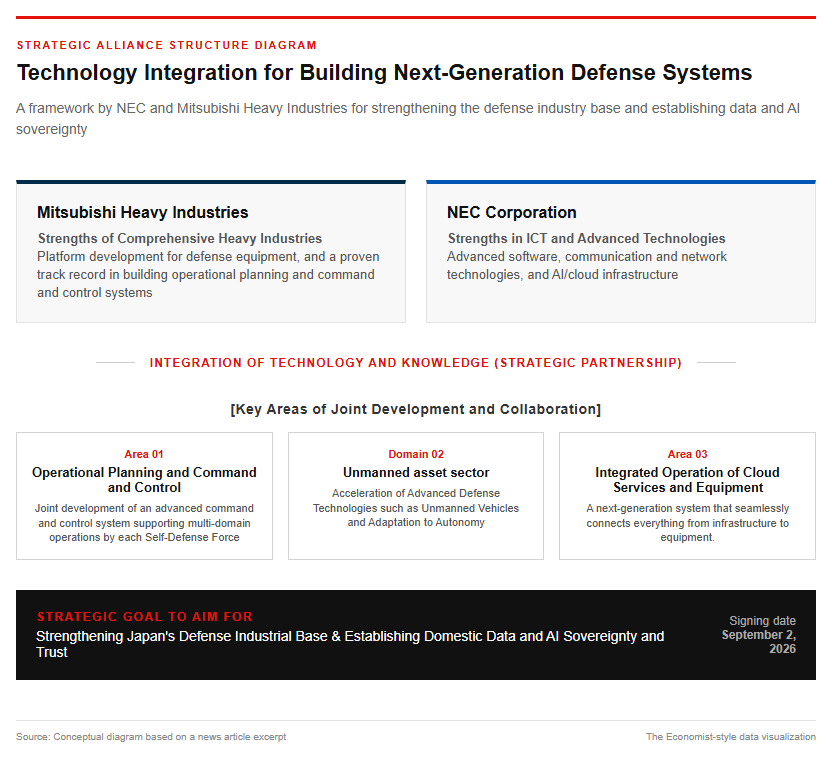
Mitsubishi Heavy Industries, one of Japan’s leading comprehensive heavy industries giants, and NEC Corporation (NEC), which supports social infrastructure through information and communication technology, announced on September 2, 2026, that they have signed a memorandum of understanding for a strategic partnership in the defense sector. This partnership aims to respond to the rapidly changing security environment of recent years, strengthen the foundation of Japan’s defense industry, and ensure domestic sovereignty and reliability over data and artificial intelligence (AI), which are the cornerstones of national security.
Specific areas of cooperation for the partnership include advanced defense technologies such as operational planning and command-and-control systems that support the multi-domain operations of each Self-Defense Force, as well as unmanned assets. NEC President and CEO Takayuki Morita noted that this is an important step toward realizing a truly sovereign and reliable defense system that brings together Japan’s technology and expertise, while Mitsubishi Heavy Industries President and CEO Eisaku Ito also stated that the two companies will fuse their advanced technologies and knowledge to maximize their technological superiority. By fusing their strengths, the two companies are hastening the construction of a next-generation defense system that integrates the operation of the cloud and defense equipment.
Please refer to the figure below.
Dramatic Shifts in the Security Environment and Rising Defense Demand
Behind this partnership are the rapidly changing security environment surrounding Japan and the consequent dramatic expansion of its defense budget. Japan’s defense-related expenditures for fiscal 2025 reached a record high of 8.4748 trillion yen, representing a substantial increase of about 9.7% from the previous fiscal year. Under its Defense Buildup Program, the government has indicated a policy to raise defense spending to the 2% level of gross domestic product (GDP) by fiscal 2027, and demand for defense equipment will remain at an extremely high level over the medium term.
Furthermore, major institutional reforms surrounding defense equipment are also underway. On April 21, 2026, the government decided to revise the Three Principles on Transfer of Defense Equipment and Technology and their implementation guidelines. As a result, the export of finished equipment, technologies, and parts such as highly lethal fighter jets and missiles has been significantly relaxed, and even direct investment and mergers and acquisitions (M&A) involving overseas defense industries have become possible. Private companies supporting the defense industry are required not only to meet domestic demand, but also to establish highly reliable technological superiority and build systems capable of cooperating with allies and friendly nations.
New Warfare Brought by AI and Unmanned Assets
The Utilization and Domestic Production of AI in Command and Control Systems
In contemporary security, in addition to land, sea, and air, cross-domain operations involving the interaction of space, cyber, and electromagnetic domains are increasingly emphasized. In such “new ways of warfare,” integrating vast amounts of information in real time and making swift decisions will dictate victory or defeat. In the United States, advanced command and control support systems, represented by Anduril’s Lattice OS, have already been put into practical use. This system uses AI to instantly analyze sensor data from multiple types of manned and unmanned assets to generate a common operating picture, and then seamlessly proposes enemy threat assessments and optimal attack targets from end to end.
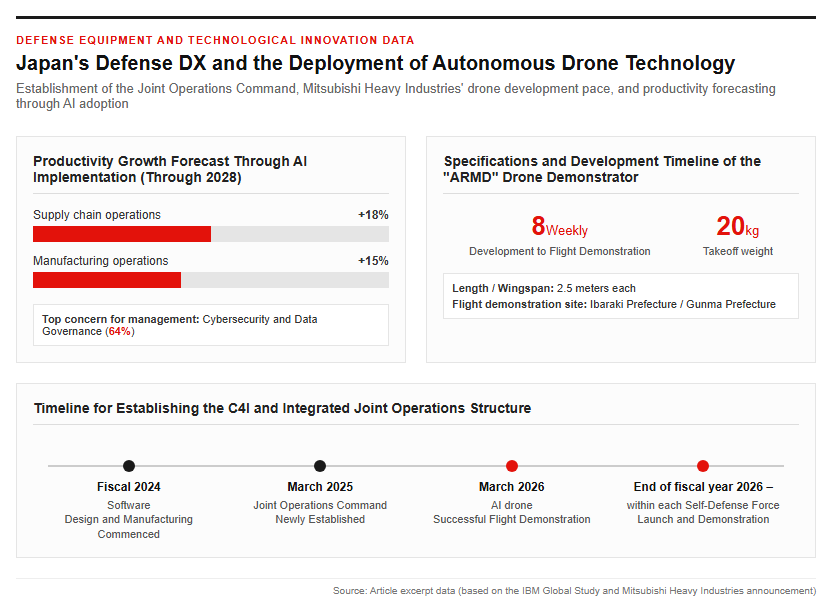
To make cross-domain operations effective in Japan as well, a Joint Operations Command was newly established in March 2025. Along with this, the Joint Staff, in cooperation with Mitsubishi Heavy Industries, has initiated the design and manufacturing of new command and control software for joint operations starting in fiscal 2024 (Reiwa 6). Demonstrations by the respective Self-Defense Forces are planned for after the commencement of operations at the end of fiscal 2026 (Reiwa 8). Because this system controls the core of defense decision-making, maintaining its development and management as an independent domestic system free from reliance on other countries—thereby establishing sovereignty over data and AI—is critically important for national security.
Mitsubishi Heavy Industries Takes on UAV AI and Domestic Autonomous Technology
Mitsubishi Heavy Industries has already achieved concrete results in autonomous technology for unmanned assets. On March 17, 2026, Mitsubishi Heavy Industries announced the successful flight demonstration of mission autonomy—an AI designed for unmanned vehicles—utilizing the AI development environment provided by the U.S.-based company Shield AI. In this demonstration project, through preliminary AI training, simulation evaluation, and Hardware-In-The-Loop testing, the integration of AI into the actual aircraft and the flight tests were completed in an extremely short period of just eight weeks from the start of development.
The unmanned aerial vehicle (UAV) ARMD used in the demonstration is an engine-powered aircraft with an overall length of 2.5 meters, a wingspan of 2.5 meters, and a takeoff weight of 20 kilograms. It successfully conducted test flights at test fields in Inashiki District, Ibaraki Prefecture, on November 7, 2025, and in Ota City, Gunma Prefecture, on December 18. Mission autonomy technology is positioned as an essential domestically produced technology for future UAV operations, and Mitsubishi Heavy Industries has indicated its intention to use the results of this development as a starting point to accelerate the development speed of highly reliable, domestically produced autonomous flight software.
The Social Significance of Partnerships on the Defense Industrial Base and Future Outlook
Transforming Defense Manufacturing Operations and Productivity Improvement
The adoption of AI in the defense industry is directly linked not only to accelerating decision-making, but also to solving extremely fundamental manufacturing challenges such as increasing production capacity for massive accumulated backlogs and streamlining supply chains. According to IBM’s global survey data targeting defense manufacturers, many companies are facing challenges such as severe order backlogs driven by surging demand, a shortage of skilled AI talent, and the increasing complexity of cybersecurity and data governance. The survey revealed that cybersecurity and governance were cited by 64% of executives as their top challenge.
However, if these challenges can be overcome and AI can be successfully implemented into business processes, substantial returns are anticipated. According to executive forecasts, productivity is projected to increase by 15% in manufacturing operations and by 18% in supply chain operations by 2028. This partnership between Mitsubishi Heavy Industries and NEC will serve as a model case for achieving this level of manufacturing process sophistication by combining advanced hardware manufacturing technologies with sophisticated information security and IT system integration capabilities, ultimately building a resilient defense manufacturing ecosystem in Japan.
Please refer to the figure below.
Future Developments and Key Points of the Defense Industry Supporting National Security
Looking ahead, the key focus will be on how domestically developed command and control systems and drone technologies—created through partnerships as the Joint Operations Command becomes fully operational—are rapidly integrated and fed back into actual troop operations. The developed software needs to establish a continuous update cycle based on data obtained from actual operational environments and Japan-specific threat scenarios. Furthermore, in light of international discussions surrounding lethal autonomous weapons systems (LAWS), it is essential to ensure safe and ethical AI design and operation in compliance with the guidelines formulated by the Japanese government in 2025.
Furthermore, with the relaxation of the Three Principles on Transfer of Defense Equipment and Technology, the provision of developed technology overseas, as well as the expansion of technological cooperation and joint development with allies and partner countries, are also coming into view. Amid the new military trend of “affordable mass”—procuring and operating large quantities of inexpensive, expendable unmanned assets—how the public and private sectors will cooperate to strengthen the industrial base supporting domestic mass-production systems is also a critical focus. We will continue to keep a close eye on the specific initiatives of both companies to safeguard the indispensability of Japan’s advanced technologies and build a sustainable security foundation.
Reference page
- 【NEC and Mitsubishi Heavy Industries to Form Strategic Partnership for Further Strengthening and Transformation of Defense Capabilities】https://jpn.nec.com/press/202609/20260902_04.html
【#ScienceAndTechnology #DefenseIndustry #AI #Drones #NationalSecurity #MitsubishiHeavyIndustries #NEC #DataSovereignty】


コメント