On September 2, 2026, the Tokyo stock market experienced a sharp plunge, with the Nikkei 225 index dropping by more than 1,700 yen at one point. This sell-off was fueled by heightened investor anxiety and risk aversion ahead of crucial U.S. economic data releases and earnings from major global companies.
- The Sharp Drop on September 2, 2026, and Its Scale
- Contrasting Key Decliners with Top Gainers Supporting the Index
- Key Macroeconomic Indicators Under the Spotlight
- Broadcom’s Earnings Call and Its Impact on the Tech Sector
- Impact of Divergent Central Bank Policies and Rising Long-Term Yields
- Plummeting Liquidity and the Risk of Cascading Sell-Offs
The Sharp Drop on September 2, 2026, and Its Scale
On September 2, 2026, the Tokyo stock market faced heavy downward pressure right from the opening bell, with the Nikkei 225 Stock Average plunging by more than 1,700 yen at its low. By 14:50, the index was down by 1,732 yen, with very limited signs of a rebound heading into the market close. This steep decline was not confined to a few specific issues but swept across the entire market, leading to an across-the-board drop in all 33 industry sectors on the Tokyo Stock Exchange. Highly cyclical sectors such as nonferrous metals, glass and stone products, services, transportation equipment, and electrical appliances led the declines. This broad slide highlights a rapid shift toward risk-off sentiment among investors. Haunted by memories of previous market corrections and structural shifts following changes in monetary policy by Japanese and U.S. central banks, market participants are increasingly worried that this drop could trigger a cascading sell-off.
Contrasting Key Decliners with Top Gainers Supporting the Index
The sharp market downturn was primarily driven by high-profile, heavyweight technology stocks that carry significant weight in the index. Specifically, tech and semiconductor giants like SoftBank Group, Advantest, and Tokyo Electron topped the list of negative contributors, dragging the benchmark down. Conversely, some stocks defied the broader market slump and provided crucial support. Kioxia Holdings, which has drawn intense attention since its recent listing, along with defensive pharmaceutical giants like Shionogi & Co. and Daiichi Sankyo, saw strong buying interest that helped cushion the index’s fall.
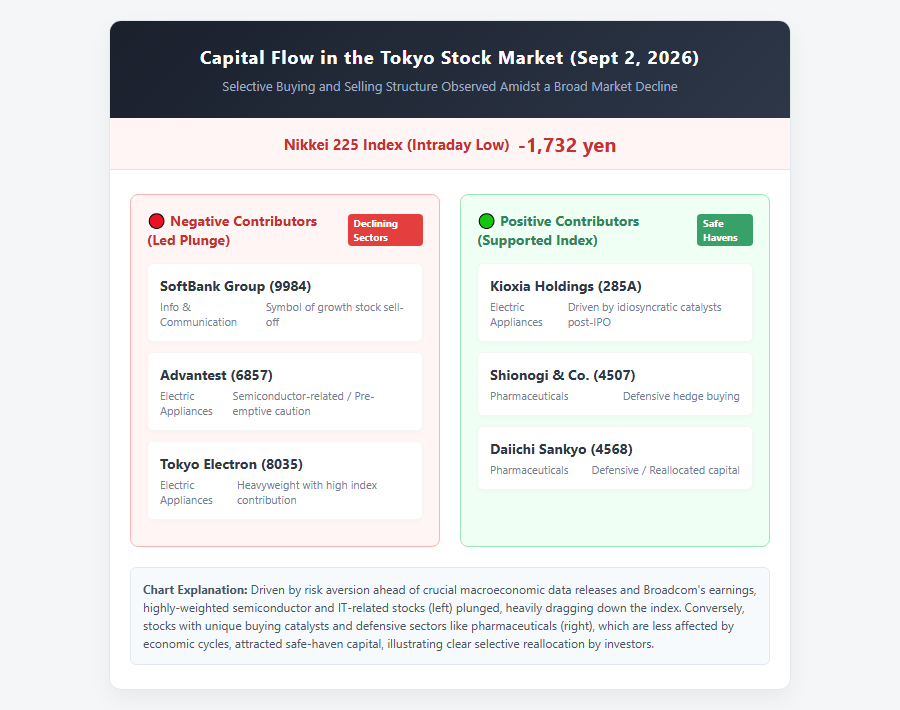
This divergence clearly shows that even as investors aggressively sold off semiconductor and growth stocks, they were simultaneously reallocating capital to defensive hedges and companies with idiosyncratic catalysts.
U.S. Economic Indicators and Events Fueling Market Anxiety
Key Macroeconomic Indicators Under the Spotlight
The primary driver of the current market anxiety and the direct catalyst for this sharp decline is a series of critical macroeconomic releases scheduled in the United States. Investors are closely watching the upcoming August ADP National Employment Report and July factory orders, looking for signs of an economic slowdown. Additionally, the Federal Reserve is set to release its Beige Book early tomorrow morning (Japan Time), which will offer a real-time assessment of economic conditions across various U.S. regions. Market participants remain highly sensitive to historical precedents, such as when past spikes in the U.S. unemployment rate triggered the Sahm Rule, sparking global recession fears and massive equity sell-offs. The palpable tension in the market reflects fears that any disappointing data could reignite panic selling worldwide.
Broadcom’s Earnings Call and Its Impact on the Tech Sector
Alongside macroeconomic data, a pivotal event for the technology sector and the broader equity market is the upcoming fiscal third-quarter (May-July) earnings release from semiconductor giant Broadcom. Broadcom’s financial performance and future guidance are widely viewed as a litmus test for the sustainability of global artificial intelligence (AI) demand. Consequently, its outlook has the power to trigger massive swings in both U.S. and Japanese tech stocks. The pre-emptive decline in Tokyo was largely driven by institutional investors scaling back their positions in semiconductor-related stocks like Advantest and Tokyo Electron to wait out the results. As the explosive AI-driven rally faces increasing scrutiny over stretched valuations, Broadcom’s commentary on AI market growth and demand will be a crucial turning point for stabilizing market sentiment.
Future Outlook and Market Liquidity Risks
Impact of Divergent Central Bank Policies and Rising Long-Term Yields
To assess any sustainable recovery in the equity market, the divergence in monetary policy between Japan and the United States, along with sovereign yield trends, remains the most critical theme. In Japan, the transition to a world with positive interest rates is accelerating, with domestic long-term government bond yields reaching the 3% threshold. This shift is fundamentally reshaping corporate financial strategies and equity valuations. Meanwhile, anticipation of further rate hikes by the Bank of Japan and uncertainty regarding the timing and scale of Federal Reserve rate cuts are putting upward pressure on the yen. A stronger yen raises concerns about downward revisions to exporters’ earnings, acting as a persistent drag on Japanese equities. Given how past rapid yen appreciation triggered a sudden unwind of the yen carry trade—escalating into systemic global risk—analysts warn that the narrowing interest rate differential and exchange rate movements demand continuous vigilance.
Plummeting Liquidity and the Risk of Cascading Sell-Offs
From a technical perspective, the most critical risk for investors to watch is the threat of sudden price volatility driven by a drop in market liquidity. An analysis of past episodes of high volatility by the Financial Services Agency (FSA) revealed that when large sell orders hit the market during periods of thin liquidity, they can easily trigger a self-reinforcing downward spiral. During the recent slide, price liquidity dropped sharply in the afternoon session on the Tokyo exchange, demonstrating how even small sell orders can cause discontinuous price gaps and amplify volatility. When high-frequency traders (HFTs)—which typically act as key liquidity providers—reduce their market share, market sentiment becomes extremely fragile, raising the risk of panic-driven trading halts, such as the activation of circuit breakers.
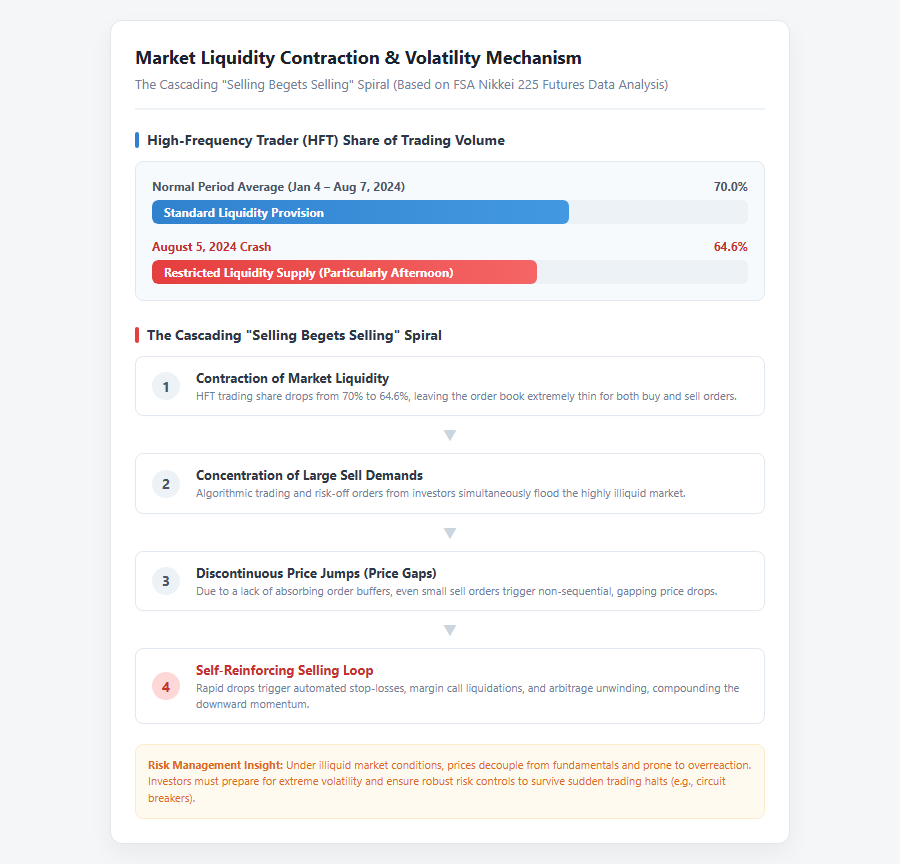
In this highly volatile environment, investors must avoid being swept up by erratic price swings, maintain appropriate position sizes, and implement rigorous risk management to withstand sudden market shocks.
References
- 【Analysis of Rapid Market Fluctuations in the Japanese Stock Market in Early August 2024】https://www.fsa.go.jp/common/about/kaikaku/fsaanalyticalnotes/20250108/02.pdf
【#Economy #JapaneseStocks #Nikkei225 #USIndicators #MarketLiquidity #MonetaryPolicy #StockMarket】


コメント