- 1-1. A Playful Numeric Easter Egg and the Breakdown of the $12.9 Billion Deal
- 1-2. Hugging Face’s Massive Scale as the “Town Square” of the AI Developer Community
- 2-1. Dominating the Distribution Layer and Vertically Integrating the CUDA Stack
- 2-2. Defending Inference Dominance Against Major Customers Abandoning GPUs
- 3-1. Platform Neutrality and Friction with Competitors
- 3-2. Lessons from the Blocked Arm Acquisition and the Impending Regulatory Grind
1-1. A Playful Numeric Easter Egg and the Breakdown of the $12.9 Billion Deal
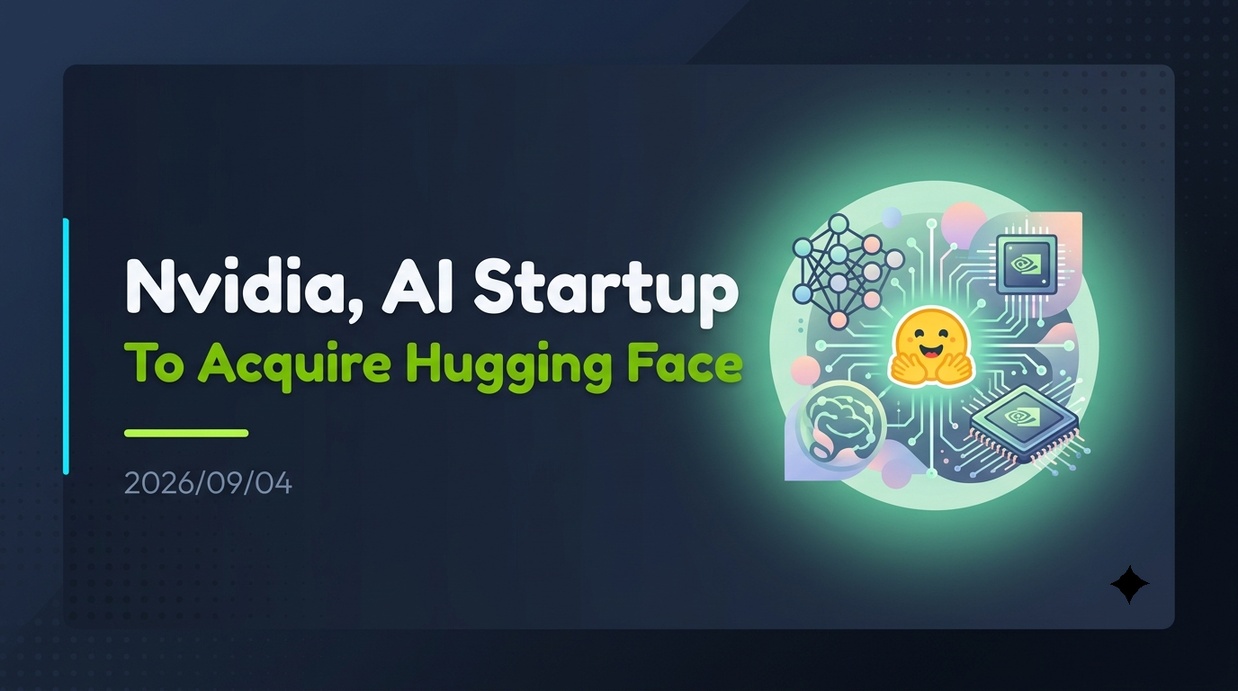
On September 2, 2026, NVIDIA and Hugging Face signed a definitive agreement, followed by a formal announcement on September 3, revealing an acquisition price of exactly \$12,930,300,000 (roughly 2.03 trillion yen, or 12.9 billion dollars). This highly specific price tag conceals a playful Easter egg: the last six digits, “129303,” represent the decimal Unicode code point for Hugging Face’s signature “hugging face” emoji (🤗). Hugging Face co-founder and CEO Clément Delangue later revealed this clever detail on social media, highlighting the highly customized and collaborative nature of the negotiations. Under the terms of the agreement, approximately \$11.9 billion will be paid to existing Hugging Face shareholders, while an equity-based retention pool of up to \$1 billion has been established for Hugging Face employees joining NVIDIA. Although the deal remains subject to regulatory approvals, this formal announcement has officially set in motion one of the most significant acquisitions in AI history.
1-2. Hugging Face’s Massive Scale as the “Town Square” of the AI Developer Community
Founded in 2016 by three French entrepreneurs, including Clément Delangue, Hugging Face originally started as a consumer-facing chatbot service aimed at teenagers. However, in 2018, the company made a pivotal pivot toward becoming an AI infrastructure hub when it open-sourced its PyTorch implementation of Google’s BERT model. Today, Hugging Face serves as the undisputed global “town square” for AI developers, boasting more than 18 million registered users and over 200,000 companies leveraging the platform for their real-world AI workflows. The platform hosts an astonishing repository of over 3 million models, 500,000 datasets, and 1 million demo applications (known as Spaces). This massive, self-reinforcing network effect—combined with foundational assets like the Transformers library and the core development team behind llama.cpp—has turned Hugging Face into a highly coveted and irreplaceable piece of the AI ecosystem.
Technical Vertical Integration and NVIDIA’s Strategic Defense
2-1. Dominating the Distribution Layer and Vertically Integrating the CUDA Stack
NVIDIA’s primary objective in acquiring Hugging Face is to transcend its role as a mere hardware supplier and become the ultimate gatekeeper of the end-to-end AI development pipeline. Historically, NVIDIA’s dominance has relied on a formidable two-layer stack: its physical GPUs and the low-level CUDA software platform. By bringing Hugging Face under its direct control, NVIDIA is constructing a powerful “third story” at the very top of this stack—the distribution and model discovery layer. Consequently, any model hosted on Hugging Face can be automatically converted and optimized for NVIDIA’s Blackwell architecture, natively supporting ultra-low-precision formats like NVFP4 and caching directly for TensorRT-LLM and NIM microservices.
Please refer to the diagram below.
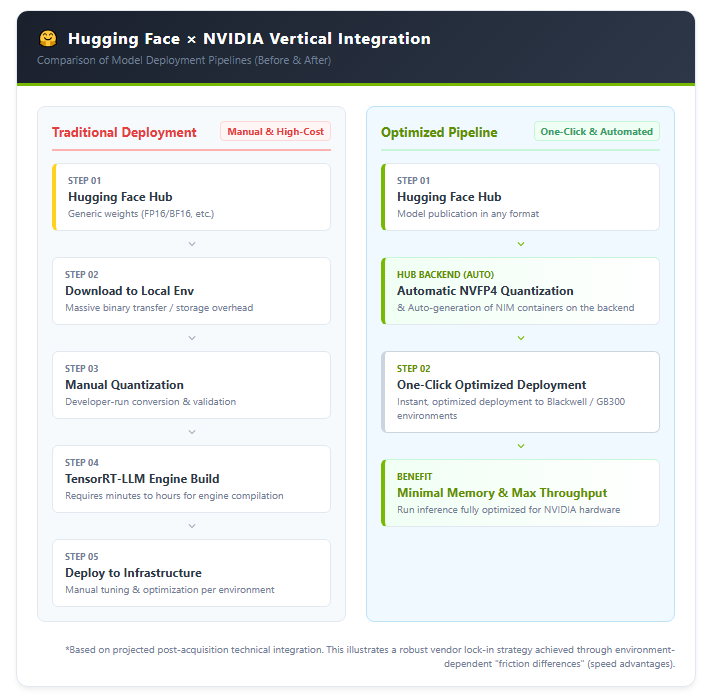
While this seamless integration dramatically enhances developer experience (DX), it also subtly degrades compatibility with rival hardware, creating a highly effective and irreversible vendor lock-in.
2-2. Defending Inference Dominance Against Major Customers Abandoning GPUs
This massive acquisition is driven by a structural shift in the AI landscape: the center of gravity for AI workloads is rapidly transitioning from model training to inference. Today, major frontier AI labs like OpenAI and Meta are actively striving to reduce their reliance on NVIDIA’s costly and supply-constrained GPUs. By developing proprietary, inference-optimized ASICs—such as OpenAI’s “Jalapeño” and Meta’s fourth-generation “Iris” chips—these tech giants are looking to slash total cost of ownership (TCO). To counter this, NVIDIA is heavily promoting its own open-weights models, such as the Nemotron series, while securing the primary distribution channel developers use to find models. Additionally, Hugging Face’s acquisition of the llama.cpp and ggml development teams in February 2026, alongside robotics initiatives like LeRobot, gives NVIDIA a crucial foothold in edge AI, physical AI, and local inference.
The Crisis of Neutrality and the Massive Hurdle of Regulatory Scrutiny
3-1. Platform Neutrality and Friction with Competitors
Hugging Face historically styled itself as the “Switzerland of AI,” maintaining a strictly vendor-neutral stance. In its 2023 Series D funding round, the company deliberately constructed an “ecosystem round,” bringing in rival tech giants like AMD, Intel, Qualcomm, Google, and Amazon alongside NVIDIA to preserve its independence. Although NVIDIA CEO Jensen Huang pledged that Hugging Face would remain an open platform that supports multi-cloud and multi-accelerator environments, competing chipmakers and cloud providers view the acquisition with deep concern. Even if NVIDIA does not actively block rival hardware, they can prioritize native optimizations for their own chips. If support for AMD or Intel chips lags by even a few weeks, developers will naturally gravitate toward NVIDIA’s seamlessly integrated environment, quietly undermining the platform’s neutrality.
3-2. Lessons from the Blocked Arm Acquisition and the Impending Regulatory Grind
In recent months, NVIDIA has bypassed regulatory scrutiny for multi-billion-dollar deals by using alternative structures, such as “non-exclusive licensing and talent transfers” seen in its agreements with Groq, Enfabrica, and Poolside. However, because the Hugging Face acquisition is a complete corporate buyout, it cannot escape mandatory pre-merger filings under the Hart-Scott-Rodino (HSR) Act in the United States. Given NVIDIA’s near-monopoly in the AI chip market, the vertical integration of the dominant model distribution platform will trigger intense, exhaustive antitrust scrutiny from the FTC, DOJ, and the European Commission. The transaction is projected to close in the first half of 2027, provided it passes regulatory hurdles. Given NVIDIA’s past failure to acquire Arm for \$40 billion due to regulatory resistance, the company faces a long, uphill battle to prove it can own the town square of AI without abusing its market power.
References
- 【NVIDIA Blog: NVIDIA to Acquire Hugging Face】https://blogs.nvidia.com/blog/nvidia-to-acquire-hugging-face/
- 【Hugging Face Hub】https://huggingface.co/
【#NVIDIA #HuggingFace #AI #Semiconductors #Acquisition #OpenSource #Antitrust #Business】
コメント