Kioxia Holdings has unveiled its next-generation SSD storage strategy designed to address the rapid spread of generative AI and the surging demand for inference workloads. The strategy aims to mitigate server-side DRAM shortages by leveraging high-performance NAND flash memory, thereby maximizing the efficiency of AI infrastructure.
- Event Essentials: Kioxia’s Comprehensive Storage Strategy for the AI Inference Era
- Leap in the Role of Non-Volatile Memory: Addressing DRAM Shortages
- Expanding Main Memory: Performance of the CXL Memory Module “XL1”
- 10th-Generation BiCS FLASH and CBA Technology: Optimizing Power and Capacity
- GP1 Series: Near-Direct GPU Access via Tight NVIDIA Collaboration
- Future Outlook and Key Focus: Massive Joint Investment Plan of 5 Trillion Yen
Event Essentials: Kioxia’s Comprehensive Storage Strategy for the AI Inference Era
On September 3, 2026, Kioxia Holdings hosted a media briefing on next-generation AI infrastructure in Tokyo, unveiling its latest product strategy tailored to structural shifts in data centers driven by generative AI. Building upon its presentations at “FMS: the Future of Memory and Storage”—the memory and storage industry’s premier event held in Santa Clara, California, from August 4 to 6, 2026—the briefing highlighted a dramatic paradigm shift in the role of SSDs and flash memory. While traditional storage has long been viewed as mere “warehouses” for data retention, the explosive rise of AI is transforming these devices into critical “computing components” that accelerate data processing. According to projections by McKinsey & Company, global data center investments are expected to reach approximately \$7 trillion by 2030, with over \$4 trillion dedicated to computing infrastructure. Targeting this massive market, Kioxia is placing high-performance SSDs at the core of its strategy to enhance the efficiency of AI inference processing, in close collaboration with key industry partners such as NVIDIA.
Leap in the Role of Non-Volatile Memory: Addressing DRAM Shortages
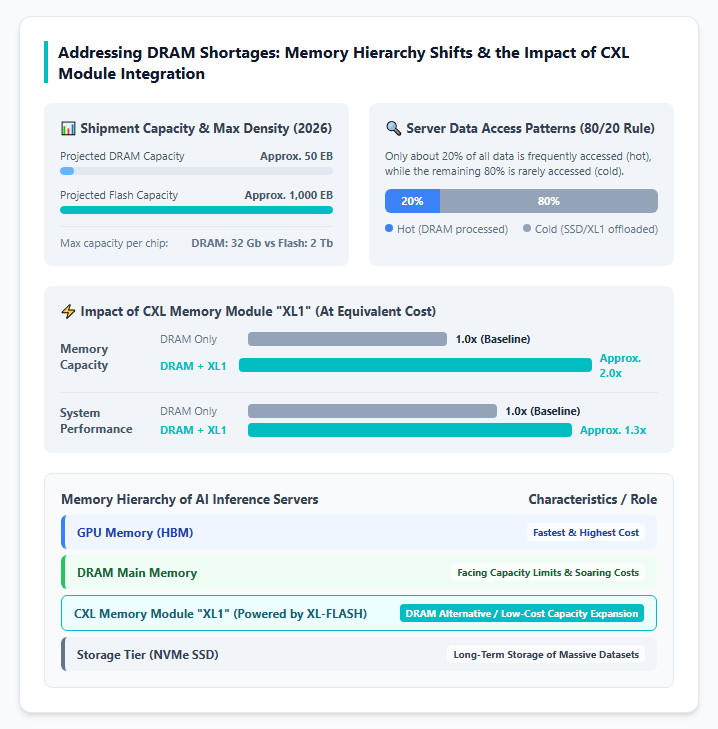
As the volume of data processed by AI continues to explode, AI servers are facing critical bottleneck issues: physical capacity limits and the soaring cost of system DRAM. While the total global DRAM shipment capacity in 2026 is projected to hover around 50 exabytes, flash memory shipments are expected to reach 1,000 exabytes, widening the capacity gap per chip even further. Consequently, high-capacity, cost-effective NAND flash memory is garnering significant attention as a crucial tier to alleviate DRAM supply constraints. An analysis of actual data access patterns reveals that only about 20% of the data is frequently read or written (hot data), while the remaining 80% is rarely accessed (cold data). By placing SSDs close to the main memory tier, systems can offload cold data to the SSD, effectively expanding memory capacity and mitigating performance degradation. To enable this architecture, Kioxia developed “XL-FLASH,” an ultra-low-latency flash memory featuring a read latency of 5 microseconds or less and an endurance of 150,000 program/erase cycles.
Please refer to the diagram below.
Technical Innovations Accelerating AI Infrastructure and Power Efficiency
Expanding Main Memory: Performance of the CXL Memory Module “XL1”
By pairing XL-FLASH with a proprietary controller designed to mask write latency, Kioxia has commercialized the CXL memory module “XL1,” achieving an ultra-low latency of under 10 microseconds. Kioxia began shipping evaluation samples of the XL1 in August 2026, offering a solution to extend system memory by replacing a portion of AI server DRAM. Company simulations indicate that compared to a memory configuration consisting entirely of DRAM, an integrated DRAM-plus-XL1 setup can double memory capacity at an equivalent cost while delivering roughly 1.3 times the overall system performance. This capacity expansion prevents the drastic performance drops that typically occur when datasets exceed system DRAM limits. Furthermore, it is ideally suited for offloading KV caches generated when Large Language Models (LLMs) process long context windows. Leveraging the CXL memory bus standard enables direct read access from the CPU, significantly mitigating data transfer bottlenecks in AI inference servers.
10th-Generation BiCS FLASH and CBA Technology: Optimizing Power and Capacity
As data centers scale up rapidly, curbing power consumption and boosting bit density have become top priorities. To address these demands, Kioxia adopted CMOS directly Bonded to Array (CBA) technology for its 10th-generation BiCS FLASH. In this process, the CMOS logic circuitry and the memory cell array are manufactured on separate wafers and then bonded together. This CBA integration maximizes the areal efficiency of memory cells even as layer counts increase, achieving a massive package capacity of up to 4 terabytes. Furthermore, CBA technology dramatically improves power efficiency, doubling read power efficiency and boosting write power efficiency by 40%. When stacking numerous dies in high-capacity SSDs, conventional interface structures often suffer from signal degradation and increased power consumption. CBA technology minimizes transmission loss at the interface layer, ensuring highly reliable, high-speed data transmission.
Rise of the Inference Market and Future Outlook Home and Abroad
GP1 Series: Near-Direct GPU Access via Tight NVIDIA Collaboration
As AI workloads shift from training to inference, Kioxia is developing the “GP1” series SSD, designed to support NVIDIA’s “Storage-Next” architecture. Powered by second-generation XL-FLASH, the GP1 achieves a staggering 10 million random read IOPS for fine-grained 512-byte accesses. Sample shipments are scheduled for the end of 2026, with mass production planned for 2027 and beyond, and a roadmap extending to 100 million IOPS by 2028. Additionally, Kioxia offers the “CM9” series, which supports “context caching”—a technique that stores previously generated token calculations in the SSD to reduce GPU overhead. This approach increases the token generation rate fivefold, effectively allowing a single system to perform workloads that previously required five separate GPUs. Kioxia maintains close, daily communication with key engineering teams at NVIDIA, solidifying its competitive advantage in the burgeoning AI inference market.
Future Outlook and Key Focus: Massive Joint Investment Plan of 5 Trillion Yen
Anticipating long-term, exponential growth in demand for AI and data center storage, Kioxia has announced a massive long-term joint investment plan with its joint-venture partner, SanDisk (the flash memory business spun off from Western Digital). Under this plan, which is contingent upon government subsidies, the two companies project a total investment of approximately 5 trillion yen (over \$31 billion) by 2032 across their Yokkaichi and Kitakami plants in Japan. At the Kitakami plant in Iwate Prefecture, preparation of land adjacent to the south side of the “K2” building (which began operations in September 2025) has already commenced to make way for the construction of a third manufacturing facility, the “K3” building. According to President Hiroo Ota, the K3 building represents an investment scale of approximately 1.8 trillion yen, with operations targeted to begin during fiscal year 2029. By securing domestic production capacity for high-density BiCS FLASH and establishing a proactive “expansion option” to scale production rapidly when demand surges, Kioxia aims to secure Japan’s position as the primary global hub for data storage during this massive AI-driven semiconductor cycle.
Reference Pages
- 【Kioxia Official Announcement: News Release on Strengthening Memory Leadership】https://www.kioxia.com/ja-jp/about/news/2026/20260827-3.html
- 【Kioxia Official Announcement: News Release on Construction of Kitakami Plant New Facility (K3)】https://www.kioxia.com/ja-jp/about/news/2026/20260827-2.html
- 【Kioxia Official Announcement: News Release on Commencing Production of 10th-Generation 3D Flash Memory at Kitakami Plant Facility K2】https://www.kioxia.com/ja-jp/about/news/2026/20260703-2.html
【#Kioxia #SSD #GenerativeAI #FlashMemory #Semiconductor #DataCenter #Technology】

コメント