On September 5, 2026, the first residents began moving into temporary emergency housing in Kumamoto Prefecture, which suffered severe damage from a major earthquake in July 2026. Local municipalities are rapidly constructing temporary housing and consolidating evacuation centers to rebuild survivors’ lives, balancing the urgent need for shelter with the preservation of local communities.
- Hikawa Town Welcomes Kumamoto’s First Temporary Housing Residents
- Hikawa Town’s Innovative Two-Story Housing and Evacuation Shelter Consolidation
- Kumamoto City’s Strategy for 50 New Temporary Housing Units
- Eligibility Criteria and Support Services for Displaced Residents
- Structural Features, High Livability, and Proven Track Record of the “Kumamoto Model”
- Fostering Community, Environmental Sustainability, and Future Outlook
Hikawa Town Welcomes Kumamoto’s First Temporary Housing Residents
On July 28, 2026, at 4:27 p.m., a powerful magnitude 7.1 earthquake struck the Kumamoto region. The disaster registered a maximum seismic intensity of 7 in Uki City and Hikawa Town, causing extensive structural damage, including the total or partial collapse of numerous homes. Faced with a sudden surge of displaced residents enduring harsh conditions in evacuation shelters, securing stable living arrangements became an urgent priority. In response, local authorities launched a rapid, coordinated effort to construct and supply emergency temporary housing.
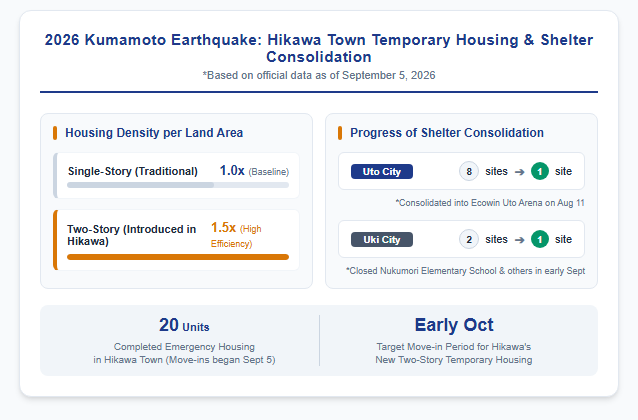
Just over a month after the disaster, on September 5, 2026, the first batch of 20 temporary housing units was completed in Hikawa Town, allowing families to move in. This marks the earliest relocation of displaced residents to temporary housing across the disaster-affected areas of Kumamoto Prefecture. Many newly admitted residents expressed relief at finally gaining personal space and privacy after weeks of communal life in crowded evacuation centers. These completed units are expected to serve as a vital stepping stone, helping survivors regain self-sufficiency and transition toward permanent housing solutions. Please refer to the photograph below.
Hikawa Town’s Innovative Two-Story Housing and Evacuation Shelter Consolidation
To maximize limited land and accommodate a high volume of applicants, Hikawa Town has introduced a pioneering solution: the construction of Kumamoto Prefecture’s first-ever two-story temporary housing units. By building vertically, developers have managed to secure 1.5 times the number of residential units compared to traditional single-story layouts on the same footprint. The prefectural government, led by specialized staff, is actively coordinating land allocation and site preparation, with the goal of allowing residents to move into these two-story structures by early October 2026.
As temporary housing construction gains momentum, local governments are systematically consolidating and closing primary evacuation centers. In Uki City, authorities closed two shelters, including Nukumori Elementary School, in early September to facilitate the resumption of school classes. Evacuees were transitioned to a single consolidated shelter at the Nukumori Gymnasium. Similarly, Uto City began consolidating its eight scattered shelters on August 11, centralizing operations at the Ecowin Uto Arena. This consolidation process is essential for streamlining support services, maintaining proper hygiene, and restoring normalcy to local communities.
Kumamoto City Opens Applications and Outlines Temporary Housing Plans
Kumamoto City’s Strategy for 50 New Temporary Housing Units
The impact of the intensity 7 earthquake was also felt in Kumamoto City, the prefectural capital. To assist displaced residents who cannot secure housing on their own, Kumamoto City accepted applications for temporary emergency housing from August 25 to September 4, 2026. To accommodate applicants under difficult circumstances, the city offered multiple submission channels, including in-person processing at the City Hall and comprehensive consultation desks, postal mail, and online submissions. If applications exceed the available capacity, a public lottery will be held on September 12, 2026, to ensure a fair and transparent selection process.
Kumamoto City’s current plan involves constructing a total of 50 temporary housing units across three dedicated complexes. The distribution includes 20 units at the Jonan (Tsukahara) site, 20 units at the Jonan (Maihara) site, and 10 units at the Tomiai (Hirabaru) site. To accommodate different household sizes, the city is providing 38 “2K” units (approximately 30 square meters) for households of one to three people, and 12 “3K” units (approximately 40 square meters) for larger families of four or more. Additionally, to support pet-owning evacuees, about two pet-friendly units will be constructed at the Jonan (Tsukahara) complex, reflecting a compassionate design approach tailored to diverse family needs.
Eligibility Criteria and Support Services for Displaced Residents
Kumamoto City has established strict guidelines to ensure that temporary housing is allocated to those in greatest need. Eligible applicants must have had a registered address or proof of residence in Kumamoto City at the time of the earthquake. Their homes must be completely destroyed, burned down, washed away, or partially damaged to the extent that they require demolition. Additionally, applicants must have no other available properties to inhabit and lack the financial means to secure alternative housing. These requirements are verified primarily through the official disaster victim certificates (Risaisho) issued by the city.
The maximum residency period is set at two years from the date of move-in, a timeframe during which residents are encouraged to work toward permanent housing recovery. To minimize financial burdens on recovering families, the city provides these units rent-free, with no security deposits or parking fees required for up to one vehicle per household. However, residents remain responsible for their utility bills, such as electricity, gas, and water, as well as community association fees and neighborhood maintenance costs. Notably, the city has waived the requirement for a joint guarantor, ensuring that elderly residents living alone or families facing extreme disruption can apply without administrative barriers.
How the Wood-Based “Kumamoto Model” is Transforming Temporary Housing
Structural Features, High Livability, and Proven Track Record of the “Kumamoto Model”
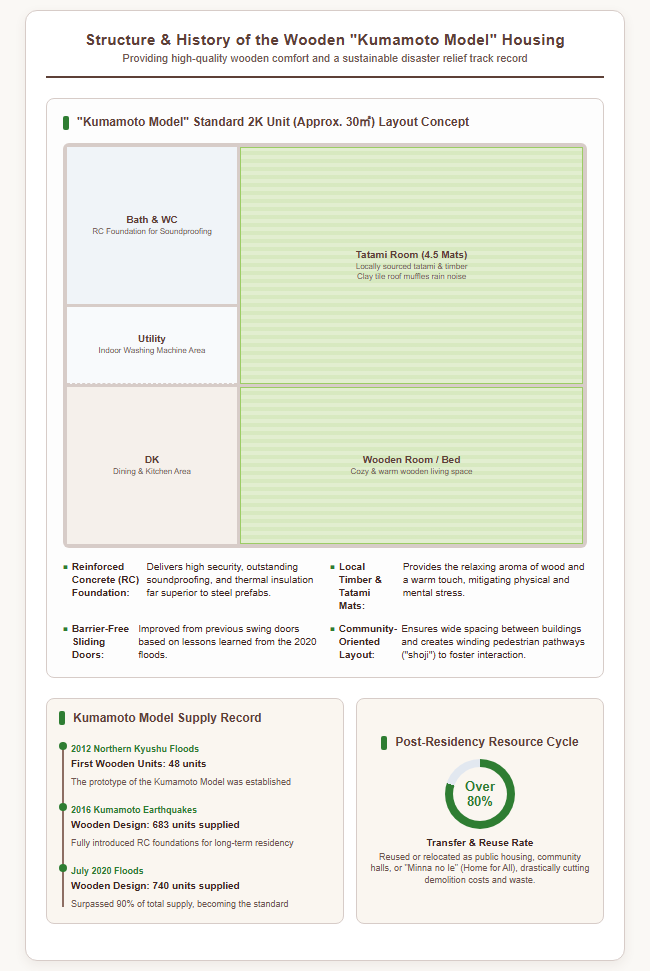
Temporary housing is evolving from simple emergency shelters into warm, comfortable homes capable of supporting long-term residency. Leading this transformation is the “Kumamoto Model,” an emergency housing system developed through years of disaster-response expertise in Kumamoto Prefecture. While traditional temporary housing has relied heavily on light-gauge prefabricated steel structures, the Kumamoto Model features wood-framed houses built on solid reinforced concrete (RC) foundations, utilizing locally sourced timber and traditional tatami straw mats. This combination provides superior thermal insulation and soundproofing, creating a highly livable environment.
The prototype of the Kumamoto Model was first deployed during the July 2012 Northern Kyushu Torrential Rains, where 48 wooden units were built across five complexes. During the 2016 Kumamoto Earthquakes, 683 of the 4,303 temporary units constructed followed this wooden design. By the July 2020 Floods, the adoption rate surged to over 90 percent, with 740 wooden units built. Continuous improvements have been made based on survivor feedback; for example, clay tile roofs are used instead of metal sheets to muffle the sound of heavy rain, mitigating psychological stress for flood survivors. While constructing these wooden homes takes one to two weeks longer than assembling steel prefabs, their superior comfort drastically reduces physical and emotional strain on residents. Please refer to the floor plan layout below.
Fostering Community, Environmental Sustainability, and Future Outlook
The Kumamoto Model is more than just high-quality housing; it is a holistic approach designed to prevent the collapse of local communities after a disaster. A key feature is the “Minna no Ie” (Home for All) community centers—shared wooden spaces where residents can gather, converse, and find mutual support. The layouts of the housing complexes are also carefully planned with wide spacing between buildings and pedestrian paths (小路, “shoji”) that encourage casual interactions. Once the temporary housing period ends, over 80 percent of these wooden homes are transferred to municipal ownership to be reused as public housing or community centers, significantly reducing waste, demolition costs, and contributing to regional carbon neutrality and SDGs.
This Kumamoto-born expertise was shared with Ishikawa Prefecture during the January 2024 Noto Peninsula Earthquake, where it was adopted as “community-building” and “hometown-return” temporary housing to prevent population outflow. In the aftermath of the 2026 Kumamoto Earthquake, the model has evolved further, incorporating multi-story designs in Hikawa Town and pet-friendly accommodations in Kumamoto City. By providing a dignified living space that respects local identity, the Kumamoto Model is poised to become the new benchmark for humanitarian disaster relief in Japan and beyond.
References
- [Application for Emergency Temporary Housing for the 2026 Kumamoto Earthquake / Kumamoto City Official Website] https://www.city.kumamoto.jp/kiji00372491/index.html
【#2026KumamotoEarthquake #TemporaryHousing #KumamotoModel #HikawaTown #KumamotoCity #LifeReconstruction #Politics_and_Society】


コメント