
According to a survey by the Ministry of Land, Infrastructure, Transport and Tourism, it has been revealed that the proportion of engineers and skilled workers at construction sites taking an average of “eight days off every four weeks” or more has reached a record-high of approximately 40% for the first time. While work style reforms are progressing one year after the implementation of overtime work regulations, challenges that need to be addressed are also being highlighted, such as the disparity in holiday acquisition between public and private construction projects.
- Current Status of Days Off: 8 or More Days Off Every 4 Weeks Reaches About 40%, Becoming the Most Common for the First Time
- Dramatic Reduction in Overtime Work: Changes One Year After the Cap Regulations
- Disparity Between Public Works and Private Construction Projects: More Than a Twofold Gap in Acquisition Status
- Proposal Status at the Order-Receiving Stage: The Spread of Site-Closure Proposals and Barriers in the Private Sector
- Consultations with Clients Toward Setting Appropriate Project Schedules
- The “New 4K” Targeted by the Construction Industry and Future Points to Watch
Current Status of Days Off: 8 or More Days Off Every 4 Weeks Reaches About 40%, Becoming the Most Common for the First Time
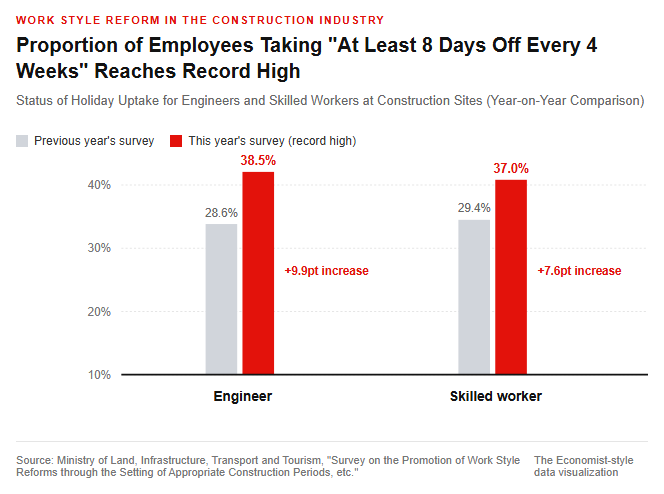
According to the results of the “Survey on the Promotion of Work Style Reforms through Appropriate Construction Timeframes, etc.” published by the Ministry of Land, Infrastructure, Transport and Tourism, the average holiday acquisition status for engineers and skilled workers at construction sites showed that responses indicating 8 days off or more per 4-week period accounted for the majority for the first time. Specifically, compared to the same survey from the previous year, engineers increased by 9.9 percentage points to 38.5%, and skilled workers increased by 7.6 percentage points to 37.0%, with both reaching approximately 40%. This result indicates that in the construction industry, where securing holidays has traditionally been considered difficult due to business customs such as daily-rate monthly salary systems and the pressure of tight delivery deadlines, the introduction of a two-day weekend system (8 days off per 4-week period) is steadily progressing and becoming established as a new standard for the industry. This represents concrete results emerging from the joint efforts of the government and companies to secure holidays, aimed at addressing the shortage of young workers and the gap in holidays compared to other industries. On the other hand, a certain number of workers still take around 6 days off per 4-week period or fewer, and further efforts are required to ensure that holidays are equally secured at all construction sites. Please refer to the figure below.
Dramatic Reduction in Overtime Work: Changes One Year After the Cap Regulations
In this survey, remarkable improvements were also observed in the reduction of overtime work. The proportion of companies responding that their average monthly overtime hours reached or exceeded the “45-hour” upper limit (set as a general rule) decreased significantly. Specifically, it remained at 3.5% for engineers (a 9.9 percentage point decrease from the previous fiscal year) and 2.4% for skilled workers (an 8.7 percentage point decrease from the previous fiscal year). One year has passed since the implementation of the penal labor regulations capping overtime hours in the construction industry, and it is believed that thorough labor time management by individual companies to comply with the law led to this dramatic decrease. The fact that all construction projects covered in this survey were commissioned after the cap regulations took effect is also behind the strong deterrent against long working hours. Although the construction industry once faced issues with chronic long-working hours, triggered by the introduction of legally binding regulations, investments in the digitalization of labor management and productivity improvement are progressing, rapidly driving forward the normalization of the work environment.
The Polarizing Public and Private Sectors: The Challenges Coming to Light
Disparity Between Public Works and Private Construction Projects: More Than a Twofold Gap in Acquisition Status
Although the overall figures for leave acquisition are improving, this survey has revealed that an extremely large gap exists in the progress of work-style reforms depending on the attributes of the construction projects undertaken. Among companies primarily engaged in public works, the proportion of those able to secure at least 8 days off every 4 weeks exceeds 50% for both engineers (52.7%) and skilled workers (52.8%). In contrast, among companies primarily engaged in private-sector construction, only 23.9% of engineers and 19.5% of skilled workers are able to take at least 8 days off every 4 weeks, representing a gap of more than double between public- and private-sector-centric companies. For companies primarily handling private construction, the highest proportion accounted for “6 days off every 4 weeks,” reaching 39.8% for engineers and 38.7% for skilled workers. This illustrates the reality that while public works have institutionalized appropriate construction scheduling and cost adjustments for two-day weekends starting from the contracting stage, private construction projects are still heavily burdened by tight schedules and cost constraints.
Proposal Status at the Order-Receiving Stage: The Spread of Site-Closure Proposals and Barriers in the Private Sector
The results of this latest survey have also revealed important facts regarding the proposal status of “eight closures every four weeks” at the order-receiving stage, which holds the key to improving the working environment. The proportion of companies that proposed or were proposed eight closures every four weeks at the time of receiving orders has increased significantly overall, reaching 62.4% from the perspective of prime contractors and 51.3% for subcontractors, with over half of the companies conscious of securing holidays starting from the proposal stage. However, when this positive movement is limited to companies mainly handling private-sector construction, a significant drop is observed, falling to 46.6% for prime contractors and 40.1% for subcontractors. The main barrier among private-sector clients is that understanding of the two-day weekend system and the transformation of business practices have not fully penetrated, due to concerns over increased costs associated with longer construction periods and delays in delivery dates. Efforts solely within the construction industry have their limits, and going forward, further bolstering is indispensable to foster understanding throughout society as a whole, including approaching private-sector clients and applying legal regulations and guidance regarding appropriate construction period settings.
Future Issues and Outlook Supporting Work-Style Reform
Consultations with Clients Toward Setting Appropriate Project Schedules
To ensure the adequate securing of holidays and the reduction of overtime hours, setting reasonable and appropriate construction periods is extremely important. In this survey, 72.5% of companies reported that they consulted with clients or primary contractors when setting construction schedules, and 60.7% of companies answered that their requests were accepted “not infrequently” or “frequently.” On the other hand, however, 21.6% of companies responded that they prioritize the client’s wishes above all else and do not conduct any consultations or requests regarding construction periods, which offers a glimpse into their vulnerable position in contracting relationships. The 2024 amendment to the Construction Business Act prohibited the conclusion of contracts with “significantly short construction periods” not only for clients but also for contractors. This has established a legal framework to regulate the acceptance of orders with unreasonable construction periods. Ensuring that clients and contractors engage in sincere consultations on an equal footing to agree on a reasonable construction period will be the most critical issue in guaranteeing the future sustainability of the construction industry.
The “New 4K” Targeted by the Construction Industry and Future Points to Watch
For the construction industry, which is facing a severe labor shortage and the aging of skilled workers, the progress in work style reforms shown in this survey can be described as a ray of hope. Through the revised Construction Business Act and other measures, the industry has set the realization of the “new 4Ks”—good pay, taking days off, having hope, and being cool—as its highest priority, moving away from the old 3Ks of “kitsui, kitanai, kiken” (demanding, dirty, and dangerous). Points to watch in the future include the penetration of “standard labor costs” created and recommended by the government, and the thorough enforcement of price-passing rules to prevent the soaring costs of materials from being unfairly shifted onto labor costs. In addition, the monitoring system by the Ministry of Land, Infrastructure, Transport and Tourism’s “Construction G-Men” is being strengthened, and on-site inspections and corrective recommendations are expected to be strictly implemented against inappropriate transactions such as designated-price ordering, extremely low estimates, and shifting burdens onto labor costs. To make improvements to the working environment sustainable, raising awareness of the system among small businesses and promoting efficient on-site management through the use of ICT tools will be major keys moving forward.
Reference Page
- [Ministry of Land, Infrastructure, Transport and Tourism] Survey Results Regarding the Promotion of Work Style Reforms through the Setting of Appropriate Construction Periods, etc.
https://www.mlit.go.jp/report/press/content/001964944.pdf
[#MinistryOfLandInfrastructureTransportAndTourism #ConstructionIndustry #WorkStyleReform #5DayWorkWeek #2024Problem #OvertimeCapRegulation #WorkEnvironmentImprovement]


コメント