Ota City, Tokyo, has conducted a pilot program utilizing artificial intelligence to automate telephone inquiries, aiming to alleviate administrative burdens on municipal staff and accelerate response times. This initiative comes in response to severe labor shortages and increasingly diverse administrative needs in local governments, highlighting an urgent need for an optimal division of labor between humans and AI.
- Overview of the Pilot in the Disaster Prevention and Crisis Management Division
- Tangible Outcomes of the Pilot Program for Municipal Staff
- Resource Constraints and the Bottleneck of Citizen Inquiries
- Building a “Hybrid Window” with AI Voice Bots
- Governance Guidelines and Legal Considerations in AI Adoption
- The Future of Public-Sector DX Spreading from Ota City
Overview of the Pilot in the Disaster Prevention and Crisis Management Division
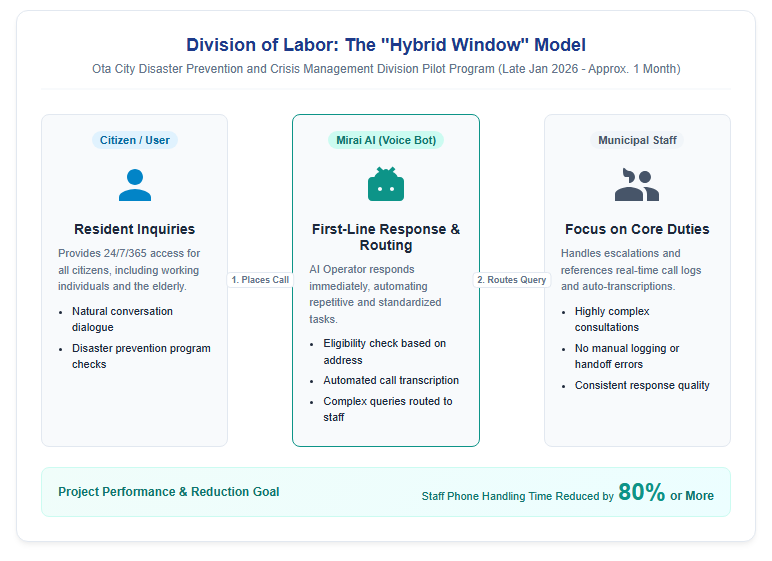
Ota City has been actively promoting the Haneda Ota Innovation Platform (HOIP), an initiative designed to improve the quality of life for its residents and solve community challenges by providing hands-on support to companies with advanced technologies. Under this program, “Mirai AI,” an automated AI telephone response service developed by SOFTSU Co., Ltd., was selected for a pilot project titled “Unmanned Telephone Window via AI Operators.” The pilot ran for approximately one month starting in late January 2026. The AI operator handled select inquiries regarding the city’s disaster prevention equipment distribution program, a service managed by the Disaster Prevention and Crisis Management Division. By pre-programming anticipated questions and answers into the system, the city established a 24/7 automated platform capable of natural-sounding conversations. This system allowed elderly citizens and working individuals—who often find it difficult to call during regular business hours—to make inquiries at any time. It verified a cooperative model where the AI system and human staff share roles, as illustrated below.
Please refer to the diagram below.
Tangible Outcomes of the Pilot Program for Municipal Staff
In the Disaster Prevention and Crisis Management Division, answering inquiries had heavily burdened the staff. Issues such as inconsistent response quality when designated personnel were away, and the tedious task of manually logging call details, had consistently distracted employees from their core administrative duties. During this pilot program, the AI voice bot completely automated routine processes, such as determining program eligibility based on address information provided by callers. This allowed the system to route calls appropriately according to the inquiry’s nature, freeing up staff to focus on highly complex consultations and critical administrative decisions. Additionally, the AI automatically transcribed the call details and instantly shared them via email and chat, eliminating manual logging errors and communication gaps. Ota City officials highly praised the system, noting that the ability to automatically categorize and route inquiries is a major advantage. This represents a significant milestone toward the project’s ultimate goal of reducing staff phone handling time by over 80%.
Challenges in Local Government Call Handling and the Case for AI
Resource Constraints and the Bottleneck of Citizen Inquiries
Like many local governments in Japan, Ota City faces severe resource constraints driven by a declining, aging population and increasingly diverse citizen needs. To maintain and improve public services under these conditions, leveraging digital technology for operational efficiency is no longer optional. Telephone inquiries, the primary point of contact between citizens and the government, present several systemic bottlenecks. The sheer volume of routine inquiries regarding residence certificates, garbage sorting, and office hours consumes valuable staff time, hindering their ability to handle specialized, sensitive consults. Furthermore, seasonal or temporary surges in call volumes—such as during tax filing seasons, benefit applications, or natural disasters—frequently overwhelm telephone lines. This leads to dropped calls, resident frustration, and significant overhead in hiring and training temporary staff. These compounding mental and operational burdens on staff cannot be solved through manual effort alone.
Building a “Hybrid Window” with AI Voice Bots
To resolve these structural bottlenecks, governments are increasingly turning to AI voice bots. Unlike conventional Interactive Voice Response (IVR) systems, which require callers to navigate tedious keypad menus, modern voice bots understand spoken language and engage in natural dialogue. This makes them highly accessible, even for elderly residents or those unable to view a screen. The key to successful public-sector telephone DX lies not in automating every interaction, but in clearly separating tasks between humans and AI. Routine tasks, such as answering FAQs, scheduling appointments, or determining initial eligibility, can be delegated to a 24/7 AI voice bot. Meanwhile, empathetic listening, nuanced consultation, and complex regulatory decisions remain in the hands of human staff. This “hybrid window” approach dramatically improves both resident satisfaction and staff morale.
Future Outlook and Risk Management in AI Utilization
Governance Guidelines and Legal Considerations in AI Adoption
As AI adoption accelerates, managing the risks of incorrect AI outputs, or hallucinations, is crucial. Because an AI system has no legal personhood, the user—in this case, the municipality or operating enterprise—is legally liable for damages resulting from incorrect information. Under Japanese civil law, the Product Liability (PL) Act applies strictly to tangible goods, making it difficult to pursue product liability claims for standalone software or AI-generated output. However, organizations still face potential liabilities regarding breach of contract, tort, copyright infringement, or personal data leaks if an AI acts negligently. According to a survey by the Ministry of Internal Affairs and Communications (MIC), while over half of municipalities had adopted, trialed, or planned to adopt generative AI by late December 2026, 1,004 organizations had yet to establish formal usage guidelines. Robust governance requires appointing a Chief AI Officer (CAIO), enforcing data opt-out mechanisms to prevent confidential data from being used in AI training, and establishing human-led fact-checking workflows before publishing AI outputs.
The Future of Public-Sector DX Spreading from Ota City
On March 10, 2026, a pilot project debrief was held at Haneda Innovation City, showcasing the successful automated routing and response model implemented by Ota City’s Disaster Prevention and Crisis Management Division. This case study was featured in the Nikkei newspaper on March 25, 2026, highlighting a broader trend of “AI Windows” expanding across municipalities in the Tokyo metropolitan area to combat labor shortages. Ota City’s HOIP program serves as an exemplary model of public-private collaboration, demonstrating how sustainable growth can be fostered when a municipality provides comprehensive, long-term support to tech startups rather than treating trials as one-off experiments. As Japan’s workforce continues to shrink, implementing systems that delegate repetitive tasks to AI—allowing humans to focus on creative and high-value public service—represents a critical first step toward resilient, resident-first local governance.
Reference Pages
- 【About Ota City’s Pilot Program and Implementation Promotion Project】https://www.city.ota.tokyo.jp/sangyo/hicity/smart_city/topics/20240726.html
- 【METI “Guidelines on the Interpretation and Application of Civil Liability in AI Utilization (Version 1.0)”】https://www.meti.go.jp/shingikai/mono_info_service/ai_utilization_civil/pdf/20260409_1.pdf
【#OtaCity #LocalGovDX #AIVoiceBot #MiraiAI #DisasterPrevention #RegionalRevitalization #AdministrativeEfficiency】
コメント