On August 31, 2026, StoryHub Inc. released the beta version of “StoryHub Form,” a service where AI automatically handles everything from interview question design and conducting the interview to transcription. This release comes as the importance of original, firsthand information continues to grow in corporate PR and communications, while heavy workloads such as scheduling and question creation in traditional interview research have posed significant challenges.
- The Introduction of the “StoryHub Form,” Which Fully Automates Interviews with AI
- 3 Key Features Supporting Everything from Question Design to Response Management
- The Importance of ‘Primary Information’ Not Found Online and Addressing the Decline in Survey Responses
- Hallucination and Governance Challenges Lurking in Automation
- Demonstration experiments and feature improvements toward the official release
- The Future of Storytelling Envisioned by the StoryHub Platform Concept
The Introduction of the “StoryHub Form,” Which Fully Automates Interviews with AI
On August 31, 2026, at 1:00 PM, StoryHub Inc. released the beta version of “StoryHub Form,” a new service where AI autonomously handles everything from interview design to execution. In recent years, with the proliferation of generative AI and various tools, low-quality content—so-called “kotatsu articles” made by cutting and pasting secondary information easily obtainable from the web—has become rampant. Amid this ongoing homogenization of information, primary information gathered directly from frontline employees and stakeholders has become indispensable for publishing high-quality content that differentiates a company from its competitors. However, conventional interview research has required personnel to manually handle a wide range of complex processes, starting from scheduling with interviewees, designing appropriate questions, conducting the actual hearing, transcribing hours of recorded data, and organizing the statements. As a result, creating just a single article requires significant effort, making it extremely difficult for public relations and marketing departments with limited resources to continuously disseminate information. “StoryHub Form” directly solves these corporate challenges, providing a mechanism to efficiently collect high-quality raw voices while minimizing the burden on both the person in charge and the respondents.
3 Key Features Supporting Everything from Question Design to Response Management
“StoryHub Form” comes with three distinctive features that set it apart from traditional surveys and automated response bots. First, it features an AI that reads and comprehends the purpose of the interview and the article summary to automatically design optimal questions. By simply having the person in charge input the form name, expected character count, and the purpose of the interview, the AI instantly auto-generates everything from items to check in advance to proposed questions for digging deeper. Fine-tuning to elicit specific anecdotes is also possible using the on-screen consultation chat. Second, it features an AI-powered voice interview function available 24/7 simply by sharing a response URL. Respondents can access it at their convenience and respond via voice. Please refer to the figure below.
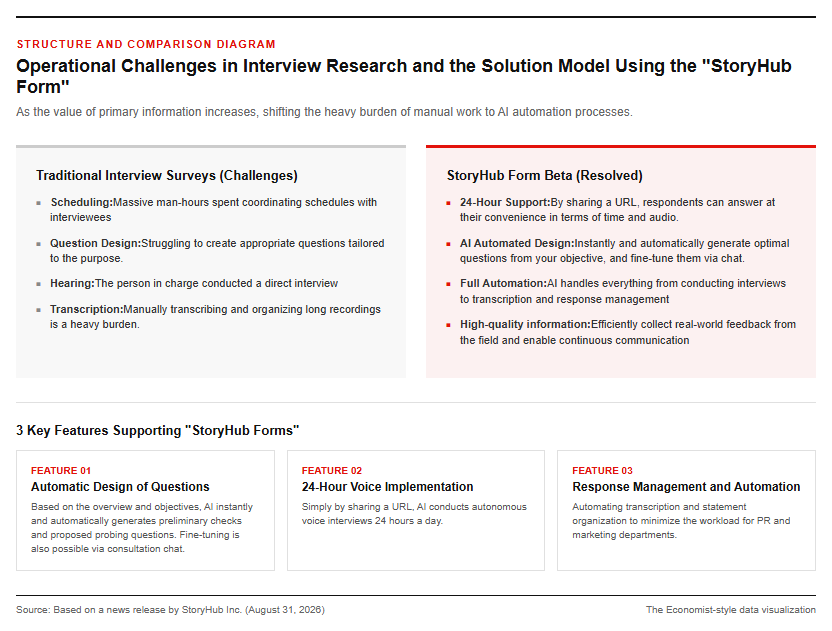
Based on the AI’s responses, it autonomously asks follow-up questions, transcribes the other party’s statements on the spot, and records them in the conversation log. The third point is that the collected primary information can be seamlessly integrated directly into the all-in-one AI editing assistant “StoryHub Studio.” All submitted conversation logs and respondent information can also be downloaded in bulk as a ZIP file, allowing them to be immediately utilized for drafting a wide range of articles, such as internal newsletters, recruitment articles, and press releases.
The Value Brought by AI Interviews and Industry Trends
The Importance of ‘Primary Information’ Not Found Online and Addressing the Decline in Survey Responses
Currently, in the fields of research and content creation, AI-driven interactive surveys are becoming a global trend. The global marketing research market size reached approximately 8.4 trillion yen as of 2024, forming a massive market of about 272.5 billion yen in Japan alone. However, as a result of the rapid increase in commonplace information on the internet, the scarcity value of primary information—such as individuals’ psychology and raw behaviors that are not published anywhere—is higher than ever before. On the other hand, conventional text-only, inorganic questionnaires are causing respondent fatigue, and serious disengagement from surveys has become a problem, with only 11.3% of newly registered survey panels remaining active one year later. In contrast, interactive interviews where AI acts as the interviewer differ from tasks that merely involve selecting choices; they provide an environment where respondents can enjoy themselves and speak their true intentions in their own words. This method is attracting significant attention as a new respondent-friendly approach that simultaneously achieves the maintenance of response quality and the improvement of active rates.
Hallucination and Governance Challenges Lurking in Automation
While AI-driven interviews bring overwhelming efficiency, they also harbor several significant challenges and risks. The risk that requires the most attention is the hallucination phenomenon, where generative AI fabricates content that differs from the facts. Cases have been confirmed where outsourcing everything from interviewing to article writing entirely to AI results in false content—never actually spoken during the interview—being automatically inserted into the manuscript. To avoid this risk, instead of blindly trusting the summaries or drafts generated by AI, it is essential to establish a human-in-the-loop system where humans strictly perform fact-checking by comparing the outputs against the original audio data or conversation logs. In addition, since interview audio and transcripts constitute non-public information or personal information obtained in the course of business, security management such as data protection and confidentiality obligations when inputting data into AI is also crucial. Furthermore, there is a concern that AI-generated content lacking sufficient human intervention may not be recognized as a copyrighted work under Japan’s Copyright Act, which could lead to complications regarding future responses to unauthorized reproduction or disputes over writer contracts. When companies adopt AI-driven interviews in practical operations, they are required to design AI governance to thoroughly manage these legal and security risks.
Future Outlook and the Future of Content Creation
Demonstration experiments and feature improvements toward the official release
In July 2025, StoryHub completed a 220 million yen Series A funding round, securing a total of 250 million yen in funding including its pre-Series A round. Building on this abundant capital, the company has been advancing the expansion of the entire value chain in content creation. The newly released beta version of “StoryHub Form” is a strategic product designed to dramatically streamline the primary information collection process, which acts as the preliminary stage to its existing product, “StoryHub Studio,” which has supported everything from planning to editing. Moving forward, the company plans to closely evaluate the actual usability of the beta version in PR and marketing environments, and to measure the quantitative effects of operational efficiency, such as an increase in the number of interviews and a reduction in production time. Furthermore, based on realistic feedback obtained from the images and other data of user companies and respondents, the company will repeatedly make improvements to the question design accuracy, the conversational experience of the AI interviewer, and the seamless data integration process with the article creation system. By further refining these features, the company aims to release a more polished official version.
The Future of Storytelling Envisioned by the StoryHub Platform Concept
In April 2026, StoryHub Inc. announced the “StoryHub Platform Initiative,” which seamlessly supports all phases of “planning,” “gathering,” “creating,” and “delivering” through multiple products. The newly introduced “StoryHub Form” plays a crucial role in gathering primary information within this initiative. Amid rapid technological changes, methods and platforms for information dissemination continue to diversify; however, the essence of moving people’s hearts still lies in stories filled with the creator’s passion and unique perspective. Rather than simply delegating everything to AI as a tool for automated writing, utilizing it as a human-centric editorial assistant allows humans to concentrate more on creative planning and the pursuit of expression. This new workflow, which carefully extracts diverse experiences and hidden knowledge lying dormant within a company using the power of AI and delivers them to society as valuable stories, will serve as a powerful storytelling foundation for businesses in the upcoming AI era.
Reference page
【#StoryHub #StoryHubForm #AIInterview #GenerativeAI #ContentCreation #PrimaryInformation #InterviewAI #Research】

コメント