Daiwa House Industry has decided on a landmark restructuring of its domestic housing business. In response to structural shifts such as a declining population and skyrocketing material costs, the company will optimize its new detached housing business to focus on 23 key areas starting April 1, 2027, while consolidating and strengthening its housing stock business.
- A Strategic Retreat: Phasing Out New Detached Home Sales in 23 Prefectures
- Rising Costs and the Strategic Pivot to Metropolitan Areas
- Merging Group Operations to Launch Daiwa House Partners
- Ensuring After-Sales Support for Existing Owners and Consolidating Rental Portfolios
- The Death of the Mid-Range Home: A Deepening Socioeconomic Divide
- Rural Vulnerability and the Long-Term Outlook for the Industry
A Strategic Retreat: Phasing Out New Detached Home Sales in 23 Prefectures
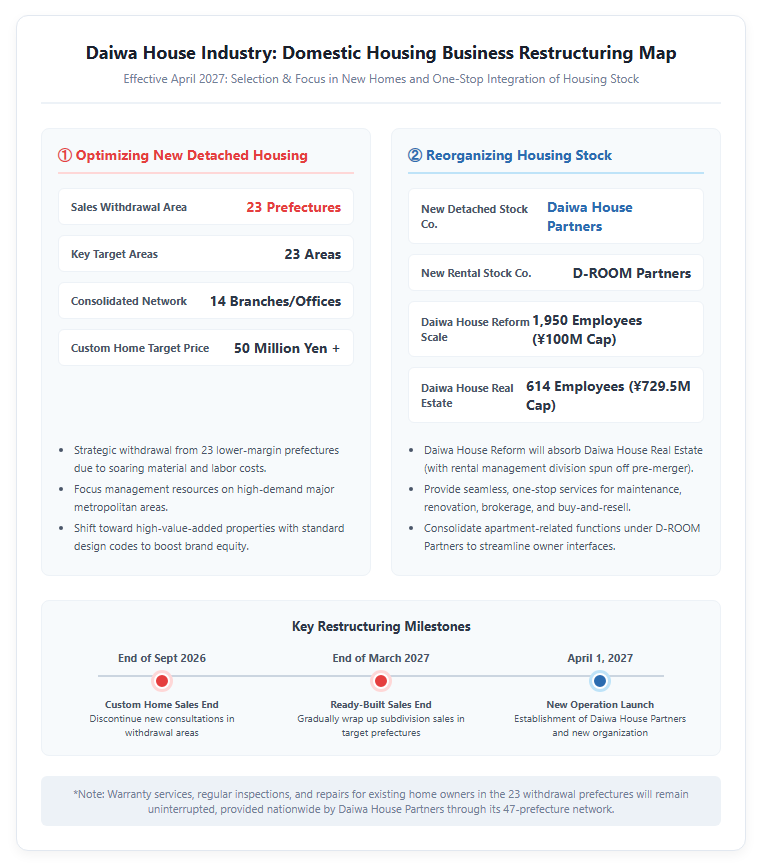
On September 4, 2026, Daiwa House Industry announced a major overhaul of its domestic housing operations designed to drive sustainable growth and enhance corporate value. Under this sweeping plan, the company will effectively withdraw from the new detached housing market in 23 prefectures—spanning from Hokkaido to Kagoshima—on April 1, 2027. Sales of custom-built homes in these designated areas will wrap up by the end of September 2026, followed by a gradual phase-out of ready-built subdivision homes by March 2027. Employees currently stationed in these regions will be redeployed to high-demand metropolitan areas. This retreat by one of Japan’s leading homebuilders, which once prided itself on its nationwide reach, marks a watershed moment that is sending shockwaves through the industry and altering the landscape of the country’s housing sector. The following diagram illustrates the direction of the new detached housing market and this strategic restructuring.
Rising Costs and the Strategic Pivot to Metropolitan Areas
This aggressive retrenchment is driven by a perfect storm of soaring material costs and chronic construction labor shortages, which have driven wages sharply higher. With the prices of lumber, steel, glass, and housing equipment climbing across the nation, the cost of building new detached homes has risen to historic highs. In rural prefectures where sales volumes are thin, maintaining expensive model homes and sales offices has become an unsustainable financial burden, heavily dragging down profitability. To address these regional imbalances, Daiwa House decided to concentrate its capital and human resources in Japan’s three major metropolitan areas and other urban zones where demand remains robust. From April 2027, the company will consolidate its sales network into 14 regional headquarters and branches, focusing its sales, design, and construction management teams on 23 high-potential areas. This move aims to optimize limited resources and establish a highly profitable structure designed to dominate resilient urban markets.
Consolidating the Housing Stock Business into a One-Stop Platform
Merging Group Operations to Launch Daiwa House Partners
While pulling back on new construction in rural areas, Daiwa House is aggressively doubling down on its housing stock business as a core growth driver. Effective April 1, 2027, the company will merge and reorganize its after-sales service departments, its “Livness” existing-home business division, and several subsidiary companies. Under this plan, Daiwa House Reform Co., Ltd. (which had 1,950 employees and 100 million yen in capital as of August 31, 2026) will serve as the surviving entity, absorbing Daiwa House Real Estate Co., Ltd. (which had 614 employees and 729.5 million yen in capital as of August 31, 2026). Prior to the merger, the rental management division of Daiwa House Real Estate will be spun off and transferred to Daiwa Living Co., Ltd. This massive consolidation will establish “Daiwa House Partners Co., Ltd.” as a single, powerful brand capable of providing a seamless, one-stop service covering maintenance, renovations, brokerage, and home buying/reselling, vastly improving convenience and customer satisfaction.
Ensuring After-Sales Support for Existing Owners and Consolidating Rental Portfolios
Despite reducing its footprint in the new construction market, Daiwa House has made it clear that it remains fully committed to its existing customers. In the 23 prefectures where new sales are ending, warranty services, regular inspections, and repairs for current Daiwa House homeowners will continue uninterrupted. These vital services will be handled by the newly formed Daiwa House Partners Co., Ltd., leveraging its comprehensive nationwide network across all 47 prefectures. Similarly, the rental housing stock business is being streamlined. Daiwa House Chintai Reform Co., Ltd. will undergo a name change to become D-ROOM Partners Co., Ltd., consolidating rental stock management. By transferring Daiwa Living’s brokerage and buy-and-resell capabilities to D-ROOM Partners, apartment owners will benefit from a unified point of contact handling everything from renovation proposals and tenant management to eventual resale. This new framework will deliver swift, comprehensive, and integrated property solutions to meet evolving owner needs.
The Era of the “50 Million Yen Home” and the Bifurcation of the Market
The Death of the Mid-Range Home: A Deepening Socioeconomic Divide
The bold restructuring by an industry giant like Daiwa House signals that the Japanese housing market has officially entered a new, challenging era—the era of the “50 million yen new home.” Moving forward, Daiwa House plans to position its custom-built homes as premium products, targeting price points starting at 50 million yen and above. Historically, mid-range homes priced between 30 million and 40 million yen served as the gateway to homeownership for first-time buyers. However, soaring material costs, high-performance product requirements, and stricter regulations like mandatory ZEH (Net Zero Energy House) compliance have made it virtually impossible for major builders to supply homes in this bracket profitably. Consequently, the market is fracturing into a sharp divide between affluent urban buyers, such as high-income dual-earner couples who can afford these premium builds, and rural, single, or lower-income households who are priced out of the new home market entirely. Forced to abandon new construction, these buyers must opt for urban condominiums, high-quality pre-owned brand homes, or rental properties, fundamentally severing the market’s traditional structure.
Rural Vulnerability and the Long-Term Outlook for the Industry
The retreat of major homebuilders from regional Japan raises serious concerns about the demographic future and the viability of local housing industries. With national players pulling out, local builders and carpenters will have to shoulder the burden of regional housing needs. However, rural areas are struggling with severe labor shortages and an aging builder population, leading to widespread business closures and a shrinking pool of skilled tradespeople. If the ability to build and renovate homes vanishes from regional Japan, the barrier to acquiring a home in these areas will rise dramatically. This could deter young, child-rearing families from settling in rural regions, creating a vicious cycle that accelerates migration to major metropolitan hubs like Tokyo and Osaka. Over the medium to long term, the domestic housing market will inevitably weed out weaker players, leaving only those companies that have established reliable recurring revenue streams from property management and remodeling. By focusing on highly profitable, premium urban segments at home and expanding into growing overseas markets like the US and Europe, Daiwa House is accelerating its transformation into a resilient global player designed to thrive beyond Japan’s demographic decline.
References
- 【Domestic Housing Business Restructuring and Strategy – Daiwa House Industry】https://www.daiwahouse.co.jp/
【#DaiwaHouse #HousingMarket #BusinessRestructuring #RealEstate #DaiwaHousePartners #HousingBubble #CorporateStrategy】


コメント