
U.S. President Trump and Chinese President Xi Jinping met in Beijing in May 2026 and agreed to position their bilateral relationship as a “constructive strategic and stable relationship.” Behind this lies the strategic intention of both countries to prioritize pragmatic deals while avoiding a decisive clash.
- Hosting the 2026 Beijing Summit
- A new paradigm of ‘Constructive Strategic Stability Relations’
- Risk Management Summit Without a Joint Statement
- Establishment of a Large-Scale Trade Deal
- Establishment of the Trade and Investment Committee
- Building AI Safety Governance
- Taiwan Issue: China’s Red Line and U.S. Ambiguity
- Impact of Semiconductor Export Controls and the MATCH Act
- Cooperation and Concerns Surrounding the Middle East and Ukraine Situation
- 2026 Midterm Elections and Political Schedules in Various Countries
- The ‘Economic Security Crisis Facing Japanese Companies’
- President Xi Jinping’s Visit to the U.S. and Future Roadmap
Hosting the 2026 Beijing Summit
From May 14 to 15, 2026, a summit between the United States and China was held in Beijing, China. President Trump and President Xi Jinping held substantive talks lasting about 135 minutes, exchanging views on the complex and intertwined bilateral and international situation. Starting with the welcoming ceremony at the Great Hall of the People, there were performances throughout the two leaders, such as strolling through the gardens of Zhongnanhai and tea gatherings at the Temple of Heaven, showcasing the personal trust between the two leaders. This was intended to emphasize that direct communication between top leaders was effective compared to the extremely tense relations under the previous Biden administration. However, it is noteworthy that no joint statement or formal agreement document was issued. This indicates that this meeting is not aimed at resolving fundamental structural conflicts, but rather on reconstructing ‘guardrails’ to prevent catastrophic clashes and managing risks. Although the two countries still face differences in core interests, they have entered a phase of exploring limited “coexistence” and “stability.” Please refer to the diagram below.
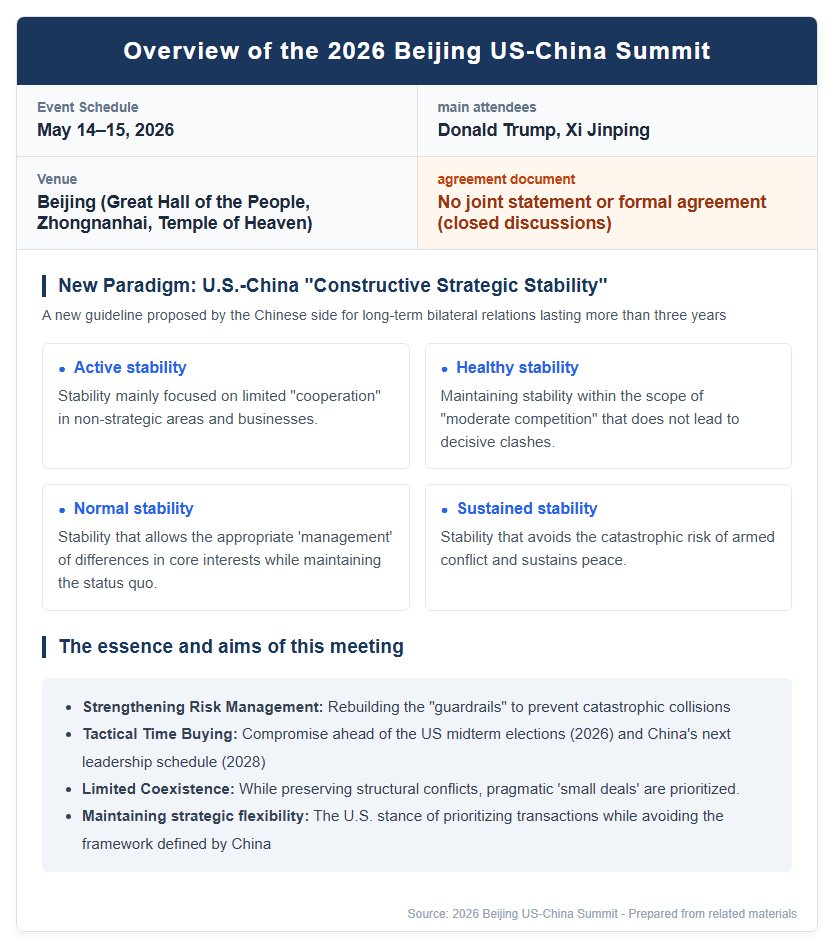
A new paradigm of ‘Constructive Strategic Stability Relations’
The most important achievement reported in this meeting was the newly defined bilateral relationship as a “constructive strategic stability relationship.” President Xi Jinping placed this concept at the center of the talks, emphasizing that both the U.S. and China should overcome the “Thucydides Trap” and build a new model of relations among major powers. China explains that this relationship consists of four elements: proactive stability centered on cooperation, healthy stability that maintains moderate competition, permanent stability that manages differences, and sustained stability that sustains peace. In particular, China hopes to institutionalize a stable framework lasting more than three years, and intends to use this as a strategic guideline for future U.S.-China relations. Meanwhile, the U.S. side has not officially used the term “strategic stability” in President Trump’s own statements. The United States maintains a pragmatic approach to deals while avoiding being bound by the framework defined by China, and there is an asymmetry between the two countries regarding how this new paradigm is perceived.
Risk Management Summit Without a Joint Statement
The fact that a joint statement was not made at the summit sharply reflects the current state of U.S.-China relations. It can be said that both countries have entered the phase of “managed competition.” The Trump administration was rushing to secure short-term and concrete economic benefits and to calm the situation in the Middle East ahead of the U.S. midterm elections scheduled for November 2026. Meanwhile, the Chinese side, looking ahead to its political agenda toward 2028, needed concessions from the U.S. on the Taiwan issue and to buy time in the high-tech sector. This shared motivation for both countries to “buy time tactically” was the background that pushed for the holding of this meeting. Although several small deals with specific numerical targets were reached in the talks, military distrust and fundamental conflicts over technological supremacy remain preserved. Therefore, this “stability” is analyzed as a fragile equilibrium state that is merely a temporary easing of tensions and carries the risk of increased volatility whenever the interests of both countries clash.
Concrete Results for Business and Economy
Establishment of a Large-Scale Trade Deal
At the summit, President Trump proudly drew out results that he described as “a great trade deal for both countries.” The Chinese side has agreed to purchase 200 Boeing-made aircraft in the United States, and has hinted at the possibility of expanding the order to up to 750 in the future. Additionally, the obligation to import 25 million tons of U.S. soybeans, promised at the Busan summit in October 2025, was reaffirmed, and specific commitments were made regarding additional purchases of energy resources such as crude oil and LNG (liquefied natural gas), as well as agricultural products. These agreements are significant domestic achievements for the Trump administration, which aims to correct the U.S. trade deficit with China. For China, by leveraging U.S. purchases of U.S. products, it aims to avoid further tariff hikes by the U.S. and to ensure stable energy supply necessary for its own economic growth. However, whether these purchase commitments will be fulfilled as planned as in the former Phase 1 agreement depends on future global economic trends and changes in bilateral relations, so market participants remain cautious.
Establishment of the Trade and Investment Committee
Aiming to stabilize economic cooperation, both countries agreed to consider establishing a Board of Trade and a Board of Investment. These are expected to serve as ongoing channels to manage daily trade frictions at the operational level and reduce uncertainty. In particular, the Investment Committee serves as a framework to supervise Chinese capital investment in the U.S. while promoting cooperation in areas with low security concerns. Currently, the U.S. and Chinese economies are increasingly disconnecting supply chains under the guise of “delisting,” and the establishment of such committees is an attempt to curb excessive decoupling and maintain and manage some of the economic interdependence. However, there is also a view that the areas covered will be limited to less than 10% of total US-China trade, and cutting-edge technology fields such as semiconductors and AI are likely to remain outside the jurisdiction of these committees. For the business world, while a certain degree of predictability is increasing, there is a growing need to adapt to new “politically driven economic relations” where direct state intervention and micromanagement are becoming the norm.
Building AI Safety Governance
One of the most highly regarded practical achievements at this summit was cooperation on the safety of artificial intelligence (AI). The U.S. and China have agreed to establish joint guardrails to prevent the indiscriminate misuse of AI technology. Behind this is a shared recognition that, with the emergence of extremely powerful AI such as the next-generation model “Mythos” announced by Anthropic in the United States, the risks of large-scale cyberattacks and unauthorized access have become direct threats to national security. The two countries plan to jointly build security governance by initiating technical dialogue to deter the development of AI-powered autonomous cyber weapons and attacks on critical infrastructure. The AI field has become the main battleground in the US-China arms race, and dialogue has so far been considered difficult. However, this agreement is significant as the “first step” to temporarily suspend competition and manage AI risks that could pose a threat to humanity as a whole. However, export controls on semiconductors continue, and how to balance the contradictory challenges of technology encroachment with ensuring safety will become a major focus going forward.
Strategic Conflicts and Unresolved Issues
Taiwan Issue: China’s Red Line and U.S. Ambiguity
The Taiwan issue was the most heated topic at this summit, and at the same time, it left the most serious concerns. President Xi Jinping clearly positioned Taiwan as the “most important core interest” in U.S.-China relations and as a “red line that must not be crossed,” strongly warning that “Taiwan independence and peace in the Taiwan Strait cannot coexist.” In response, President Trump maintained a “strategic ambiguity” by avoiding clear references to Taiwan’s defense involvement, but it appears that the center of gravity is shifting in favor of China. At a press conference after returning to the United States, Trump downplayed the 1982 “Six Guarantees,” saying, “The 1980s are a long time ago,” and hinted at treating arms sales to Taiwan as a trump card in negotiations with China. He also stated, “We do not want war in distant places,” and among U.S. allies and partners, trust in U.S. security commitments is beginning to waver. This growing uncertainty could have serious ripple effects on East Asia’s security environment.
Impact of Semiconductor Export Controls and the MATCH Act
In the semiconductor sector, a symbol of the struggle for high-tech hegemony, the “MATCH Act” being discussed in the U.S. Congress casts a significant shadow. Submitted in April 2026, this bill stipulates that the U.S. will exercise its Extraterritorial Jurisdiction (FDPR) to impose unilateral regulations on allies and partners who do not implement export controls equivalent to those of the U.S. against China. During the summit, the Trump administration showed a flexible stance, such as approving the sale of semiconductors to some Chinese IT companies, but at the congressional level, there is still a growing movement toward strict regulations. For countries with strong semiconductor manufacturing capabilities, such as Japan and the Netherlands, a situation of “encirclement economic security” has emerged, where U.S. domestic laws unilaterally restrict access to the Chinese market. If the MATCH Act is enacted, it will require the introduction of regulations equivalent to those in the U.S. within 150 days of enforcement, forcing Japanese companies like Tokyo Electron to face a harsh dilemma: either lose sales in the Chinese market or be excluded from the U.S. system. This institutional pressure has also brought new sparks to Japan-U.S. relations and Japan-China relations.
Cooperation and Concerns Surrounding the Middle East and Ukraine Situation
Opinions were also exchanged between the two leaders on the Middle East situation and the Ukraine crisis. Especially regarding the Middle East, although there was consensus on the principles of deterring Iran from acquiring nuclear weapons and maintaining the opening of the Strait of Hormuz, there remains significant gap in specific approaches. The United States is urging China to use its influence over Iran to de-escalate regional tensions, but China indirectly criticizes U.S. military actions and maintains a stance of avoiding collusion with specific forces. On the first day of talks, a symbolic incident occurred in the seizure of a Chinese-owned vessel in the Strait of Hormuz, highlighting just how difficult regional control is. Regarding the situation in Ukraine, the United States is highly wary of China’s deepening ties with Russia. In this way, international conflict zones have become not mere venues for U.S.-China cooperation, but rather serve as ‘testing grounds’ where the strategic interests of both countries collide and each other’s influence is tested. The longer turmoil in the Middle East and Europe drags on, the more U.S. resources are dispersed, resulting in a structural contradiction where China’s leverage in the Asia-Pacific region increases.
Future Developments and Highlights
2026 Midterm Elections and Political Schedules in Various Countries
The biggest variable predicting future U.S.-China relations will be the U.S. midterm elections in November 2026. The Trump administration wants to promote a “diplomatic victory through the China deal” ahead of the election, but depending on declining approval ratings and domestic inflation in the U.S., there is also the unpredictability of a sudden shift to a tough stance toward China again. Meanwhile, China’s Xi Jinping leadership also needs economic stability and a calming of U.S.-China relations to achieve its political goals toward 2028. Thus, while the domestic affairs of both countries are creating a temporary ‘tactical détente,’ depending on the election results, the U.S. policy toward China could once again be greatly shaken. For neighboring countries, especially South Korea and Japan, it is urgent to view this interim period of stability as a “strategic window” and to diversify supply chains and strengthen autonomous defense capabilities while the U.S.-China guardrails remain active. The political situation after autumn will be the first touchstone to test the effectiveness of the “strategic stability” agreed upon in Beijing.
The ‘Economic Security Crisis Facing Japanese Companies’
The most important focus for Japan is how to respond to the “institutional competition” between the US and China. In response to the strengthened extraterritorial application seen in the U.S. MATCH Act, China has also fully implemented blocking rules enforced in 2021, establishing countermeasures that allow companies complying with U.S. regulations to sue in court. As a result, Japanese companies are forced to take legal responsibility in China if they comply with U.S. law, while prioritizing Chinese law means being excluded from the U.S. financial system—a ‘test measure’ has become a reality. This pincer situation is especially severe in the fields of semiconductor manufacturing equipment and critical minerals. The Japanese government is required to strengthen policy coordination with the United States and secure exceptions for extraterritorial applications, while also implementing proactive economic security policies that establish trade insurance to cover corporate losses and support further market diversification. From “following” to “formation,” how Japan can incorporate its own rules into the international framework is key to maintaining industrial competitiveness.
President Xi Jinping’s Visit to the U.S. and Future Roadmap
The next major milestone following the Beijing Summit is President Xi Jinping’s visit to the United States, scheduled for September 2026. Ahead of this visit to the U.S., the focus will be on how concretely the dialogue on trade and investment and AI safety, which has been agreed upon this time, will be implemented. Through his visit to Washington, President Xi hopes to make a strong impression both domestically and internationally that China is a major power that bears the international order on equal footing with the United States. Additionally, a series of high-level diplomatic events will be held through the end of the year, such as APEC (held in Shenzhen, China) in November and the G20 (held in Miami, USA) in December. In these forums, the question is whether this “Constructive Strategic Stability Relations” will not remain mere slogans but will be reflected in the policies of both countries as concrete actions. In particular, without “visible progress” such as curbing military activities around Taiwan or easing export controls on critical resources, the achievements of the Beijing summit will be seen as merely a temporary stage. The quality of achievements accumulated at the practical level by the September visit will determine the tone of U.S.-China relations over the coming years.
[#米中関係 #経済安全保障 #半導体 #トランプ政権 #習近平 #外交ディール #AIガバナンス #台湾問題]
、エルニーニョ現象の発生を発表_en-1.png)

コメント