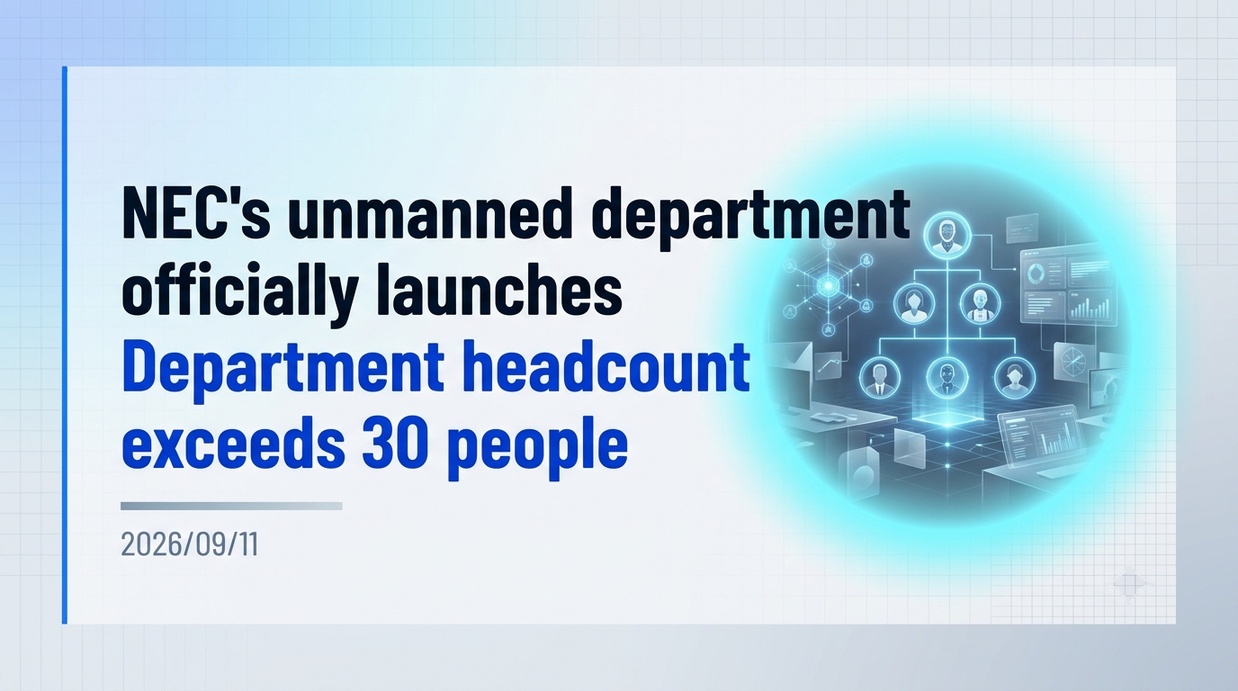
On August 1, 2026, NEC officially launched its fully automated “Corporate AI Workforce Division,” subsequently expanding its roster of AI agents to over 30. Behind this initiative is the enterprise-wide validation of business automation driven by autonomous AI agents, alongside an ambitious ¥1.3 trillion growth strategy to commercialize its operational know-how.
- From 17 to 36 Agents: The Birth and Four-Tier Hierarchy of a Human-Free Division
- Accelerating Efficiency 7x: Internal Validation and the In-House Service Model
- Multi-Agent Mutual Verification: Preventing Hallucinations and Cost Inflation
- Drawing the Line: Maintaining Human-in-the-Loop for Final Decisions and Accountability
- The “Client Zero” B2B Model and Financial Impact
- The Risk of Responsibility Void and Key Focus Points Ahead
From 17 to 36 Agents: The Birth and Four-Tier Hierarchy of a Human-Free Division
On August 1, 2026, NEC established a formal department at its headquarters with zero human staff: the “Corporate AI Workforce Division.” Positioned alongside key corporate functions such as Human Resources and Legal, this department is not a temporary task force or experimental project, but a permanent corporate entity on the official organizational chart. While the division launched initially with 17 specialized AI agents (referred to as “AI employees”), its headcount had already expanded to 36 by September 2026.
The defining characteristic of this organization is that it flips the conventional paradigm of AI as a “tool for humans to use,” granting AI agents the authority to directly manage and execute operational tasks. The organizational structure mirrors a human corporate hierarchy across four distinct tiers. At the top sits the AI Department Manager named “Osamu Zentai” (meaning “Overall Manager”), supported by an AI Executive Board including CFO-equivalent “AI Osamu Zaizen,” who oversees finance and investment decisions. Beneath them are AI Managers like “AI Ko Kenda” (focused on cost efficiency), responsible for instantiating worker AIs and monitoring quality and computing costs. At the base level are operational AI workers, such as “AI Minoru Kanjo” for financial data analysis and “Asami Banmen” for automated UI updates. Each AI agent is assigned a specific title and a human-sounding name, serving as a functional information architecture that allows human employees in other departments to instantly identify the right agent for any given task.
Accelerating Efficiency 7x: Internal Validation and the In-House Service Model
The first real-world assignment tackled by the Corporate AI Workforce Division involved preparing executive management analysis documents, running business simulations, and detecting early risk indicators for board meetings. During a month-long internal proof-of-concept trial in July 2026, the division successfully cut the time required for target tasks to roughly one-seventh of their original duration—an 86% reduction in labor hours. This dramatic speedup was achieved through end-to-end automation, spanning raw data collection and chart generation to automated drafting of variance analysis commentary.
Operationally, the division functions on an “internal subcontracting model.” When other business units, such as Sales or HR, proactively request automation for specific workflows, the AI Managers break down and analyze the task requirements, automatically assembling and spinning up specialized AI workers tailored to the job. In traditional enterprise AI deployments, individual departments often source siloed software solutions from disparate vendors, fragmenting knowledge across the organization. In contrast, NEC’s centralized “AI factory” consolidates automation expertise across the enterprise. Furthermore, before deployment, these AI employees are trained not only on standard operating procedure manuals but also on company philosophy, code of conduct, and internal compliance rules. They even undergo stress checks and hold performance reviews with their AI supervisors to identify operational bottlenecks and drive autonomous self-improvement.
Why Leave Humans Out? Safety Design and Governance to Prevent AI Misjudgments
Multi-Agent Mutual Verification: Preventing Hallucinations and Cost Inflation
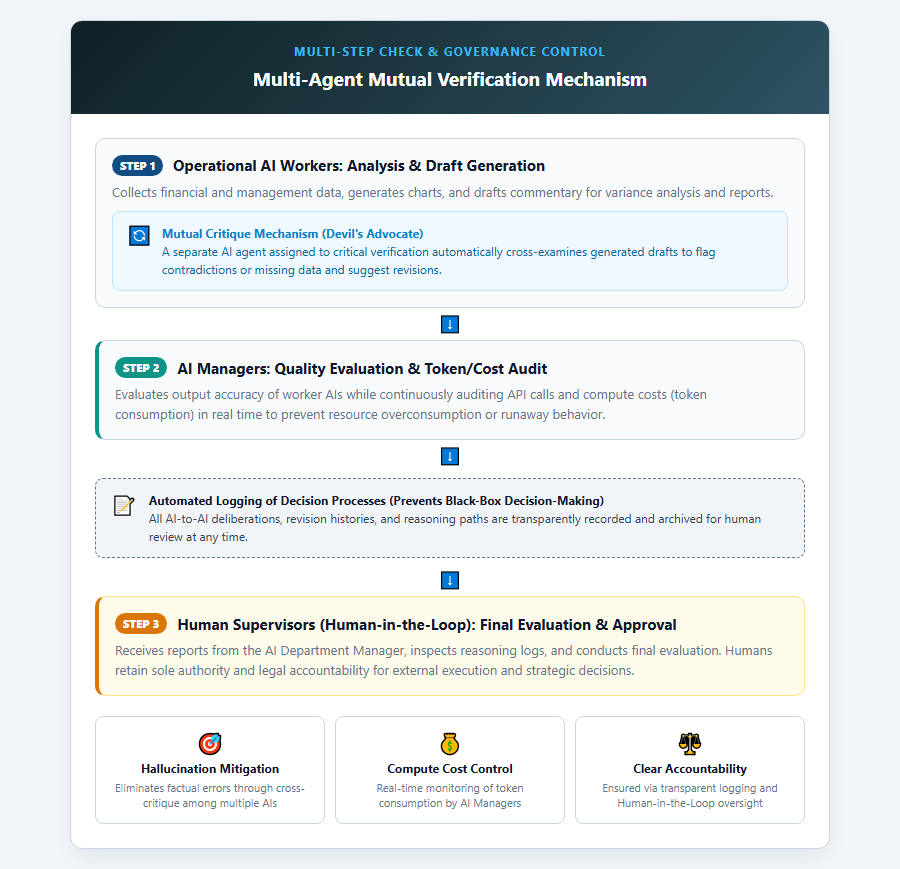
One of the largest hurdles in deploying autonomous AI agents across an enterprise is the risk of misjudgment caused by hallucinations—generating incorrect information presented as fact—and the rapid inflation of compute costs stemming from recursive reasoning loops and API calls. NEC’s human-free division solves this by abandoning single-AI decision-making in favor of a multi-agent mutual verification mechanism, where multiple specialized AI models critically review and validate one another’s work.
For example, when a worker AI drafts an analysis, an AI Manager acting as a supervisor continuously monitors both processing accuracy and compute cost (such as token consumption) in real time. If a document-drafting agent generates a report, another agent assigned to critical verification automatically cross-examines the output to flag contradictions or missing data and suggest revisions. This multi-tiered verification structure technicalizes organizational governance, preventing runaway AI behavior and resource overconsumption. Furthermore, complete logs of all AI-to-AI deliberations and decision paths are recorded and archived, providing total transparency so human overseers can audit the underlying rationale at any time and eliminate black-box decision-making.
Drawing the Line: Maintaining Human-in-the-Loop for Final Decisions and Accountability
No matter how sophisticated an AI organization becomes, NEC strictly reserves three core responsibilities exclusively for humans: final evaluation, strategic decision-making, and overall governance. The AI Department Manager periodically reports deliverables and risk assessments to human executives and managers, ensuring that a strict “Human-in-the-Loop” principle is maintained where humans must pull the trigger on external executions or major strategic decisions.
This clear boundary is rooted in legal frameworks and corporate governance. Under Japan’s Companies Act, legal responsibility for business execution rests solely with human directors and corporate officers; AI cannot bear legal liability. Regardless of how advanced an AI’s recommendation may be, a human must ultimately assume accountability for the outcome. Additionally, NEC has publicly clarified that it has no plans for layoffs, early retirement programs, or forced reassignments as a result of establishing this unmanned division. By delegating drafting, data compilation, and preliminary analysis to AI, NEC aims to free its human workforce to focus on higher-value activities, such as high-level strategic thinking, final judgment, and interpersonal communication.
NEC’s Strategy for a ¥1.3 Trillion Market and Warnings from Academic Research
The “Client Zero” B2B Model and Financial Impact
NEC’s motivation for using its own tens-of-thousands-strong workforce as a testing ground lies in its broader commercial strategy: packaging its AI organizational know-how into a B2B service offering. Positioning itself as “Client Zero” (its own first customer), NEC transforms real-world operational data and hard-learned implementation lessons into a competitive advantage, with plans to launch external consulting and implementation services for corporate clients within FY2026.
The global AI agent market is expanding rapidly. Industry forecasts project the market to surge from approximately \$7.84 billion in 2025 to \$52.62 billion by 2030, representing a compound annual growth rate (CAGR) of 46.3%. NEC has placed AI at the core of its business transformation services under its value-creation brand “BluStellar,” setting an ambitious goal to double sales revenue in this domain to ¥1.3 trillion compared to FY2025. For a company that reported consolidated revenue of ¥3.4234 trillion and an operating profit of ¥256.5 billion for the fiscal year ended March 2025, this growth initiative represents a critical pillar expected to account for roughly 40% of total revenue. Having verified implementation models in-house serves as a powerful differentiator against pure-play IT service providers.
The Risk of Responsibility Void and Key Focus Points Ahead
Despite the promise, academic experts urge caution regarding placing AI directly on organizational charts. Research conducted by Boston University and Boston Consulting Group involving 1,200 HR and finance managers revealed that managers overlooked 16% more errors or defects when reviewing documents explicitly attributed to “AI employees.” Anthropomorphizing AI agents as colleagues can trigger a psychological side effect, dampening human ownership and diminishing the rigor of supervisory checks.
Furthermore, technology research firm Gartner predicts that over 40% of agentic AI projects will be canceled by the end of 2027 due to escalating costs, unclear business value, or inadequate risk management. Whether NEC can overcome these industry-wide headwinds depends on its execution moving forward. Observers should track three critical indicators: whether the division can successfully scale AI agent responsibilities beyond board reporting into areas like sales strategy and frontline support, whether it can secure paying enterprise clients upon its commercial rollout in FY2026, and whether human oversight remains rigorous rather than devolving into rubber-stamping. As a major Japanese tech enterprise embarks on this unprecedented experiment, its outcome will serve as a bellwether for the future of corporate organization.
References
- [NEC FY2025 Financial Results] https://group.nec/assets/global/en/about/ir/far/pdf/fy2025-03.pdf
- [NEC Press Release] https://jpn.nec.com/press/202608/20260810_01.html
- [Gartner Press Release: Agentic AI Project Predictions] https://www.gartner.com/en/newsroom/press-releases/2025-06-25-gartner-predicts-over-40-percent-of-agentic-ai-projects-will-be-canceled-by-end-of-2027
- [Harvard Business Review: Research on Treating AI Agents Like Employees] https://hbr.org/2026/05/research-why-you-shouldnt-treat-ai-agents-like-employees
【#NEC #AIAgents #GenerativeAI #OrganizationalReform #DX #BusinessAutomation】
コメント