NEC Corporation has unveiled an ambitious target to cut its internal generative AI token costs to one-tenth by the second half of 2026. By dramatically increasing operational efficiency alongside enterprise-wide AI expansion, the company aims to prevent skyrocketing infrastructure expenses while accelerating its transformation into an “AI-native” enterprise.
- Overview of the Enterprise-Wide AI Cost-Reduction Strategy
- Three Key Technological Approaches to Achieving a 90% Cost Reduction
- A Growth Strategy Grounded in Expanding AI Adoption, Not Restricting It
- Inside the Four-Tier Corporate AI & Workforce Division
- Trial Results: Cutting Executive Management Analysis Time to One-Seventh
- Skyrocketing Token Costs and the Urgency of Optimization
- Translating “Client Zero” Insights into BluStellar Solutions
Overview of the Enterprise-Wide AI Cost-Reduction Strategy
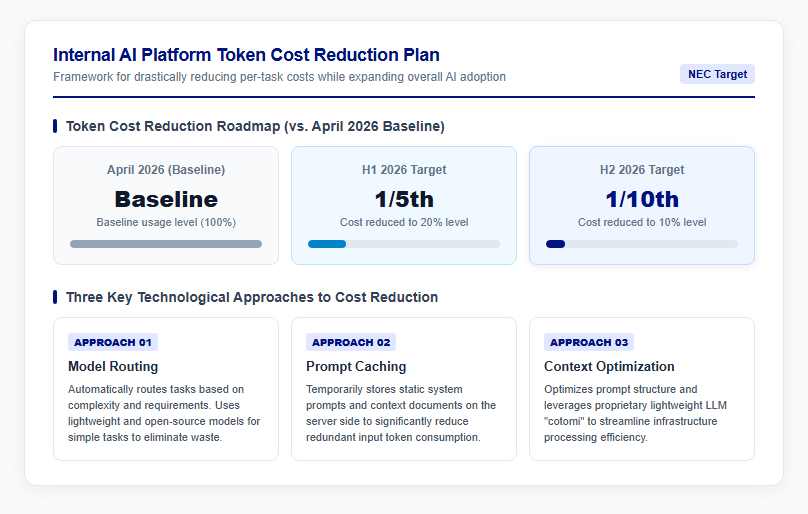
On September 9, 2026, NEC announced an enterprise-wide initiative to optimize token costs associated with generative AI usage. According to Hiroshi Kodama, Executive Corporate EVP and Chief AI Transformation Officer (CAXO), using the internal AI usage baseline from April 2026, the company plans to reduce effective token costs to one-fifth in H1 2026 and to one-tenth by H2 2026. As the adoption of large language models (LLMs) accelerates across industries, corporate AI usage has surged, bringing growing concerns over unpredictable pay-as-you-go cloud infrastructure costs. NEC’s strategy, however, is not a cost-cutting measure designed to restrict employee AI usage. Instead, it focuses on achieving a dramatic leap in efficiency—delivering the same processing outputs at one-tenth of the cost. As employees incorporate AI into their daily workflows, this initiative serves as a pivotal management strategy to maximize productivity while curbing runaway expenditures.
Three Key Technological Approaches to Achieving a 90% Cost Reduction
To achieve this ten-fold cost reduction, NEC is deploying a control mechanism built on several advanced technologies. A central pillar is model routing, a mechanism that automatically directs prompts to the most appropriate AI model based on task complexity and requirements. By routing simple summarization or classification tasks away from expensive, ultra-large frontier models toward lightweight or open-source models, unnecessary spending is eliminated. The second approach leverages prompt caching. By temporarily storing static system prompts and repetitive context documents on the server side, redundant input token consumption is sharply reduced. In addition, NEC combines structured context engineering with infrastructure optimization powered by cotomi, its proprietary lightweight LLM. The figure below illustrates the optimization architecture implemented within NEC’s internal AI platform.
A Growth Strategy Grounded in Expanding AI Adoption, Not Restricting It
What makes this cost-reduction goal particularly notable is NEC’s proactive commitment to further expanding overall AI adoption. As CAXO Kodama emphasized, the scope and frequency of generative AI applications in daily business operations are expanding rapidly, making an increase in total usage a natural progression. So long as output quality and business results improve, the increased investment in AI volume delivers a strong return on investment. The real challenge lies in efficiency—disrupting the legacy cost structure where identical tasks consume tokens at unoptimized rates. By driving down the unit cost of AI processing to one-tenth, NEC establishes an environment that accelerates enterprise-wide AI utilization while maintaining strict fiscal discipline.
Launch of the Autonomous AI Division and Internal Trial Results
Inside the Four-Tier Corporate AI & Workforce Division
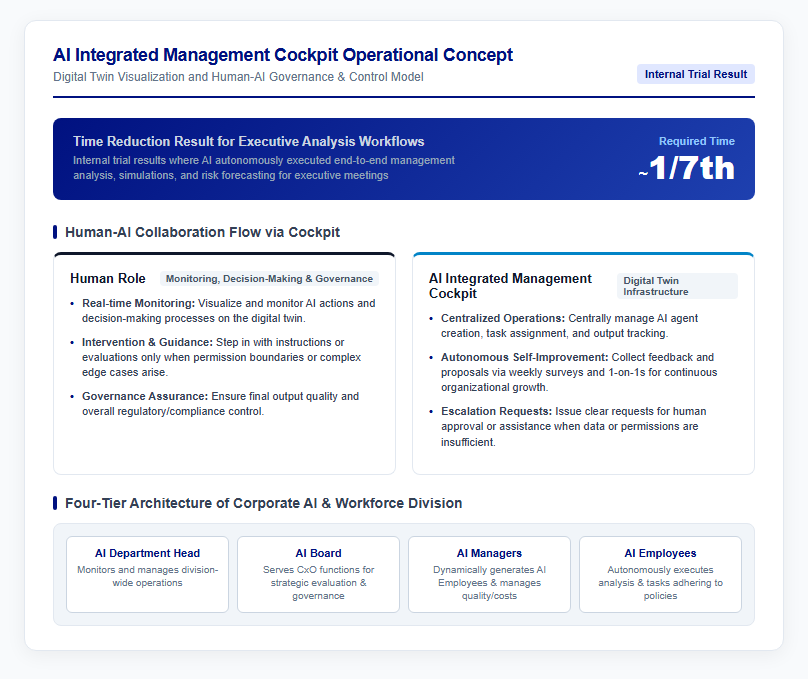
Underpinning this cost optimization is a fundamental restructuring of NEC’s organizational model. On August 1, 2026, NEC formally established the Corporate AI & Workforce Division, designed for human-AI co-creation. The division features a four-tier architecture: an AI Department Head managing overall operations, an AI Board fulfilling CxO-level strategic functions, AI Managers overseeing cross-functional workflows, and AI Employees executing operational tasks. Operating with dozens of specialized AI agents, AI Managers dynamically generate and assign new AI Employees equipped with relevant skills whenever business demands arise. Every AI agent undergoes onboarding to learn NEC’s Code of Values, company purpose, and internal regulations, ensuring that operations proceed autonomously under strict enterprise governance.
Trial Results: Cutting Executive Management Analysis Time to One-Seventh
Internal trials of this autonomous AI organization demonstrated extraordinary efficiency gains. When AI agents autonomously executed end-to-end management analysis, simulations, and risk forecasting for executive meetings—tasks that previously demanded extensive human oversight—the required operational time was reduced to approximately one-seventh. The operating status and decision-making processes of all AI agents are monitored in real time via an AI Integrated Management Cockpit built on digital twin technology. Human supervisors maintain oversight through the cockpit, stepping in to provide guidance or approval only when permission boundaries or ambiguous edge cases arise, thereby guaranteeing final output quality and compliance. The figure below illustrates the operational concept of the AI Integrated Management Cockpit.
Management Challenges in the Generative AI Era and Market Expansion
Skyrocketing Token Costs and the Urgency of Optimization
As a growing number of enterprises push for company-wide generative AI adoption, rising token costs and opaque cloud expenditures have emerged as major pain points for corporate leadership. Under usage-based pricing models, monthly costs can escalate rapidly from hundreds of thousands to tens of millions of yen as employee engagement scales. Furthermore, organizations must manage operational risks such as “AI debt”—the degradation of response accuracy caused by outdated training data. NEC’s implementation of model routing and prompt caching to reduce token costs to one-tenth offers Japanese enterprises a clear blueprint for scaling AI deployment while preserving ROI.
Translating “Client Zero” Insights into BluStellar Solutions
NEC operates on the principle of “Client Zero,” using its own workforce of approximately 100,000 employees as a live testing ground for transformation. The operational expertise, cost-reduction mechanisms, and technical frameworks developed through this internal implementation are packaged and delivered to corporate clients and society through BluStellar, NEC’s value-creation platform. Moving beyond simple AI system integration, NEC packages optimal human-capital and AI-capital allocation methodologies, positioning itself to lead digital transformation across Japanese industry over the medium to long term.
Reference Pages
- [AI Governance | NEC] https://jpn.nec.com/profile/ai-governance/index.html
- [NEC Press Release] https://jpn.nec.com/press/202608/20260810_01.html
- [BluStellar | NEC] https://group.nec/jp/ja/solutions/nec-blustellar/
【#NEC #GenerativeAI #AIGovernance #TokenCost #BluStellar #DX #AIAgents】
コメント