
The total water storage rate of four dams located upstream on the Kinu River has dropped to its lowest level in the past decade. Behind this abnormal situation is a record trend of low rainfall, and the Ministry of Land, Infrastructure, Transport and Tourism has established a drought countermeasure branch to heighten vigilance.
- Lowest water storage level in the past decade
- Record low rainfall at only 27%
- Establishment of the Drought Countermeasure Branch and Administrative Actions
- Concerns over water shortages directly impacting agriculture
- Corporate Production Activities and Water Risks
- Impact on Civic Life and Lessons from 1994
- Advanced water management through four dam-linked facilities
- Shifting Climate and River Maintenance Plans
- Future Outlook and Key Focus
Lowest water storage level in the past decade
Since June 2026, the water storage levels of four dams located upstream of the Kinugawa River (Kawamata Dam, Kawaji Dam, Yunishigawa Dam, and Isori Dam) have plummeted to a severe level. According to data as of 0:00 on June 11, 2026, the total storage capacity of the four dams is 122.49 million cubic meters, with a storage rate of only 48%. This is 82% of the average for the same period in the past, and is as severe as during the drought in 2016, when a 20% water intake limit was implemented.
In particular, the situation at the Isori Dam is particularly poor, with the water storage rate dropping to just 34%. This is well below the historical average of 89%. Additionally, Kawaji Dam is at 47% and Kawamata Dam at 48%, meaning major dams are all below 50%. The diagram below shows the current specific water storage status of each dam.
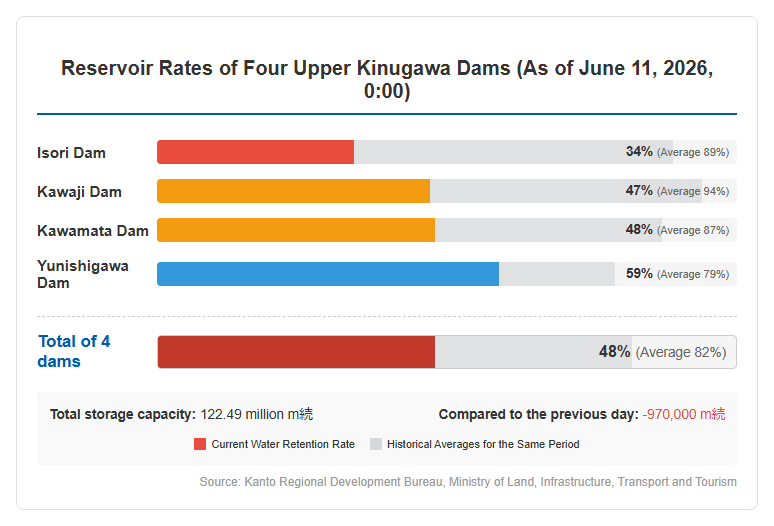
The daily decrease since the previous day has reached about 970,000 cubic meters, with water resources being eroded without any signs of recovery. If the water storage volume continues to decline as it is, it could have a severe impact on widespread social activities downstream.
Record low rainfall at only 27%
The direct cause of this drop in storage rate is the extreme lack of precipitation since the beginning of 2026. Looking closely at the average precipitation in the upper reaches of the Sanuki point on the Kinugawa River, from January 2026 to the present, many months have been below average. Notably, by June 11, precipitation was only 45 millimeters, which is only 27% of the average for the same time of year.
Compared to previous drought cases, this year’s lack of rainfall stands out.
-
The rainfall in February 2026 was 22 millimeters, 42% of the average year.
-
In March 2026, the temperature was 56 millimeters, 75% of the average year.
-
Until June 11, 2026, 45 millimeters is 27% of the average year.
Earlier this month, due to the influence of Typhoon No. 6, there was a temporary and substantial rainfall, causing a slight recovery in water storage levels, but since then, the water level has started to decrease again. The Japan Meteorological Agency’s short-term forecast also suggests that substantial rainfall is not expected for the time being, raising concerns that the inflow to the dam may decrease further. The data also reveals that the weather conditions in the basin are becoming more severe than ever.
Establishment of the Drought Countermeasure Branch and Administrative Actions
Taking the situation seriously, the Kanto Regional Development Bureau Shimodate River Office of the Ministry of Land, Infrastructure, Transport and Tourism has initiated swift responses. At 13:00 on June 18, 2026, the office established a drought countermeasures branch and began preparations. This is an organized posture to strengthen coordination with relevant agencies and smoothly implement measures such as emergency water intake restrictions in preparation for further future water storage reductions.
The administration is not only conducting surveillance but also focusing on raising awareness among citizens through public relations activities. It emphasizes that the water resources stored in the dam are limited, and strongly calls on residents, businesses, and farmers who use the Kinugawa River water to cooperate in water conservation. Additionally, the Kinugawa Dam Integrated Management Office continues to efficiently operate the four dams and their connected facilities, making adjustments to make the most effective use of limited water.
In the future, if the storage rate falls further and falls below a certain threshold, phased water intake restrictions will be implemented based on agreements such as the Kinugawa Water Use Adjustment Liaison Committee. At present, preparations are underway, but depending on the scenario, a 10% to 20% water intake restriction is becoming increasingly realistic, heightening administrative tension.
The significant risks drought poses to society and the economy
Concerns over water shortages directly impacting agriculture
The largest share of Kinugawa’s water use is agricultural water. According to statistics, among water use on the Kinugawa River, agricultural water has a maximum intake of about 43.2 cubic meters per second, which far exceeds the amount used for tap water (about 2.2 cubic meters/second) and industrial water (about 0.8 cubic meters per second). A shortage of this water, which supports the vast farmland of Tochigi and Ibaraki Prefectures, could deal a devastating blow to the region’s core industries.
Especially in June, a period requiring large amounts of water for post-planting management and crop growth, if water intake restrictions are implemented, it directly leads to poor crop growth and reduced yields. In past cases, when droughts worsen, rivers have experienced breaks (a phenomenon where the flow is interrupted), making it impossible to pump water with agricultural pumps.
For farmers, this is not just an economic loss, but also threatens the cultivation environment they have protected for many years. Currently, the government is also working with agricultural organizations to quickly coordinate measures such as detailed water management and preparing water supply (alternating water intake times) to minimize damage.
Corporate Production Activities and Water Risks
Drought poses a serious threat not only to agriculture but also to the business activities that support the local economy. For factories and businesses that use industrial water, water shortages can lead to the shutdown of cooling facilities and halts in manufacturing processes, posing risks of production line downsizing or shutdowns.
In recent years, as drought risks have become normalized due to climate change, many companies have incorporated drought countermeasures into their BCPs (Business Continuity Plans).
-
Reduction in usage through the introduction of circulating cooling water
-
Utilization of Rainwater Utilization Systems
-
Capital Investment in Water-Saving Equipment
For energy-related companies like Tokyo Electric Power Company, water is an essential resource for cooling power generation facilities and hydroelectric power generation. Especially in hydropower generation, a drop in dam storage level directly leads to a decrease in the amount of power that can be generated, and from the perspective of stable power supply, it has an impact that cannot be ignored. The current situation at Kinugawa is not just a natural phenomenon, but must be seen as an economic risk that shakes the entire supply chain.
Impact on Civic Life and Lessons from 1994
If the water storage rate worsens further and water intake restrictions are tightened, it will also affect our daily lives. During the “Great Drought of Heisei” in 1994 (Heisei 6), a serious case in the past, large-scale water intake restrictions were implemented nationwide, with some areas experiencing water outages or reduced-pressure water supply. At that time, the Kanto region avoided water outages through the use of new water sources and thorough water conservation, but the current rate of decline in storage rates brings back memories of those times.
If the scenario worsens and the storage rate falls below 50%, leading to a water intake restriction of around 30%, the following impacts are expected.
-
Restrictions on public pool usage and stopping park irrigation
-
Usability deteriorates due to reduced water pressure (depressurized water supply) at home
-
Considering shortening business hours in restaurants and service industries
Some data shows that water demand in modern society has decreased by about 20% compared to 1994, but even so, the psychological and social anxiety caused by water stopping is immeasurable. The government continues to provide accurate information to prevent panic, and requires every citizen to recognize that “water is a limited resource” and to work on effective water conservation measures such as accumulating washing and reducing shower times in daily life.
Integrated Management and Climate Change Resilience
Advanced water management through four dam-linked facilities
Despite the severe water storage conditions of the upper Kinugawa dam group, the reason they have been able to avoid a critical water shortage at present is thanks to the advanced operation of the “Upper Kinugawa Dam Group Collaboration Facility.” This system connects Igori Dam and Kawaji Dam with a water conveyance tunnel, allowing water to flow between the two dams.
The existence of this collaborative facility enables flexible operations such as the following:
-
Redirecting inflow concentrated to specific dams to other dams
-
Prioritize replenishment for dams with low storage rates
-
Release from the optimal dam considering the time it takes to reach the usage site
Currently, four dams, including the Yunishigawa Dam, are operated as an integrated unit, and even if individual dams are on the verge of depletion, the entire system supports each other. The diagram below shows a cross-sectional view of this collaborative facility and explains how water moves between dams.
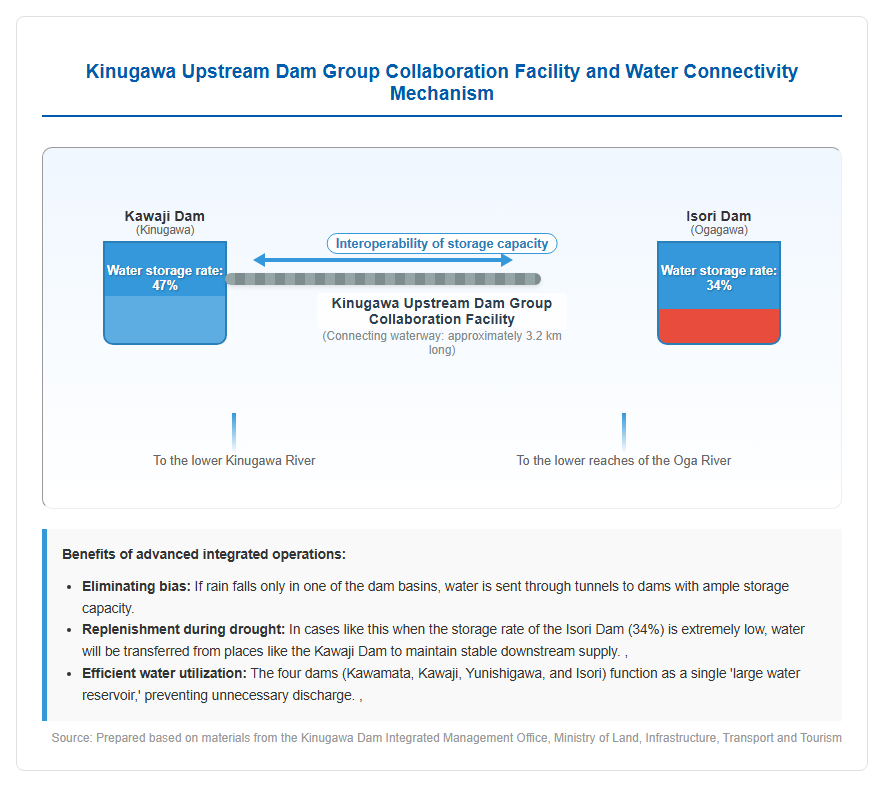
However, even this advanced system has its limits without the underlying rainfall. Currently, “low water management” is being conducted 24 hours a day, carefully balancing the expected recovery of future storage volumes with the current discharge replenishment balance.
Shifting Climate and River Maintenance Plans
There is growing consensus that this record-breaking drop in water storage is not just a temporary abnormal weather event, but rather part of long-term climate change. Due to recent changes in rainfall patterns, there have been frequent “extreme phenomena” where large amounts of rain fall all at once, while prolonged periods without rain like this have occurred.
In response, the Ministry of Land, Infrastructure, Transport and Tourism regularly inspects the Kinugawa River development plan and makes corrections based on the latest findings.
-
Assuming amplitudes of increased or decreased rainfall due to climate change
-
Reviewing plans not only for flood control (flood countermeasures) but also to ensure stability in water utilization (water use)
-
Introduction of more precise hydrological observation and forecasting models utilizing digital technology (infrastructure DX)
In the second inspection conducted in August 2025, it was emphasized that it is important to further improve flood control safety in light of climate change and to promote rational water use during droughts. As the unpredictable nature becomes unpredictable, enhancing resilience through both the hardware aspects of infrastructure and the soft aspects leveraging digital technologies will determine the survival of local communities going forward.
Future Outlook and Key Focus
The biggest focus going forward will be whether they can weather the soon-to-be-full-scale summer demand season. The 48% water storage rate is a figure that should normally be stored with ample margin before the peak of summer, so starting at the current level is an extremely risky situation.
There are three key points to watch for going forward.
-
Will the rainfall in the latter half of the rainy season return to normal levels, or will it become an empty rainy season?
-
Whether the percentage of water intake restrictions will be raised during peak demand periods for agricultural water
-
How much water-saving activities by companies and citizens can suppress the decline in dam storage capacity
In the worst-case scenario, the water storage rate could fall below 30%, and there is a possibility of direct restrictions on citizens’ lives. On the other hand, there is a possibility that water storage levels could suddenly recover due to typhoons or autumn rain fronts, but this also comes with the risk of flooding. While waiting for the rain of blessings, we must face the reality of the “lowest level in the past decade” before us and continue to take cautious actions to use water carefully.
[#鬼怒川渇水2026 #ダム貯水率 #水資源管理 #節水 #気候変動 #国土交通省 #農業用水 #工業用水]


コメント