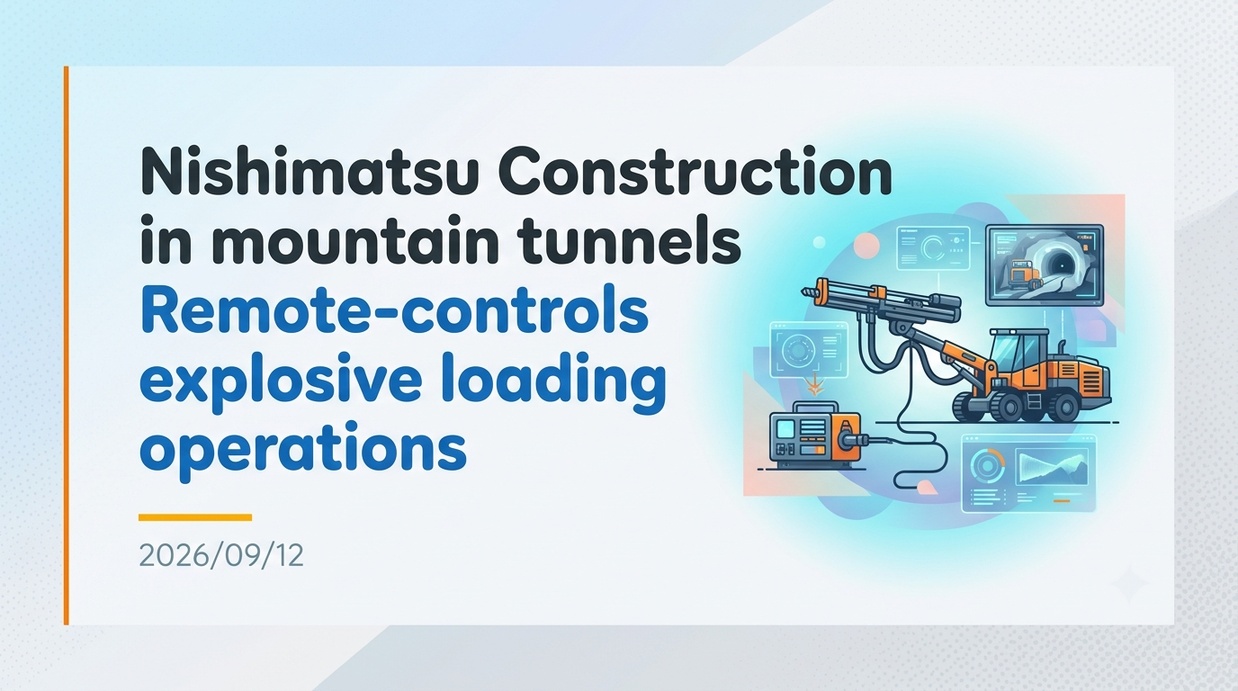
Nishimatsu Construction Co., Ltd. has developed a remote explosive loading device that enables remote charging operations in mountain tunnel construction. This breakthrough is driven by severe labor shortages and an aging workforce in the construction industry, alongside urgent demands to eliminate rockfall hazard risks at the dangerous tunnel face and enhance occupational safety.
- Technological Breakthrough Eliminating the Need for Workers to Enter the 45-Degree Danger Zone at the Tunnel Face
- Results of the 80-Meter Remote Control Demonstration and Prospects for Site Application
- Worsening Labor Shortages and Projected Workforce Decline Over the Next Decade
- Regulatory and Administrative Initiatives to Eliminate Rockfall Disasters at the Tunnel Face
- Complete Automation Through the Convergence of Tunnel RemOS and Digital Twin Technologies
- DX Investment and Job-Site Transformation Under “Nishimatsu-Vision 2035”
Technological Breakthrough Eliminating the Need for Workers to Enter the 45-Degree Danger Zone at the Tunnel Face
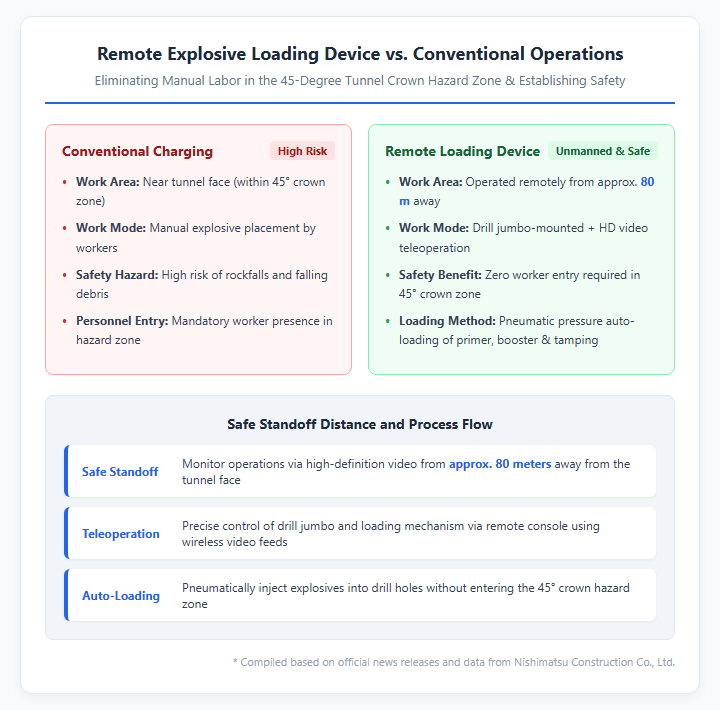
On September 8, 2026, Nishimatsu Construction Co., Ltd. announced the development of a remote explosive loading device designed to teleoperate charging operations during blasting excavation in mountain tunnel construction. In mountain tunneling, explosive charging—packing explosives into drilled holes—is an indispensable process. Traditionally, workers had to manually perform this task near the hazardous tunnel face. The newly developed system is mounted directly onto a heavy-duty drill jumbo used in mountain tunnel excavation. Connected to the drifter, the device equips the tip of a charging pipe with a primer cartridge, booster cartridges, and tamping material, inserting them into the blast hole and automatically loading explosives via pneumatic pressure. The primary advantage of this technology is that it allows the entire charging process to be completed without any worker stepping into the 45-degree zone from the tunnel crown—an area designated as a high-risk zone under the Ministry of Health, Labour and Welfare guidelines. In verification tests, in addition to specimen testing at the Hiratsuka Factory, operators successfully performed the loading process via remote control from approximately 80 meters away while monitoring high-definition video feeds. The technology has garnered significant industry attention for completely removing human labor from high-hazard areas. Please refer to the figure below.
Results of the 80-Meter Remote Control Demonstration and Prospects for Site Application
During testing of the remote explosive loading device, Nishimatsu Construction conducted remote charging experiments on a mock tunnel face using granite specimens at its Hiratsuka Factory demonstration facility. High-definition video transmission equipment and a control console were stationed in a safe area approximately 80 meters from the tunnel face. Operators precisely maneuvered both the drill jumbo and the remote charging device using clear, wirelessly transmitted footage. The trial successfully demonstrated that the entire sequence—from inserting the loading pipe to pneumatically injecting the explosives—could be seamlessly executed without personnel standing directly under the un-reinforced tunnel face. Mountain tunnel environments present harsh conditions characterized by heavy dust, loud noise, high heat and humidity, and extreme contrast between light and dark, demanding advanced video transmission capabilities and precise remote maneuvering. Nishimatsu Construction surmounted these environmental hurdles by leveraging an ultra-high-definition wireless video transmission system, establishing a robust technological foundation for field deployment. Moving forward, the company plans to mount the device onto drill jumbos operating at active tunnel excavation sites to evaluate its continuous operational performance and efficiency under real-world conditions. This milestone fundamentally transforms traditional tunnel face operations, where heavy machinery and manual labor previously coexisted, simultaneously securing worker safety and achieving labor-saving automation.
[Institutional & Industry Background] Challenges of Hazardous Work and the Imperative for Labor-Saving Solutions
Worsening Labor Shortages and Projected Workforce Decline Over the Next Decade
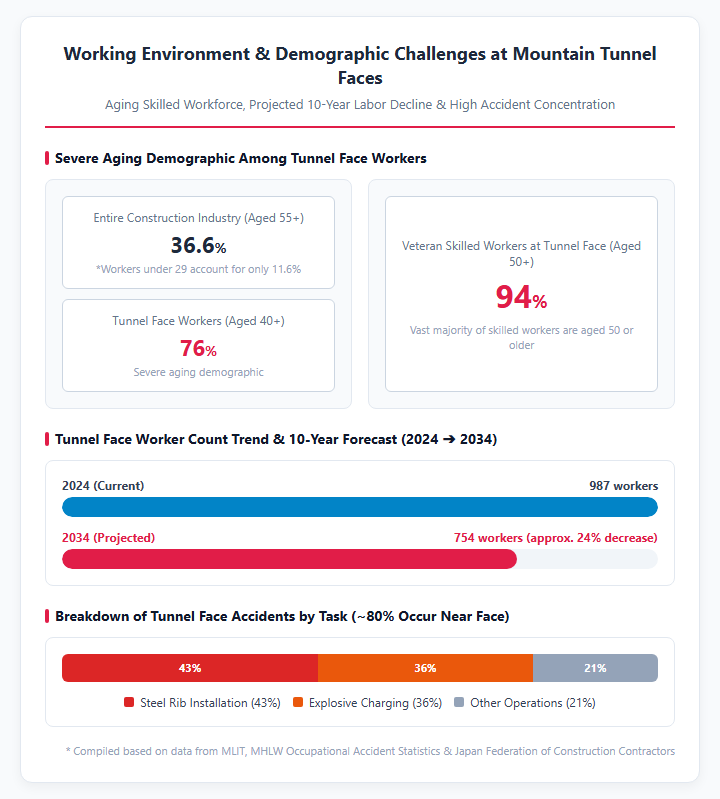
The shortage of skilled labor and an aging workforce due to Japan’s demographic decline have become exceptionally critical issues at mountain tunnel construction sites. According to data from the Ministry of Land, Infrastructure, Transport and Tourism, workers aged 55 and older account for 36.6% of the general construction workforce, whereas those under 29 make up a mere 11.6%. The aging demographic is even more severe among mountain tunnel face workers, where individuals aged 40 and above represent 76% of the total, and veteran skilled workers aged 50 and older reach an astounding 94%. Furthermore, a survey conducted by the Japan Federation of Construction Contractors predicts that the number of tunnel face workers will drop from 987 in 2024 to 754 in 2034—a decline of roughly 24% over ten years. Mountain tunnel construction relies heavily on worker experience and intuition because it involves repeating complex cyclical steps: drilling, mucking, installing steel ribs, shotcreting, and rock bolting. As young people increasingly avoid the industry due to tough, dirty, and hazardous working conditions, developing automated and labor-saving technologies that allow operations with fewer personnel has become an urgent imperative to sustain national infrastructure maintenance. Please refer to the figure below.
Regulatory and Administrative Initiatives to Eliminate Rockfall Disasters at the Tunnel Face
Mountain tunnel construction suffers from higher accident rates compared to other civil engineering fields, with approximately 80% of all occupational injuries occurring near the tunnel face. The overwhelming majority of these accidents stem from rockfalls—the sudden collapse of loose rock and soil from the excavated rock face. According to occupational accident statistics and analytical reports from the Ministry of Health, Labour and Welfare, a breakdown of tunnel face accidents by task reveals that steel rib installation accounts for 43% and explosive charging accounts for 36%, together comprising nearly 80% of total incidents. These tasks historically required personnel to remain in close proximity to the face for extended periods. In one tragic incident during a national highway tunnel project, a fatal rockfall occurred immediately after charging operations commenced without adequate preliminary inspection. In response, the Ministry of Health, Labour and Welfare established guidelines for preventing rockfall disasters at mountain tunnel faces, calling on contractors to restrict access to hazardous zones and adopt remote technologies. Similarly, the Digital Agency and the Ministry of Land, Infrastructure, Transport and Tourism are accelerating regulatory reform and updating technical catalogs through initiatives like the interim report on tunnel blasting automation and teleoperation, fostering a strong joint push between government and industry toward completely unmanned tunnel faces.
[Future Outlook] Unmanned Construction Platforms and Mid-Term Management Plan
Complete Automation Through the Convergence of Tunnel RemOS and Digital Twin Technologies
Nishimatsu Construction is actively pushing forward with the development of “Tunnel RemOS,” an integrated umbrella system designed to teleoperate and automate various heavy construction machinery used in mountain tunneling. The newly developed remote explosive loading device serves as a core component technology within the Tunnel RemOS architecture. The company aims to complete field verification tests across all core constituent technologies by FY2027. Having successfully automated explosive loading following previous achievements in drilling, shotcreting, and rock bolting, Nishimatsu has made a massive stride toward fully autonomous excavation. Furthermore, this system will integrate with the Mountain Tunnel Digital Twin Platform unveiled by the company in June 2025. By continuously streaming real-time site data—such as machinery positioning, operational status, worker vitals, and environmental conditions—into a virtual space, the platform performs AI-driven analytics to simulate optimal construction workflows. Feeding these analytical results back into Tunnel RemOS enables autonomous heavy equipment control, aiming for a fully automated excavation management system operated entirely from remote locations. Competition in unmanned tunneling is accelerating industry-wide, with competitors like Kajima Corporation also conducting automated blasting trials using site-manufactured bulk emulsion explosives under its “A4CSEL for Tunnel” framework.
DX Investment and Job-Site Transformation Under “Nishimatsu-Vision 2035”
The development of cutting-edge technologies like the remote charging device is intimately tied to Nishimatsu Construction’s long-term corporate strategy. In its long-term vision, “Nishimatsu-Vision 2035,” and its “Medium-Term Management Plan 2028,” the company cites DX and AI-driven productivity gains alongside structural streamlining as paramount strategies to become the “No. 1 Most Attractive General Contractor.” Under this strategic framework, Nishimatsu has earmarked a total strategic investment quota of 650 billion yen between FY2026 and FY2035 for automated/labor-saving technology R&D, company-wide DX, and smart site implementation. By enhancing individual output and reducing the administrative workload on field personnel, the firm targets an annual productivity improvement of at least 2.5% per job site. Transitioning from traditional tunnel construction—which relied heavily on the tacit knowledge and intuition of veteran workers—to data-driven, high-tech systems utilizing AI, robotics, and digital twins, Nishimatsu aims to harmonize improved working conditions with robust corporate profitability. The company intends to expand these remote unmanned technologies pioneered in mountain tunneling to other civil engineering domains, such as dam construction and large-scale earthworks, positioning itself as a key driver of DX and work-style reform across the construction sector.
Reference Pages
- 【Development of Remote Explosive Loading Device for Unmanned Mountain Tunnel Faces | Nishimatsu Construction Co., Ltd.】https://www.nishimatsu.co.jp/news/2026/post_171.html
- 【Guidelines for Preventing Rockfall Disasters at Mountain Tunnel Faces | Ministry of Health, Labour and Welfare】https://www.mhlw.go.jp/content/11300000/001233649.pdf
- 【Release of the Interim Report (Draft) on “Current Status of Automation and Teleoperation Technologies for Tunnel Blasting” | Ministry of Land, Infrastructure, Transport and Tourism】https://www.mlit.go.jp/report/press/road01_hh_001919.html
- 【Construction of Mountain Tunnel Digital Twin Platform | Nishimatsu Construction Co., Ltd.】https://www.nishimatsu.co.jp/news/2025/post_150.html
【#NishimatsuConstruction #MountainTunnel #RemoteExplosiveLoading #TunnelRemOS #ConstructionDX #OccupationalSafety #RockfallPrevention #SmartConstructionSite】


コメント