Chubu Electric Power has decided to withdraw its application for the safety review required to restart Units 3 and 4 of the Hamaoka Nuclear Power Station. This decision follows the discovery of data manipulation and underestimation in its seismic design calculations, bringing an unprecedented halt to a regulatory review process that has been underway for over a decade.
- Decision to Withdraw Application and Executive Accountability
- The Reality of Data Manipulation in Seismic Ground Motion Calculations
- Accumulation of Massive Maintenance Costs and Loss of Revenue Opportunities
- Governance Failures and a Series of Compliance Violations
- Dark Clouds Over the 2040 Nuclear Power Target
- Key Focus Points of the Press Conference and Challenges to Restoring Trust
Decision to Withdraw Application and Executive Accountability
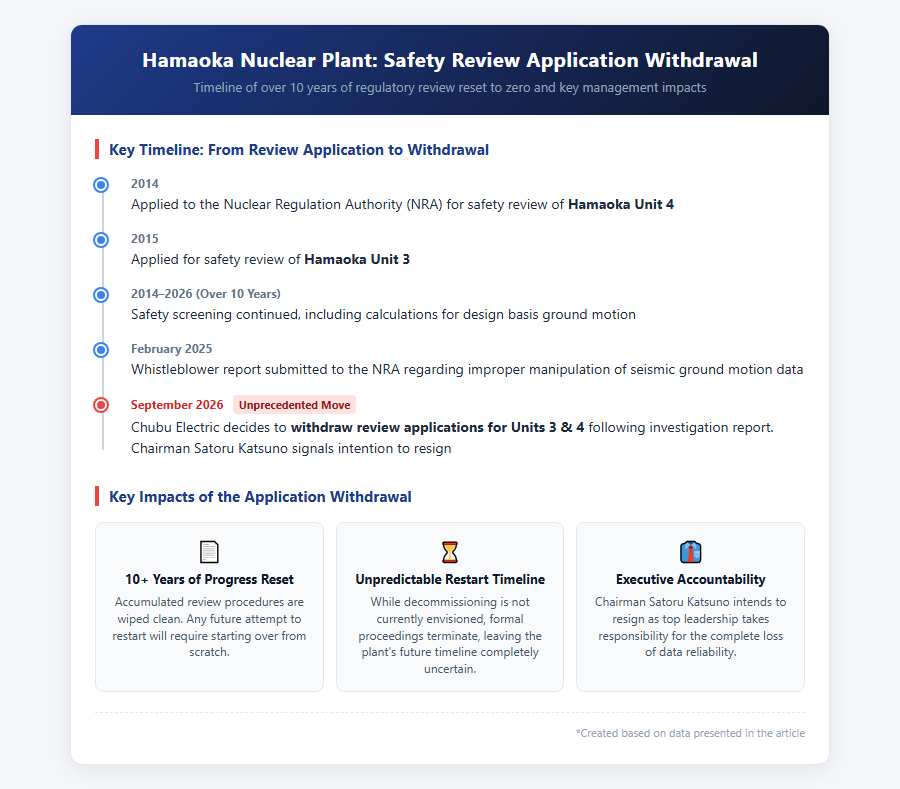
Chubu Electric Power finalized its decision in September 2026 to withdraw its application for the new safety standards compliance review for Units 3 and 4 of the Hamaoka Nuclear Power Station in Omaezaki, Shizuoka Prefecture. In light of executive responsibility for a series of fraudulent data practices, Chairman Satoru Katsuno has expressed his intention to resign to those around him. Chubu Electric Power originally applied for the safety review for Unit 4 in 2014 and Unit 3 in 2015 to the Nuclear Regulation Authority (NRA), with the screening continuing for over ten years. However, because the fundamental reliability of the seismic design data was severely compromised, the company had no choice but to conclude that continuing the review was impossible. If officially executed, a utility withdrawing a restart review application represents an extremely unprecedented situation. According to sources within Chubu Electric Power, while decommissioning Units 3 and 4 is not currently envisioned, the formal application procedures will be terminated. Even if the company seeks to restart the reactors in the future by reapplying, the extensive track record built over a decade of review will essentially be wiped clean, leaving the timeline for restarting the Hamaoka plant completely unpredictable. Please refer to the figure below.
The Reality of Data Manipulation in Seismic Ground Motion Calculations
The direct cause behind the withdrawal of the review application was misconduct in the process of formulating the “design basis ground motion,” which serves as the foundation for seismic design. In February 2025, a whistleblower report was submitted to the Nuclear Regulation Agency under the Nuclear Facility Safety Information Reporting System, alleging that intentional data manipulation differing from explanations given at review meetings was taking place. Subsequent investigations revealed that arbitrary data selection had been performed during ground motion evaluations using fault models (specifically the statistical Green’s function method). Specifically, prior to 2018, a method (Method 1) was employed to selectively choose favorable ground motion sets that yielded smaller values from among numerous generated sets. From 2018 onward, another method (Method 2) was applied, where a representative wave yielding intentionally smaller evaluation results was selected from thousands of analysis pairs, and the remaining 19 waves were artificially adjusted to match it. Consequently, it is suspected that ground motion from active faults significantly affecting the site was deliberately underestimated. The reliability of all 45 formulated design basis ground motion wave sets has been completely lost, drawing severe criticism from the NRA for abandoning the primary responsibility of ensuring nuclear safety. Chubu Electric Power established an independent investigation committee composed of external lawyers, receiving the final investigation report on September 11, 2026.
Financial Blow to Management and a Chain of Misconduct
Accumulation of Massive Maintenance Costs and Loss of Revenue Opportunities
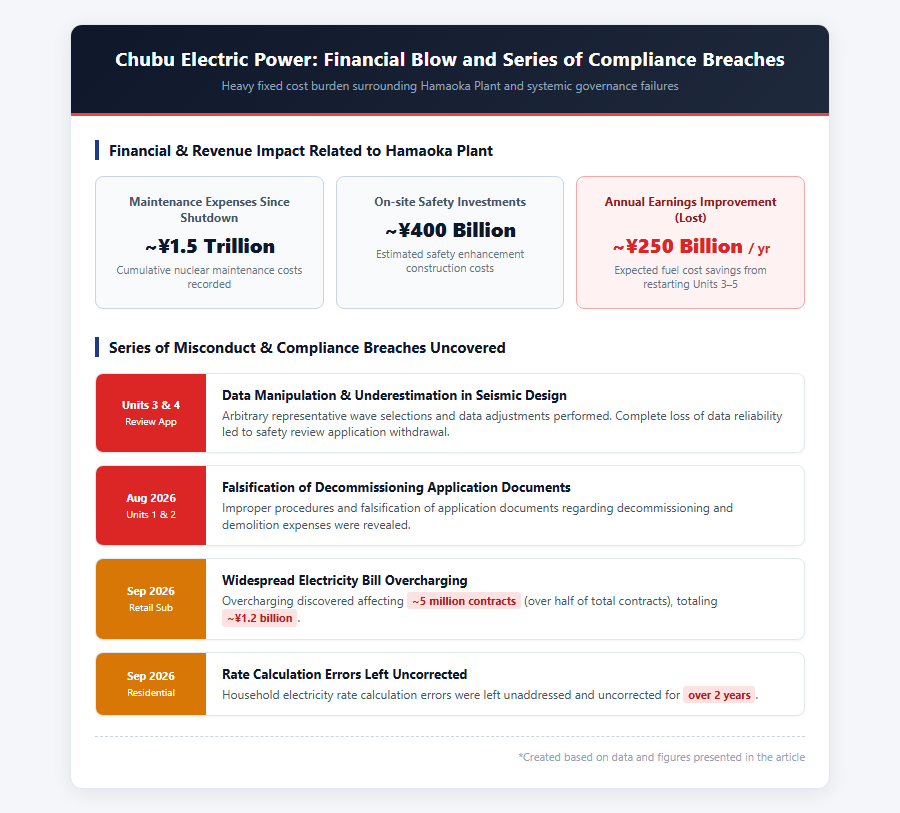
The withdrawal of the restart review application deals a severe blow to Chubu Electric Power’s management and financial standing. The Hamaoka Nuclear Power Station has remained offline since all reactors were shut down in 2011, during which the company has incurred a cumulative total of approximately 1.5 trillion yen in nuclear power maintenance expenses. Furthermore, Chubu Electric Power has spent an estimated 400 billion yen on safety enhancement construction within the site to comply with new regulatory standards. According to the company’s estimates, if all reactors from Units 3 to 5 were restarted, an annual earnings improvement of approximately 250 billion yen was expected, primarily driven by reduced fossil fuel costs. However, with this application withdrawal, this revenue enhancement opportunity has effectively evaporated. In its midterm management plan outline released in April 2026, Chubu Electric Power had already adopted a policy excluding the financial benefits of Hamaoka’s restart; nevertheless, the structural burden of ongoing fixed costs continues to weigh heavily on its balance sheet. Additionally, the company recently decided to pull out of offshore wind power projects across three domestic sea areas aimed at decarbonization, placing it in a precarious position regarding both core revenue strengthening and future growth strategies.
Governance Failures and a Series of Compliance Violations
Beyond the data fraud at the Hamaoka plant, a series of scandals demonstrating systemic governance failures have come to light across Chubu Electric Power. In August 2026, it was revealed that application documents regarding decommissioning expenses for Hamaoka Units 1 and 2—which are currently undergoing decommissioning—had been falsified due to improper procedures. Furthermore, in early September 2026, the company disclosed that its retail sales subsidiary had overcharged customers on electricity bills, affecting approximately 5 million contracts—more than half of its total contracts—amounting to approximately 1.2 billion yen. It was also revealed that errors in calculating household electricity rates had been left uncorrected and unaddressed for over two years. Experts point out that intense market competition following power market deregulation, combined with the heavy pressure of maintaining non-operating nuclear plants, created an environment that pushed field personnel to rush restarts and cost-cutting, fueling this chain of misconduct. These repeated compliance breaches have severely damaged public trust among local residents and society, necessitating a fundamental overhaul of corporate culture and governance. Please refer to the figure below.
Impact on National Energy Policy and Future Focus Areas
Dark Clouds Over the 2040 Nuclear Power Target
Chubu Electric Power’s withdrawal of its review application extends beyond corporate management issues, casting a shadow over Japan’s broader national energy strategy. In the 7th Strategic Energy Plan approved by the Cabinet, the government set a target to increase the share of nuclear power in the total energy mix to around 20% by fiscal 2040, up from less than 10% currently. With domestic electricity demand rising rapidly due to the proliferation of artificial intelligence and the expansion of data centers, restarting nuclear power plants as baseload power sources has been considered a cornerstone of the government’s decarbonization and energy security strategies. However, only 15 reactors are currently operational nationwide. With the restart of the Hamaoka plant (Units 3, 4, and 5)—a massive power source intended to supply the Kanto and Chubu industrial regions—now completely stalled, experts note that achieving the 2040 target of 20% nuclear power has become extraordinarily difficult. Other electric utilities are also facing prolonged compliance reviews and delays in securing local consent, making this unprecedented withdrawal a major turning point forcing a reconsideration of national energy security strategy.
Key Focus Points of the Press Conference and Challenges to Restoring Trust
The immediate point of focus is the detailed content of the investigation report to be published by Chubu Electric Power and how executive management will take responsibility. On September 14, 2026, President Kingo Hayashi and other executives are scheduled to hold a press conference in Nagoya to present the findings of the investigation report and outline future management actions. The central focus will be the extent to which the company discloses detailed motives, organizational involvement, and executive disciplinary measures or resignations. The Nuclear Regulation Authority intends to fully uncover facts and investigate root causes through reporting orders under the Reactor Regulation Act and nuclear regulatory inspections. For Chubu Electric Power, which compromised the very data required to verify safety, thorough cause-and-effect analysis, robust measures to prevent recurrence, and effective organizational reform are indispensable steps. The path to recovering lost social trust will be arduous, and the company’s commitment to restructuring its management system and ensuring transparency will be rigorously tested going forward.
Reference Pages
- 【Receipt of Investigation Report Regarding Inappropriate Misconduct in Formulating Design Basis Ground Motion in Safety Review for Hamaoka Nuclear Power Station】https://www.chuden.co.jp/publicity/press/1218304_3273.html
- 【Document 1: Future Actions Against Misconduct by Chubu Electric Power Co., Inc. – 51st Nuclear Regulation Authority Meeting (January 14, 2026)】https://www.da.nra.go.jp/detail/NRA100015153
【#ChubuElectricPower #HamaokaNuclearPlant #SafetyReview #DataFraud #EnergyPolicy #CorporateGovernance】
コメント