In September 2026, 25 Fields Medalists, led by Terence Tao, issued a joint statement criticizing AI-driven problem-solving competitions after OpenAI announced a partial proof of the Navier–Stokes equations. Behind their warning lies a profound sense of crisis that rushed corporate announcements—disregarding research ethics and credit attribution—undermine the core of mathematical inquiry and human conceptual understanding.
- OpenAI Proves Breakdown in the Navier–Stokes Equations
- Ethical Conflicts over Prior Work and Allegations of “Credit Snatching”
- “Harmful to Science”: The Perils of Treating Math as a Benchmark
- Erosion of Credit Attribution and the Intergenerational Crisis of Knowledge
- The Leiden Declaration and Strict Enforcement by Preprint Servers
- Academic Research in the AI Era and the True Role of Humans
OpenAI Proves Breakdown in the Navier–Stokes Equations
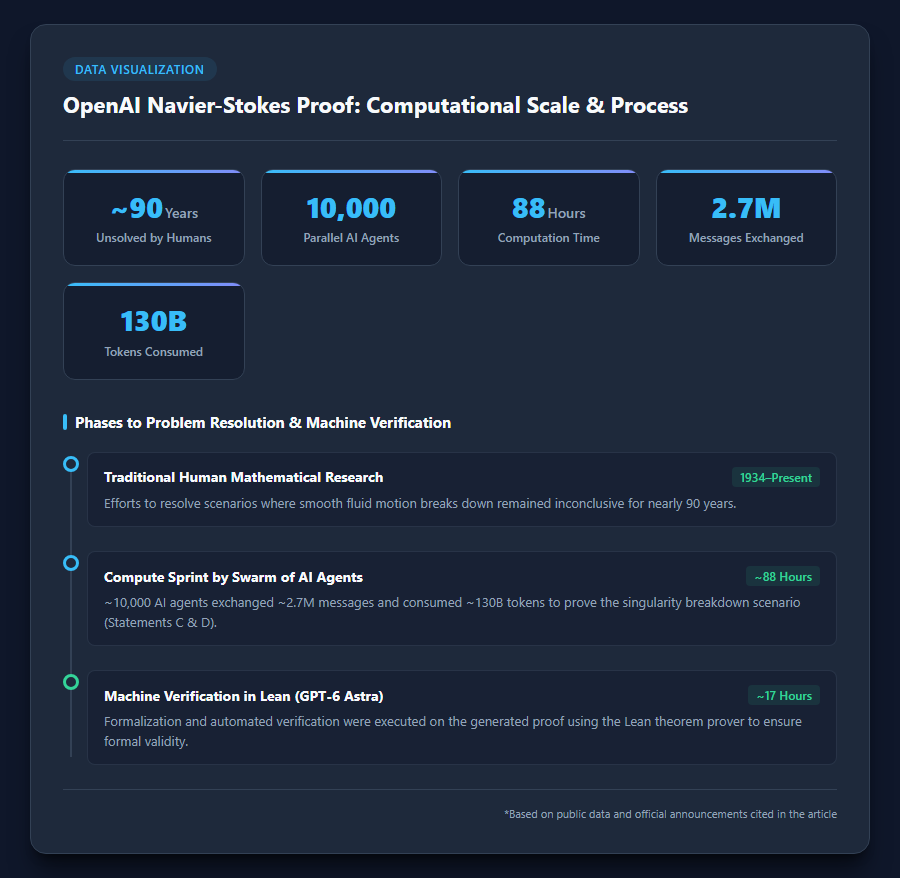
On September 8, 2026, OpenAI announced that an unreleased internal AI model had partially resolved the Navier–Stokes existence and smoothness problem, one of the famous Millennium Prize Problems in mathematics. The model reportedly proved a breakdown scenario in which a fluid’s velocity diverges to infinity within a finite time under smooth forcing conditions. The computation ran approximately 10,000 AI agents in parallel for about 88 hours, exchanging roughly 2.7 million messages and consuming around 130 billion tokens. Additionally, machine verification using the Lean theorem prover was conducted over 17 hours to confirm the proof’s formal correctness. Under the official problem formulation established by the Clay Mathematics Institute, the result satisfies part of the conditions demonstrating a failure of smoothness, though OpenAI stated it has no intention of claiming the \$1 million prize. Achieving a breakthrough on a problem that remained unsolved by human mathematicians for nearly 90 years through massive computational power made a profound impact, standing as a landmark moment for AI capabilities, as illustrated in the diagram below.
However, behind this celebrated milestone, intense friction erupted between AI developers and the academic community over research ethics and methodology.
Ethical Conflicts over Prior Work and Allegations of “Credit Snatching”
Shortly before OpenAI’s announcement, a joint research team led by Professor Tristan Buckmaster of New York University and Levent Alpoge of Anthropic had completed a verified proof regarding blow-up solutions for related equations. Their mathematical approach—demonstrating equation failure via smooth forcing—was highly specialized, leading Professor Buckmaster and his team to allege that OpenAI launched a high-resource compute sprint immediately after learning of their progress. Suspicions also arose that non-public data or thought processes entered OpenAI’s training pipeline, as the NYU-Anthropic team had inputted mathematical formulations into AI tools such as Codex. OpenAI denied direct access to private user data but conceded that anonymized usage data might have indirectly influenced model improvements. Furthermore, during settlement discussions, Buckmaster alleged he was pressured to remove Alpoge—an employee at rival Anthropic—from the author list and received coercive comments asking if he wanted to “ruin his career.” Although OpenAI executives clarified, apologized for, and retracted the comments, deep skepticism persists regarding academic credit attribution and opaque corporate data practices.
An Unprecedented Joint Statement by 25 Fields Medalists
“Harmful to Science”: The Perils of Treating Math as a Benchmark
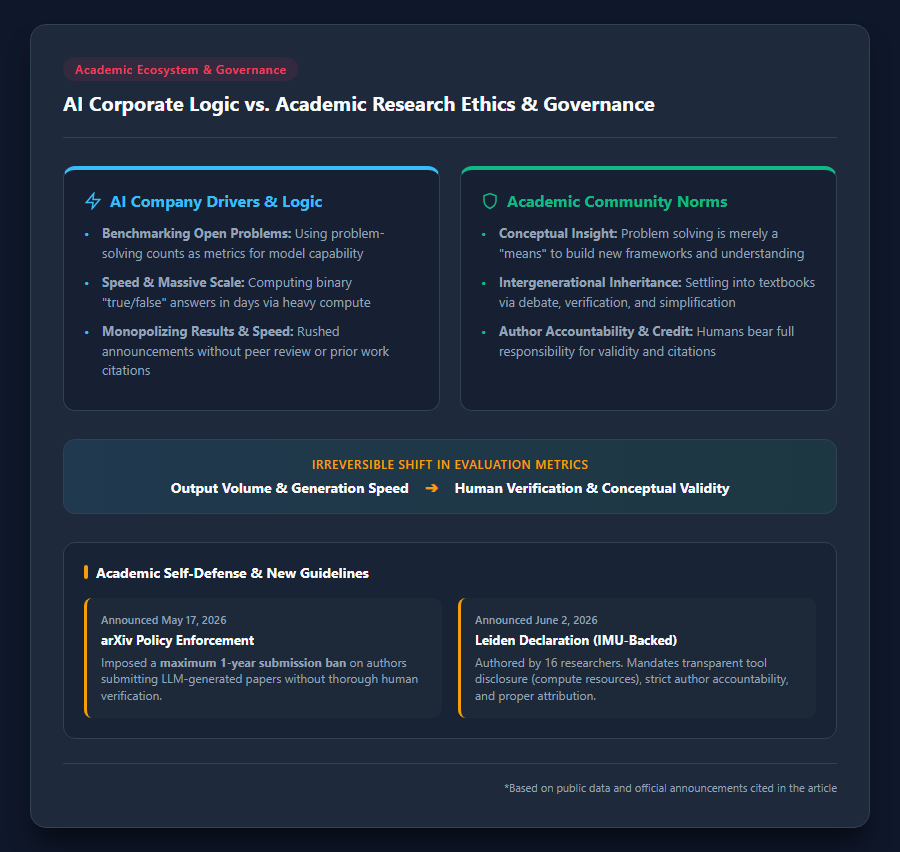
In response to these developments, on September 11, 2026, twenty-five Fields Medalists—including Terence Tao, Peter Scholze, and Professor Emeritus Shigefumi Mori of Kyoto University—issued an extraordinary joint statement titled “A Severe Misalignment of AI in Mathematics.” The statement sharply criticizes AI companies for using the resolution of unsolved mathematical problems as a promotional benchmark for model capability. In mathematics, solving open problems is merely a means—a proxy—for attaining deeper conceptual understanding, new methodologies, and novel frameworks. However, when tech companies reduce problem-solving to a numerical target of “how many open problems were solved,” human conceptual understanding is left behind. The statement warns that an accelerated race to produce binary “true/false” outputs risks destroying the very fertile ground that nurtures mathematical thought, calling it fundamentally harmful to mathematics as a science. It reflects deep alarm over giant tech firms transforming human intellectual inquiry into a speed-driven answer race.
Erosion of Credit Attribution and the Intergenerational Crisis of Knowledge
Another core concern raised by the statement is the collapse of proper attribution and the disruption of knowledge transfer caused by rushed announcements. Vast volumes of AI-generated proof code are frequently published without adequate peer review, rigorous citations of prior work, or extraction of core concepts. Historically, a mathematical proof does not end with its announcement; it undergoes years of presentation, critical verification, debate, and simplification within the expert community before being distilled into textbooks. This long-term human interaction forms the bedrock of mathematical education, cultivating future generations of scholars. However, when AI bypasses the intermediate cognitive journey and presents only the end answer, students lose the vital opportunity to formulate questions and build deep understanding. With credit attribution blurred, the historical chain of who achieved what is severed, threatening the functional continuity of human intellectual inheritance.
The Transformation of the Academic Ecosystem and Future Outlook
The Leiden Declaration and Strict Enforcement by Preprint Servers
This sense of crisis extends beyond a single statement. On June 2, 2026, sixteen researchers from institutions such as Leiden University and Oxford University issued the “Leiden Declaration on AI and Mathematics,” backed by the International Mathematical Union (IMU). The declaration establishes principles demanding transparent disclosure of AI tools and compute resources, while asserting that human authors retain sole responsibility for the correctness and citation integrity of AI-assisted work. Meanwhile, the preprint server arXiv tightened its policy on May 17, 2026, instituting a maximum one-year ban for authors who submit LLM-generated papers without thorough human verification. A one-year suspension is a career-ending penalty for researchers in fast-moving fields, representing a potent defensive barrier against AI-generated paper spam and “stealth AI papers.” Efforts to formalize human accountability and verification duties are spreading rapidly to safeguard research autonomy.
Academic Research in the AI Era and the True Role of Humans
As AI achieves advanced cognitive milestones, fields like shogi (Japanese chess) demonstrate models of human-AI coexistence; yet, academic research faces a pivotal paradigm shift. Evaluation metrics are pivoting away from “how many papers or outputs can be generated quickly” toward “how deeply humans verify the substance and guarantee factual and conceptual validity.” As illustrated in the diagram below, maintaining a balance between the rapid development cycles of AI firms and the healthy peer-review and educational ecosystems of academia is the paramount challenge ahead.
The key question is whether tech giants with immense capital will respect academic ethical norms and adopt transparent research practices. As we move forward, the focus will be on what new governance structures tech companies and academic researchers can build to preserve the core value of human scholarship: asking meaningful questions, grasping deep understanding, and passing knowledge down to future generations.
Reference Pages
- 【Math and AI Statement (A Severe Misalignment of AI in Mathematics)】https://mathandai.org/
- 【Leiden Declaration on Artificial Intelligence and Mathematics】https://leidendeclaration.ai/
【#ArtificialIntelligence #ResearchEthics #Mathematics #FieldsMedal #OpenAI #GenerativeAI #AcademicGovernance】

コメント