To support sustainable wage increases at small and medium-sized enterprises (SMEs), the Ministry of Economy, Trade and Industry (METI) and the Small and Medium Enterprise Agency (SMEA) have designated March and September as “Price Negotiation Promotion Months,” stepping up efforts to encourage price pass-through. This initiative comes in response to significant delays in passing on labor costs compared to raw material and energy expenses, making fair transaction practices across entire supply chains an urgent priority.
- Objectives of Price Negotiation Promotion Months and the Latest Trends in 2026
- Tier Disparities in Supply Chains and the Polarization of Labor Cost Pass-Through
- Background Behind Record-High Enforcement Recommendations Under the Subcontract Act
- Structural Challenges: Why Passing On Labor Costs Lags Behind Raw Materials
- The Government’s 12 Action Rules and the Publication of the Buyer Target List
- Local Success Stories: Saitama Prefecture’s Hands-On Support for SMEs
- Outcomes of the 2025 Spring Wage Negotiations and the SME Wage Limit Debate
- Minimum Wage Hikes and Fair Profit Distribution Across Supply Chains
Objectives of Price Negotiation Promotion Months and the Latest Trends in 2026
To enable small and medium-sized enterprises (SMEs) to appropriately reflect rising raw material, energy, and labor costs in their transaction prices, the Small and Medium Enterprise Agency (SMEA) designates March and September each year as “Price Negotiation Promotion Months.” Coming one month prior to April and October, when many Japanese companies revise their prices, these promotional months serve as a period of concentrated public relations, training seminars, and follow-up surveys to foster an environment where businesses can more easily initiate price negotiations. According to a follow-up survey regarding the March 2026 Price Negotiation Promotion Month, the proportion of SMEs reporting that price negotiations took place rose by about 1 percentage point from the previous survey, surpassing 90%. Furthermore, over 70% of these companies engaged in price negotiations specifically concerning labor costs. However, many companies have been unable to convert these negotiations into actual price pass-through, resulting in a persistent polarization between businesses successfully passing on costs and those unable to do so. To preserve the financial resources secured for pay raises and achieve structural wage growth, it is increasingly crucial to provide support measures that transform formal negotiations into effective cost pass-through.
Tier Disparities in Supply Chains and the Polarization of Labor Cost Pass-Through
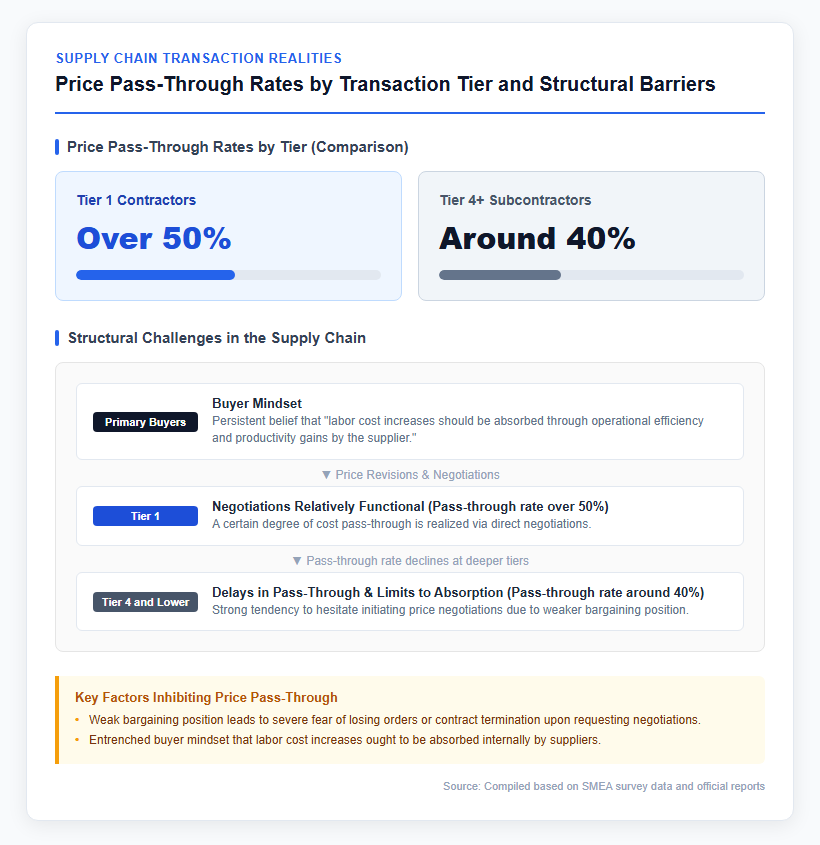
A deep-seated challenge in supply chain transaction structures is that passing on cost increases becomes progressively more difficult at deeper subcontracting tiers. According to SMEA surveys, while the price pass-through rate for Tier 1 contractors—who deal directly with primary buyers—exceeds 50%, the rate drops to around 40% for Tier 4 and lower sub-contractors. Although the gap in pass-through rates between Tier 1 contractors and Tier 4+ sub-contractors has shown signs of narrowing compared to the past, the structural problem wherein companies at deeper tiers cannot fully absorb cost increases remains unresolved. Subcontractors at deeper tiers often occupy weaker bargaining positions, making them hesitant to request price negotiations out of fear of losing orders or having their business contracts terminated. Moreover, buyer companies frequently retain the mindset that “labor cost increases should be absorbed through operational efficiency and productivity gains by the supplier,” posing a major hurdle to price pass-through for lower-tier suppliers. The diagram below illustrates the pass-through situation across different transaction tiers:
To ensure that price pass-through extends to companies at the deepest levels of the transaction hierarchy, optimizing business practices across the entire supply chain—rather than focusing solely on negotiations with Tier 1 suppliers—is essential.
Background Behind Record-High Enforcement Recommendations Under the Subcontract Act
The Japan Fair Trade Commission (JFTC) and the SMEA are strengthening monitoring and enforcement against unfair practices such as abusive price-buying (buying at unfairly low prices) and arbitrary reductions in subcontract payments. In fiscal year 2024, the JFTC issued 21 formal recommendations based on violations of the Subcontract Act. Combined with 3 cases of voluntary disclosures, the total reached 24 cases (an increase of 11 cases from the previous fiscal year), marking the highest number since public disclosure of company names began in 2004. Additionally, non-public guidance cases reached 8,230, highlighting the widespread prevalence of non-compliant practices. Violations subject to recommendations included unilateral cuts or reductions in subcontract payments and refusal to accept manufactured goods. The targeted entities spanned major corporations across diverse sectors, including electronics retailers, leading publishers, and food manufacturers. Reimbursements paid back to subcontractors following these recommendations and guidance totaled 1.35279 billion yen. The government has signaled a firm stance against severe violations, aiming to establish an environment where SMEs can confidently enter price negotiations through strict legal enforcement.
Strategic & Regulatory Context: Barriers to Passing On Labor Costs and Government Guidelines
Structural Challenges: Why Passing On Labor Costs Lags Behind Raw Materials
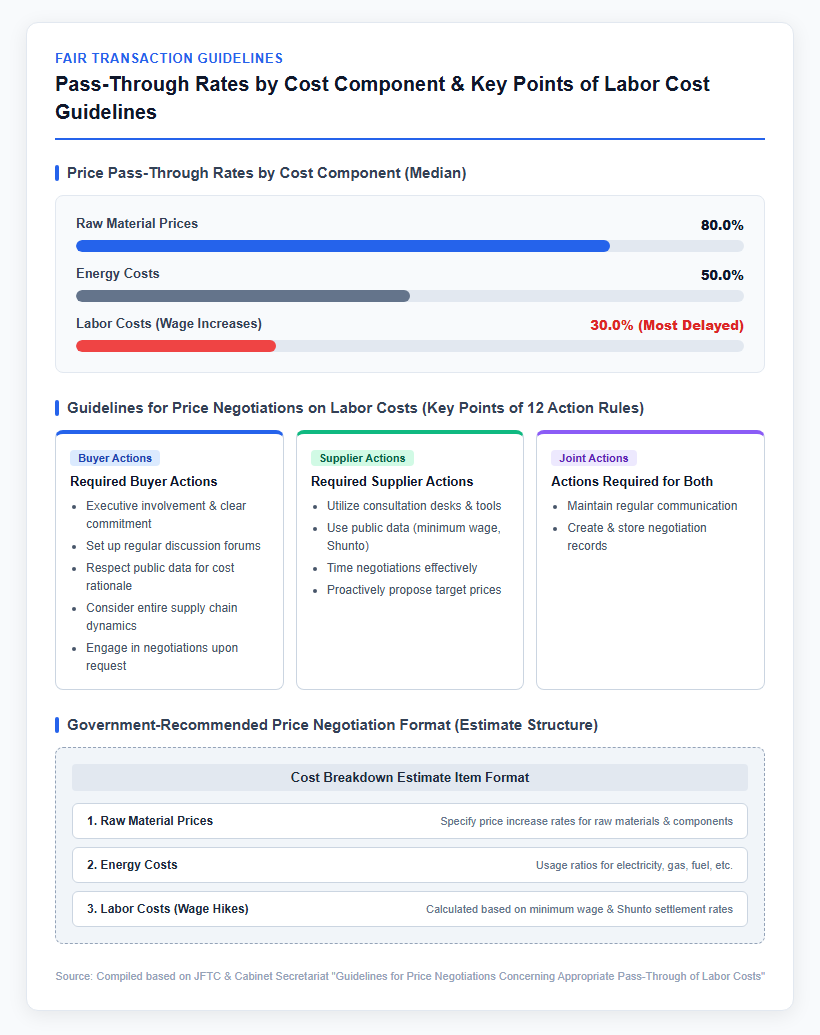
While corporate cost pressures stem from multiple components—including raw materials, energy, and labor—passing through labor cost increases has lagged behind the most. According to a special survey conducted by the JFTC, the median price pass-through rate by cost category stood at 80.0% for raw materials and 50.0% for energy, but only 30.0% for labor costs. This inability to reflect labor cost increases in transaction prices is especially pronounced in labor-intensive industries such as building maintenance, security services, IT services, technical services, and road freight transport. Unlike raw materials, which have objective market benchmark data, labor expenses are easily treated as internal fixed costs. Consequently, buyers frequently demand detailed cost structure breakdowns or individual wage records during negotiations. SME suppliers often strongly resist disclosing their internal cost structures and proprietary operational know-how, creating a vicious cycle where companies end up abandoning price negotiations altogether.
The Government’s 12 Action Rules and the Publication of the Buyer Target List
To overcome the barriers hindering appropriate labor cost pass-through, the Cabinet Secretariat and the JFTC jointly formulated the “Guidelines for Price Negotiations Concerning Appropriate Pass-Through of Labor Costs,” presenting 12 actionable rules for both buyers and suppliers. These guidelines require top management at buyer companies to establish and explicitly communicate policies accepting price pass-through internally and externally, set up regular discussion forums even without explicit supplier requests, and respect public data—such as minimum wage increases and spring wage negotiation (Shunto) settlement rates—when requesting supporting documentation. The image below shows a sample price negotiation form recommended by the government:
Furthermore, in January 2026, METI and the SMEA published a “Buyer Target List” compiled from the September 2025 follow-up survey. The list covers 522 buyer companies and 89 public sector agencies that were cited as primary business partners by 10 or more SME suppliers. For buyer companies demonstrating unsatisfactory performance in price negotiations or pass-through, the government is taking actionable steps, including issuing formal guidance and advice under the Minister’s name in accordance with the Act on the Promotion of Subcontracting Small and Medium Enterprises.
Local Success Stories: Saitama Prefecture’s Hands-On Support for SMEs
In addition to national policy frameworks, local governments are implementing unique support measures to boost SMEs’ bargaining power. Saitama Prefecture offers hands-on consulting by dispatching experts to local businesses struggling with rising energy and material prices, helping them master cost calculation techniques and negotiation tactics. The prefecture published the “Saitama Prefecture Price Pass-Through Success Casebook,” highlighting practical tips from supported companies. Notable examples include a logistics firm that successfully revised its freight rates for the first time in roughly 40 years—achieving a 30% rate increase with support from local administrative bodies—and a manufacturer that overhauled its management structure to focus on profitability by visualizing profit margins on a per-project basis. The casebook also highlights hair salons and restaurants that successfully raised prices by enhancing service value while gaining customer understanding. These regional initiatives demonstrate how price negotiations can serve not merely as a tool to pass on cost increases, but as an opportunity to strengthen overall corporate resilience.
Medium- to Long-Term Outlook: Key Factors in Achieving a Sustainable High-Wage Economy
Outcomes of the 2025 Spring Wage Negotiations and the SME Wage Limit Debate
In the Japanese labor market, realizing wage increases that outpace inflation is the top economic priority. According to data compiled by RENGO (Japanese Trade Union Confederation) for the 2025 Spring Wage Negotiations (Shunto), the overall average wage increase rate reached 5.32%, maintaining strong momentum following the 5.10% recorded in 2024 (which was the highest level in about 33 years). Labor unions at SMEs also achieved a notable 4.93% wage increase, reflecting meaningful progress. However, the wage gap between large corporations and SMEs remains substantial, with wage levels at small business establishments with fewer than 100 employees remaining below 70% of those at major enterprises. Furthermore, SMEs that have been continually raising wages defensively amidst prolonged cost pressures are increasingly expressing that “their capacity for further wage hikes has reached its limit,” raising concerns that future wage growth could stall. Because wage increases are essential for SMEs to recruit new talent and prevent turnover amid severe labor shortages, their very business survival is at risk if they cannot secure adequate profits through price pass-through.
Minimum Wage Hikes and Fair Profit Distribution Across Supply Chains
To support structural wage growth, the Japanese government has set an ambitious goal of raising the national weighted average minimum wage to 1,500 yen per hour during the 2020s. While higher minimum wages directly boost the incomes of workers at regional SMEs, they also present a severe financial challenge for small businesses struggling to maintain adequate earnings due to surging labor costs. Achieving this target requires an average annual increase of over 7% between FY2025 and FY2029. Analysts warn that without concurrent progress in price pass-through and labor productivity, this rapid pace could trigger job losses or business closures. Moving forward, it is essential for businesses to leverage government support for labor-saving automation investments and IT adoption to enhance operational efficiency. At the same time, establishing fair trade practices that equitably distribute value added across the entire supply chain—from large corporations down to sub-tier suppliers—is indispensable. Collaboration among government, labor, and management to balance seamless price pass-through with productivity gains holds the key to establishing a virtuous economic cycle across Japan.
Reference Pages
- [Price Negotiation Promotion Month – Announcements | METI SMEA Fair Transaction Support Site] https://tekitorisupport.go.jp/
- [Implementation of Price Negotiation Promotion Month and Follow-up Survey Results | Small and Medium Enterprise Agency] https://www.chusho.meti.go.jp/keiei/torihiki/follow-up/index.html
- [Guidelines for Price Negotiations Concerning Appropriate Pass-Through of Labor Costs | Japan Fair Trade Commission] https://www.jftc.go.jp/dk/guideline/unyoukijun/romuhitenka.html
- [Saitama Prefecture Price Pass-Through Success Casebook | Saitama Prefecture] https://www.pref.saitama.lg.jp/a0801/kakakutenka-bansougatashien.html#jireisyuu
【#SME #PricePassThrough #PriceNegotiationMonth #WageHikes #JFTC #SubcontractAct #FairTransactions #Economy】

コメント