Oracle reported strong Q1 FY2027 financial results, sending its stock surging. The rally was driven by surging demand for AI cloud infrastructure and sustained revenue acceleration.
- Key Event Highlights: Q1 FY2027 Results and Stock Surge
- OCI’s Explosive Growth and High Utilization Outpacing Competitors
- Architectural Design as a Second-Generation Cloud
- Ultra-Fast RDMA Networks and Large-Scale GPU Clusters
- FY2027 Financing Plans and Capital Balance
- Future Outlook and Key Factors for Investors to Watch
Key Event Highlights: Q1 FY2027 Results and Stock Surge
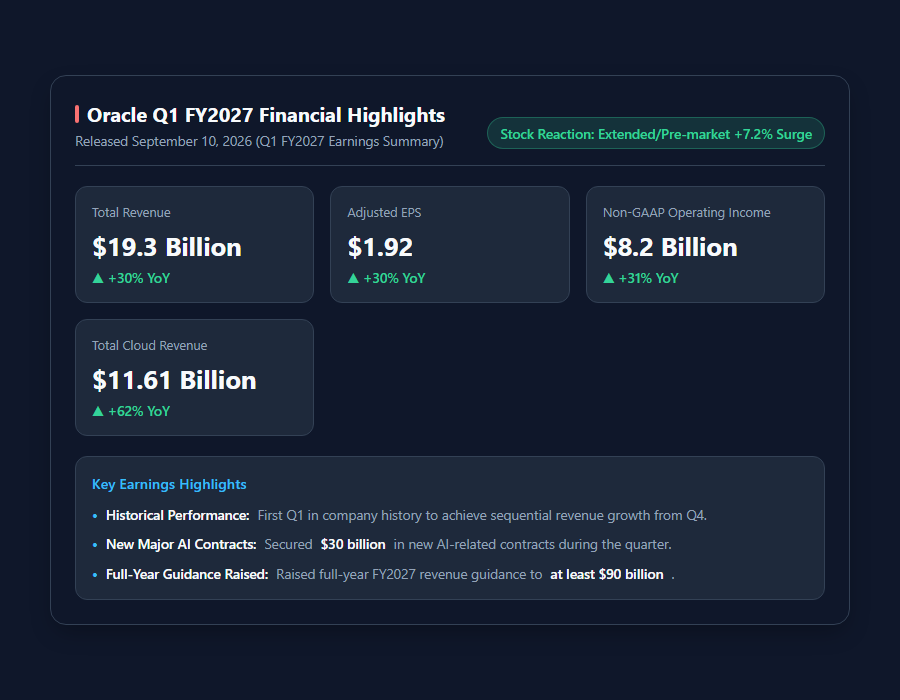
Oracle reported its Q1 FY2027 financial results on September 10, 2026, delivering top- and bottom-line figures that surpassed market expectations. Total revenue surged 30% year-over-year to \$19.3 billion, marking the first time in company history that first-quarter revenue grew sequentially from the fourth quarter. Adjusted earnings per share (EPS) climbed 30% to \$1.92, while non-GAAP operating income rose 31% to \$8.2 billion. Driven by these strong results, Oracle’s stock jumped 7.2% in extended and pre-market trading. Key drivers behind the stock rally included:
-
Total cloud revenue expanding 62% year-over-year to \$11.61 billion
-
Full-year revenue guidance being revised upward to at least \$90 billion
-
Securing \$30 billion in new major AI-related contracts
Amid broader market concerns over rising interest rates and macroeconomic uncertainty, investors highly valued the robust growth momentum of Oracle’s cloud business. Please refer to the figure below.
OCI’s Explosive Growth and High Utilization Outpacing Competitors
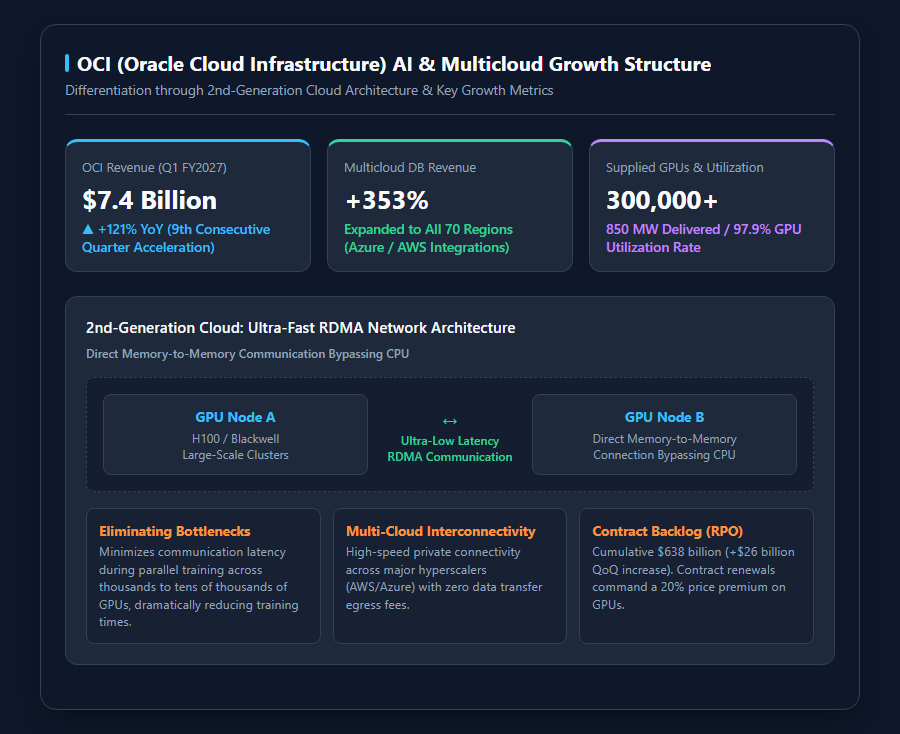
The primary growth engine for this performance expansion was the Oracle Cloud Infrastructure (OCI) segment. In Q1 FY2027, OCI revenue skyrocketed 121% year-over-year to \$7.4 billion, marking the ninth consecutive quarter of accelerating growth. This growth rate significantly outpaced major hyperscale competitors. During the quarter, Oracle delivered 850 megawatts of AI capacity—including over 300,000 GPUs—maintaining an exceptionally high GPU utilization rate of 97.9%.
-
The Abilene, Texas facility supplied 131,000 GPUs, contributing significantly to the training of state-of-the-art AI models
-
Contract renewals commanded a 20% price premium, underscoring robust underlying demand
-
Remaining Performance Obligations (RPO), indicating future contracted revenue, grew by \$26 billion from the previous quarter to reach a cumulative \$638 billion
By utilizing prepaid contracts and customer-provided hardware models, Oracle is expanding its infrastructure efficiently.
Technical Background Behind OCI Becoming the Platform of Choice in the Generative AI Era
Architectural Design as a Second-Generation Cloud
The core reason AI enterprises choose Oracle Cloud Infrastructure (OCI) is that it was engineered from the ground up as a “second-generation cloud” specifically optimized for generative AI and high-performance computing (HPC). While first-generation clouds were designed primarily to rent general-purpose servers, OCI was built around the core philosophy of efficiently operating tens of thousands of GPUs in parallel.
-
Proprietary network design eliminates communication bottlenecks between nodes
-
Deep partnership with NVIDIA secured massive allocations of cutting-edge GPUs, including H100 and Blackwell architectures
-
OCI was selected as a critical execution foundation for NVIDIA’s DGX Cloud
Compared to competing clouds, AI startups favor OCI because identical GPU configurations yield faster training speeds alongside predictable computing costs.
Ultra-Fast RDMA Networks and Large-Scale GPU Clusters
In AI training environments operating thousands to tens of thousands of GPUs simultaneously, reducing network latency is critical. OCI adopts Remote Direct Memory Access (RDMA) technology as a standard feature, enabling direct, high-speed memory-to-memory communication without passing through the CPU. This successfully addresses data traffic explosions associated with scaling model sizes and dramatically reduces training times. Additionally, multi-cloud integration serves as a key technical strength.
-
Reached 70 multi-cloud database regions across Microsoft Azure and AWS integrations
-
Provided high-speed inter-hyperscaler connectivity without data transfer egress fees
-
Multi-cloud database revenue recorded explosive growth, rising 353% year-over-year
In addition to building out its own data centers, Oracle’s flexibility in integrating with diverse cloud environments is highly regarded by the market. Please refer to the figure below.
Massive Capital Expenditure, Financing, and Risk Factors
FY2027 Financing Plans and Capital Balance
To meet rapidly expanding AI cloud demand, Oracle is executing massive capital expenditures (CapEx). For fiscal year 2027, CapEx is projected to reach \$90 billion to \$95 billion, with net cash CapEx estimated at up to \$70 billion. To support this scale of investment, the company is advancing the following financing and financial strategies:
-
Announced plans to raise approximately \$40 billion through a combination of debt and equity issuances in FY2027
-
Completed a \$20 billion At-The-Market (ATM) equity offering program during Q1
-
Indicated no additional debt issuances are anticipated for the remainder of calendar year 2026
With total liabilities expanding to \$218.7 billion alongside rapid capital deployment, financial management toward positive free cash flow remains closely watched by equity markets.
Future Outlook and Key Factors for Investors to Watch
Looking ahead, key operational focal points include overcoming technical bottlenecks in data center construction and accelerating revenue conversion. Deploying direct liquid cooling systems capable of supporting 100kW+ high-density racks and installing 500kV-class substations involve procurement lead times of up to 24 months. However, management expressed confidence in achieving FY2027 performance targets through a diversified supply chain approach. Key points for investors to monitor going forward include:
-
Whether the massive \$638 billion RPO converts into recognized revenue as scheduled
-
Whether non-GAAP operating margins can be maintained at the 42% level as data centers progressively come online
-
Potential impacts from the European Union’s preliminary scrutiny into software licensing practices
As AI infrastructure demand continues unabated, how effectively Oracle converts its record backlog into profitable revenue will dictate its future corporate value.
Reference Pages
-
【Oracle 10-Q filing】https://www.sec.gov/Archives/edgar/data/1341439/000134143925000012/orcl-20250430.htm
-
【Oracle Investor Relations Financials】https://www.oracle.com/investor-relations/financials/earnings/
[#Oracle #AICloud #OCI #EarningsAnalysis #CloudInfrastructure #GPU]


コメント