The Ministry of Health, Labour and Welfare has set a new target to achieve nearly 100% electronic health record (EHR) adoption across medical institutions nationwide by FY2030. By encouraging a shift from traditional on-premise systems to cloud-native standardized EHRs, the government aims to establish a unified national infrastructure for sharing medical information.
- Overview of the 2030 Target and the Push for Cloud-Based EHR Systems
- Structural Challenges and Adoption Barriers of Legacy On-Premise Systems
- HL7 FHIR Compliance and Cloud-Native Infrastructure Architecture
- Development and Rollout Schedule for Non-Bed Clinics and Hospitals
- Policy Incentives and Financial Subsidies Driving Adoption
- Benefits of Inter-Facility Information Sharing and Patient Experience Transformation
- Cybersecurity Safeguards and Operational Integration Outlook
Overview of the 2030 Target and the Push for Cloud-Based EHR Systems
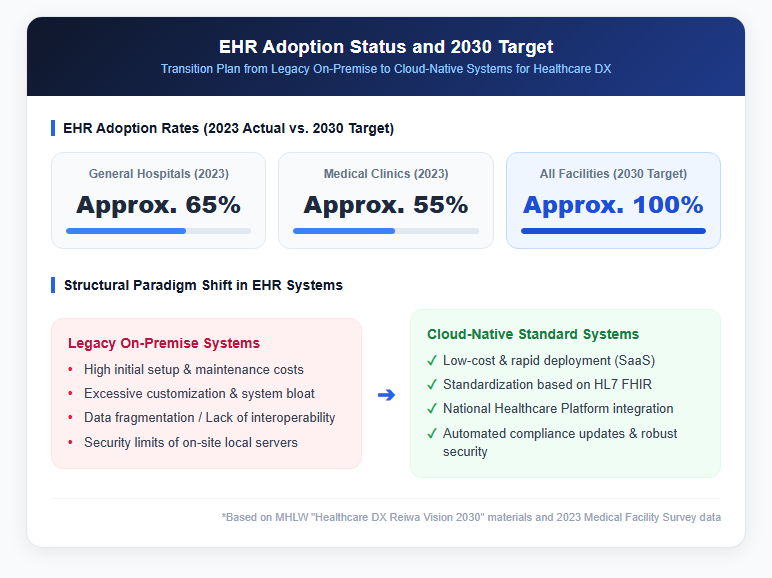
In July 2025, Japan’s Ministry of Health, Labour and Welfare (MHLW) presented a new target and roadmap at a promotion team meeting, aiming to achieve full adoption of electronic health records (EHRs) and electronic prescriptions across all healthcare facilities by FY2030 at the latest. Under the Act on Securing Comprehensive Medical and Long-term Care in Communities, reaching nearly 100% adoption by December 31, 2030, is designated as a key national milestone within Japan’s broader Healthcare DX strategy. According to the 2023 Medical Facility Survey, EHR adoption stood at approximately 65% for general hospitals and 55% for medical clinics, meaning nearly half of all facilities had yet to digitize. Key obstacles to adoption included high initial setup and maintenance costs, technical anxieties among staff, and system bloat caused by excessive customization. To overcome these hurdles, the government is driving a comprehensive transition from legacy on-premise systems—which require dedicated in-house servers—to cloud-native standardized EHRs that can be deployed quickly and cost-effectively via the internet. Backed by both regulatory reforms and financial incentives, the state is establishing a robust framework for nationwide implementation. Please refer to the conceptual diagram below.
Structural Challenges and Adoption Barriers of Legacy On-Premise Systems
On-premise EHR systems traditionally used by hospitals and clinics were heavily customized to meet individual facility preferences. Consequently, systems from different vendors lacked interoperability, preventing seamless data transfer when patients changed hospitals and creating vendor lock-in. Furthermore, maintaining dedicated local servers required initial investments ranging from millions to tens of millions of yen, alongside substantial recurring fees during system refreshes every few years. For small to medium-sized hospitals with under 200 beds and non-bed medical clinics lacking capital and IT personnel, these financial and operational burdens posed severe barriers to abandoning paper charts. In addition, growing cyber threats in recent years have exposed the extreme difficulty smaller facilities face in implementing adequate cybersecurity and business continuity plans (BCP) on their own.
Technical Specifications and Roadmap for Standardized EHRs
HL7 FHIR Compliance and Cloud-Native Infrastructure Architecture
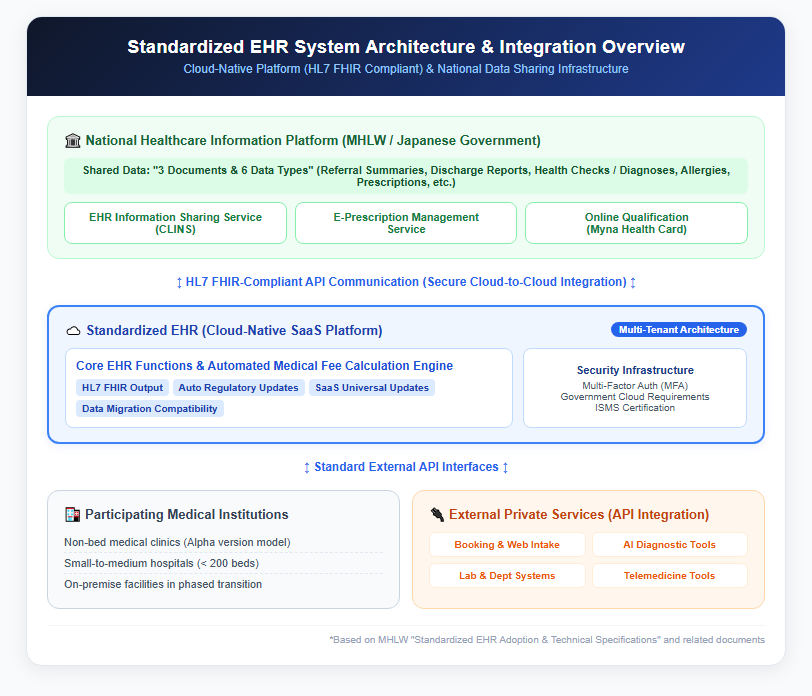
The government-led Standardized Electronic Health Record system is built upon the international HL7 FHIR standard. Compliance with HL7 FHIR ensures that diverse vendor systems can securely exchange core patient data—specifically “3 Documents and 6 Data Types” (medical information summaries, discharge summaries, health checkup reports, alongside diagnoses, allergies, prescriptions, and lab results)—via the National Healthcare Information Platform. Systemically, it operates as a SaaS multi-tenant cloud model, allowing multiple facilities to share a single platform. This architecture drastically lowers costs compared to traditional on-premise setups and allows regulatory updates to be deployed automatically in the cloud. The Digital Agency has formally commissioned cloud infrastructure specialist FIXER Inc. to develop the platform. Equipped with standardized APIs, the platform offers high scalability for integration with third-party tools such as online booking systems and AI diagnostic aids. Please refer to the system architecture diagram below.
Development and Rollout Schedule for Non-Bed Clinics and Hospitals
According to the MHLW roadmap, a model trial for the alpha version of the standardized EHR for non-bed medical clinics commenced in March 2025. Following operational feedback, full specification finalizing and commercial release are scheduled for FY2026. Non-digitized clinics will be encouraged to adopt this standardized EHR, while facilities already using on-premise systems will be guided toward cloud-native upgrades during their next contract renewals. For hospitals, the government plans to release standard cloud specifications by FY2025, enabling private vendors to begin compliant product development in FY2026. A comprehensive adoption plan for EHRs and data-sharing services will be finalized by summer 2026. Target milestones include deploying cloud-standard systems in hospitals with 200 or more beds (excluding long-term care beds) by FY2028, and establishing an environment where all requesting hospitals can adopt cloud-native systems by 2030.
Policy Incentives and Financial Subsidies Driving Adoption
To accelerate the adoption of standardized EHRs, the government is combining policy incentives with direct financial subsidies. Under the FY2026 medical fee revision, the reimbursement structure was revamped to introduce the Electronic Medical Information Sharing System Addition to initial and follow-up consultation fees. This new scheme rewards facilities that implement both the Electronic Health Record Information Sharing Service (CLINS) and electronic prescriptions, creating a clear financial divergence between digitized facilities and those remaining on paper. On the funding side, the MHLW’s FY2027 budget requests include dedicated support measures, such as covering up to half the implementation costs for certified cloud-native EHRs. Furthermore, medical corporations and small practices can leverage broader digital transformation and AI integration grants, significantly lowering initial capital requirements and encouraging reluctant providers to digitize.
Societal Impact and Future Challenges of Healthcare DX
Benefits of Inter-Facility Information Sharing and Patient Experience Transformation
Universal standardization and nationwide sharing of EHRs promise to transform Japanese clinical practice and patient experiences. Instant access to historical prescriptions, test results, and allergy records across different care settings prevents duplicate testing and inappropriate prescribing, mitigating adverse drug reaction risks. In emergency care or natural disasters, physicians can quickly access accurate medical histories to administer appropriate life-saving care, even if patients are unable to articulate their medical backgrounds. For patients, this eliminates the hassle of repeatedly explaining past medical histories at new clinics and empowers individuals to track their health metrics via the Myna Portal. For healthcare professionals, automated documentation and data entry reduce administrative workloads, freeing up time for direct patient care and driving work-style reforms across the healthcare sector.
Cybersecurity Safeguards and Operational Integration Outlook
Achieving 100% EHR adoption and cloud migration requires robust cybersecurity and smooth operational integration. In response to rising ransomware threats targeting healthcare facilities, government certification standards mandate cloud environments such as Government Cloud, multi-factor authentication (MFA), and ISMS certification. While cloud migration mitigates individual facility security vulnerabilities, establishing backup systems and business continuity plans (BCP) for potential widespread network outages remains essential. Furthermore, comprehensive training and technical support for elderly physicians and staff unfamiliar with IT interfaces are critical to success. Beyond software replacement, workflow optimization and user-friendly interface design will be essential to building an effective digital healthcare infrastructure by 2030.
References
- [Healthcare DX Initiatives | Ministry of Health, Labour and Welfare] https://www.mhlw.go.jp/stf/iryoudx.html
- [Standard Specifications for Electronic Health Records and Claims Computers (Basic Requirements) | Ministry of Health, Labour and Welfare] https://www.mhlw.go.jp/stf/seisakunitsuite/bunya/kenkou_iryou/iryou/johoka/standardspec.html
- [Progress on Electronic Health Record Adoption (March 12, 2026) | Ministry of Health, Labour and Welfare] https://www.mhlw.go.jp/content/10808000/001657580.pdf
【#HealthcareDX #StandardizedEHR #MHLW #CloudEHR #EPrescription #MedicalFeeRevision #HealthcareIT】


コメント