On the morning of September 12, 2026, a Japan Coast Guard helicopter crew member participating in a rescue operation off Ishigaki Island, Okinawa Prefecture, sustained fractured ribs after making contact with a rocky outcrop while suspended from a hoist cable. The Ministry of Land, Infrastructure, Transport and Tourism officially designated the incident as an aviation accident, prompting the Japan Transport Safety Board to launch a specialized investigation to determine the cause.
- Rocky Outcrop Contact and Crew Injury During Rescue Operation
- Aviation Accident Designation and Investigation Team Assignment
- Challenges of Hovering and Hoisting Operations in Rescue Missions
- JTSB Analysis of Helicopter Accident Factors and Trends
- On-Site Work Environment Improvements (“Kaizen”) and Human Factor Mitigations
- Investigation Outlook and Implications for Rescue Operations
Rocky Outcrop Contact and Crew Injury During Rescue Operation
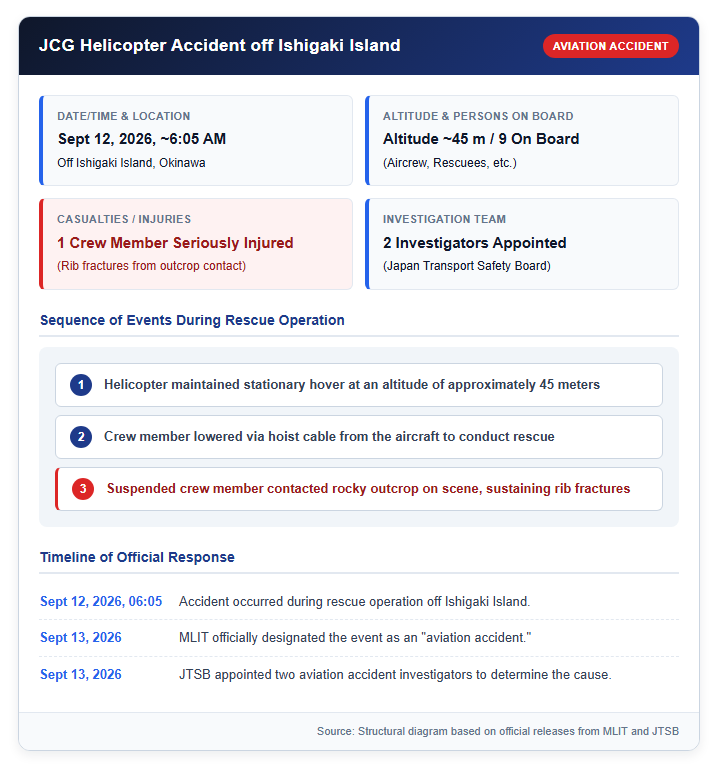
At approximately 6:05 AM on September 12, 2026, a serious accident occurred during a rescue operation conducted by a Japan Coast Guard (JCG) helicopter off Ishigaki Island, Okinawa Prefecture. At the time of the incident, the helicopter was hovering at an altitude of approximately 45 meters with nine individuals on board, including operational crew members and rescuees. During the operation, a rescue team member being lowered via a hoist cable to the surface collided with a nearby rocky outcrop. The force of the impact inflicted severe injuries, including fractured ribs. Executing rescue missions in harsh natural environments demands exceptional precision in aircraft positioning and personnel control, both of which are highly vulnerable to sudden wind gusts and complex terrain. The JCG immediately initiated field assessments, provided emergency first aid, and arranged medical evacuation for the injured officer, while launching a detailed inquiry into meteorological conditions—such as wind speed, direction, and visibility—as well as operational protocols. This injury incident on the front lines of emergency response underscores the inherent risks and extreme challenges of maritime rescue operations. Please refer to the image placeholder below.
Aviation Accident Designation and Investigation Team Assignment
Following the incident, the Ministry of Land, Infrastructure, Transport and Tourism (MLIT) officially classified the event as an “aviation accident” on September 13, 2026. Pursuant to the Aviation Act, this designation triggered a formal, scientific investigation by the Japan Transport Safety Board (JTSB), which immediately dispatched two designated aviation accident investigators to the scene. The JTSB is an independent agency tasked with conducting impartial investigations into major aviation, railway, and maritime accidents to recommend preventative measures. The assigned investigators are inspecting the helicopter’s structural condition, flight data, and flight logs, while conducting interviews with aircrew and operational personnel. The investigation focuses particularly on aircraft stability during the 45-meter hover, the mechanical operation of the hoisting equipment, and coordination among the pilot, hoisted crew member, and radio operator. The findings from MLIT and the JTSB are expected to serve as vital reference material for revising operational standards and strengthening safety management protocols for similar helicopter units in the future.
Helicopter Operational Risks and Historical Precedents in Rescue Missions
Challenges of Hovering and Hoisting Operations in Rescue Missions
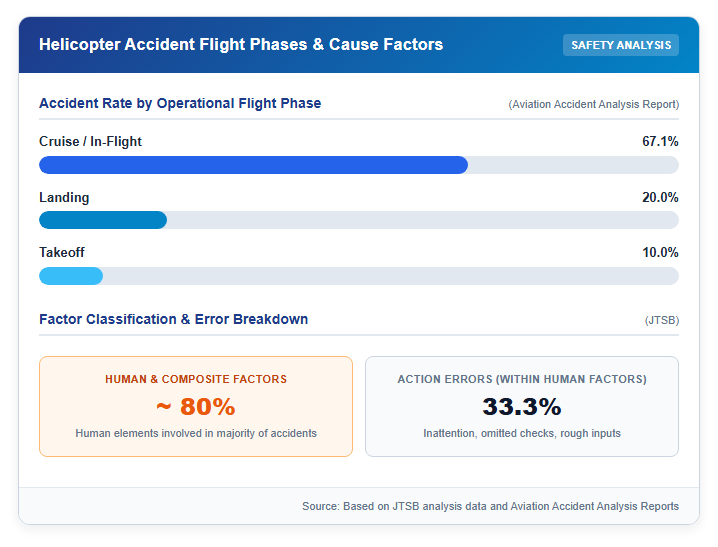
Helicopter rescue missions frequently require extended hovering—maintaining a stationary airborne position—while deploying personnel and equipment via cable hoists. This maneuver represents one of the most demanding aspects of flight operations, as the aircraft is directly subjected to rotor-generated downwash, gross weight shifts, and localized wind turbulence. Operating near coastal cliffs or rocky topography increases susceptibility to downdrafts and turbulent airflow, making it exceptionally difficult to maintain position within centimeters while hovering at a low altitude of approximately 45 meters. According to historical accident analysis reports published by aviation authorities, in terms of operational flight phases, cruise flight accounts for approximately 67.1 percent of helicopter accidents, landing accounts for 20.0 percent, and takeoff represents 10.0 percent. Furthermore, low-altitude hovering in confined or rocky terrain presents continuous hazards of main rotor, airframe, or hoist cable contact with surrounding obstacles. The Ishigaki Island incident occurred under these precise conditions—combining unpredictable terrain with a stationary hover at 45 meters—highlighting the urgent need to review flight control procedures and visual lookout protocols to protect rescue personnel. Please refer to the image placeholder below.
JTSB Analysis of Helicopter Accident Factors and Trends
Statistical data and analytical reports from the JTSB reveal that approximately 80 percent of all helicopter accidents stem from human error or composite factors involving human elements. A detailed breakdown of human factors shows that “action errors”—including inattention, omitted checks, and rough control inputs—constitute the single largest category at 33.3 percent. Typical examples include inadequate visual scanning during hovering, misjudging clearance from obstacles, and delayed responses to localized weather changes. Although societal demand for helicopter operations—such as emergency medical services (Doctor-Heli) and disaster rescue—has surged in recent years, the overall accident rate has plateaued rather than declining. Past accident reports document multiple instances where helicopters struck trees or rock faces during mountain rescues or cargo transport operations, resulting in crashes and casualties. Human error rarely occurs in isolation; it is frequently compounded by harsh environmental conditions, operational pressure, and psychological stress. Establishing robust mutual-verification procedures and strict adherence to standard operating procedures (SOPs) remain critical safeguards.
JCG Safety Management Framework and Future Preventive Measures
On-Site Work Environment Improvements (“Kaizen”) and Human Factor Mitigations
To address demanding working conditions and enhance operational efficiency, the JCG launched an agency-wide “Kaizen” (continuous improvement) initiative in 2023. Amid intense operational demands in offshore and coastal environments, the JCG is actively working to curb turnover, recruit talent, and foster a supportive workplace culture, while maintaining flight safety and infrastructure as foundational imperatives. The JCG’s budget request for Fiscal Year 2026 totals 317.7 billion yen (approximately 1.14 times the previous year’s budget). This funding targets both physical asset expansion—such as patrol vessels and aircraft—and the enhancement of operational foundations supporting safe, precise mission execution. Preventing accidents during rescue operations requires not only modernizing airframes and deploying advanced technologies, but also enriching training programs for pilots and rescue personnel. Lessons highlighted by the JTSB strongly emphasize strict adherence to minimum safe altitudes, reviewing emergency communication protocols, and maintaining continuous contingency training. Rebuilding multi-layered safety management rules while alleviating frontline workloads has become an urgent priority.
Investigation Outlook and Implications for Rescue Operations
The findings of the ongoing JTSB investigation into this officially designated aviation accident are anticipated to significantly influence future revisions of JCG helicopter flight guidelines and operational manuals. Investigators are analyzing weather conditions at the time of the accident—including wind profiles and visibility—alongside flight radio communications and hoist device telemetry log records. As the inquiry progresses, the JTSB may issue safety information advisories or formal recommendations to relevant administrative bodies. For its part, the JCG is cooperating fully with the investigation while instructing aviation bases and vessel-launched helicopter units nationwide to re-verify safety clearance standards and reinforce risk management during hoist rescue operations. For an agency dedicated to saving lives in hazardous conditions, ensuring the safety of its own crew members is an absolute prerequisite. Uncovering the root cause of this accident and implementing concrete preventive measures are essential steps toward sustaining public trust and building a resilient, long-term maritime safety and rescue framework.
Reference Pages
- 【Ministry of Land, Infrastructure, Transport and Tourism / Japan Transport Safety Board】https://jtsb.mlit.go.jp/index.html
- 【Japan Coast Guard】https://www.kaiho.mlit.go.jp/
【#JapanCoastGuard #AviationAccident #JapanTransportSafetyBoard #IshigakiIsland #HelicopterRescue #MLIT #AccidentInvestigation】


コメント