In its latest financial results, U.S. semiconductor giant Broadcom reported a massive year-over-year surge in AI-related semiconductor revenue, strongly driving overall business expansion. This rapid growth is propelled by escalating demand for custom AI accelerators developed for major tech enterprises alongside rapid sales expansion in data center networking products.
- Key Financial Highlights and Accelerated AI Revenue Expansion
- Expanding Adoption of Custom AI Accelerators Among Hyperscalers
- Cost Advantages Over General-Purpose GPUs and Proprietary Architectures
- Large-Scale Financing and Deployment Support via the XPV Platform
- Physical Supply Constraints: Power Availability and Data Center Site Readiness
- Customer Concentration Risks, Growth Scenarios, and Key Watchpoints
Key Financial Highlights and Accelerated AI Revenue Expansion
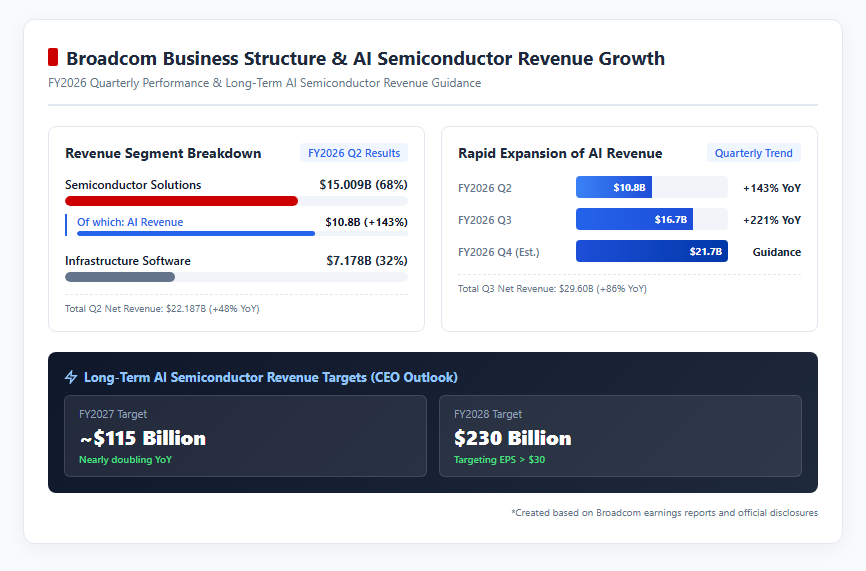
In its fiscal Q3 2026 earnings release, Broadcom reported consolidated revenue of \$29.6 billion, up 86% year-over-year. At the heart of this extraordinary growth was its AI semiconductor revenue, which soared 221% year-over-year to \$16.7 billion. This marks a significant acceleration from fiscal Q2 2026, when total revenue reached \$22.187 billion (up 48% year-over-year) and AI semiconductor revenue stood at \$10.8 billion (up 143% year-over-year). AI products continue to serve as a powerful engine for the broader Semiconductor Solutions segment, with the company projecting fiscal Q4 2026 AI semiconductor revenue to reach approximately \$21.7 billion. The diagram below illustrates Broadcom’s revenue and business segment structure.
Behind this expansion is the skyrocketing global demand for compute resources required to train and deploy generative AI models. Broadcom has substantially increased shipments of data center networking switches and custom AI chips, establishing a highly resilient revenue foundation alongside its Infrastructure Software segment.
Expanding Adoption of Custom AI Accelerators Among Hyperscalers
The primary competitive advantage of Broadcom’s semiconductor business lies in supplying custom AI accelerators (XPUs) tailored specifically for hyperscalers and frontier AI research institutions, including Alphabet’s Google, Meta Platforms, OpenAI, and Anthropic. Designed for distinct AI workloads, Broadcom’s custom silicon delivers superior energy efficiency and throughput compared to general-purpose GPUs, rapidly capturing demand from enterprises operating massive computing infrastructures. Product development speed has been exceptionally swift: in co-developing the “Jalapeño” custom processor for LLM inference with OpenAI, Broadcom delivered initial samples just nine months after reaching an agreement. Furthermore, the company plans to supply compute capacity equivalent to 1 gigawatt in 2026 and 5 gigawatts in 2027 for Anthropic. Through these close strategic partnerships, Broadcom has secured direct growth channels not only with traditional cloud titans but also with leading AI model developers.
Competitive Edges of Custom Silicon and Infrastructure Financing Frameworks
Cost Advantages Over General-Purpose GPUs and Proprietary Architectures
While Nvidia’s general-purpose GPUs currently hold a dominant share of the AI infrastructure market, Broadcom’s custom accelerators present a compelling alternative for specific workloads. As CEO Hock Tan highlighted during earnings calls and industry conferences, application-specific chips tailored precisely to a customer’s model architecture offer substantial reductions in per-compute energy costs and Total Cost of Ownership (TCO). The “Jalapeño” chip co-developed with OpenAI achieves superior power efficiency in targeted inference tasks compared to rival general-purpose processors, reportedly cutting compute costs nearly in half. On the engineering front, to overcome physical limits associated with Moore’s Law, Broadcom leverages multi-die packaging technology—integrating multiple dies into a single chip package—alongside ultra-high-speed SerDes interconnects and advanced packaging methodologies. This enables the creation of massive processors that transcend single-die constraints, constructing a formidable technological moat.
Large-Scale Financing and Deployment Support via the XPV Platform
Broadcom does not merely design and manufacture chips; it actively builds an ecosystem that supports customers’ massive AI infrastructure deployments from both financial and logistical angles. In June 2026, Broadcom established a special purpose vehicle named the “AI XPV Platform” in partnership with investment firms Apollo Global Management and Blackstone. This framework aims to facilitate the deployment of over 20 gigawatts of AI compute capacity powered by Broadcom’s XPUs and networking products by 2028. Its inaugural project involves deploying compute infrastructure for Anthropic, backed by a \$35 billion credit facility led by Apollo. By collaborating with financial partners to lower capital expenditure hurdles for emerging AI model developers that lack substantial internal cash flows, Broadcom has instituted a strategic mechanism to generate steady, long-term demand for its products.
Physical Infrastructure Constraints and Long-Term Outlook
Physical Supply Constraints: Power Availability and Data Center Site Readiness
The primary constraint on Broadcom’s financial performance is not semiconductor wafer manufacturing capacity, but rather the physical infrastructure readiness at data center sites. As CEO Hock Tan pointed out, bringing an AI data center online requires a lead time of 1.5 to 2 years to secure power grid capacity, procure heavy electrical equipment such as transformers and gas turbines, obtain local permits, and complete construction. Supply shortages stem more from the speed of making power-ready sites operational than from chip manufacturing limits, making physical site readiness the primary pacing factor for growth. As shown in the structural diagram below, scaling AI infrastructure requires both semiconductor supply and physical facility readiness.
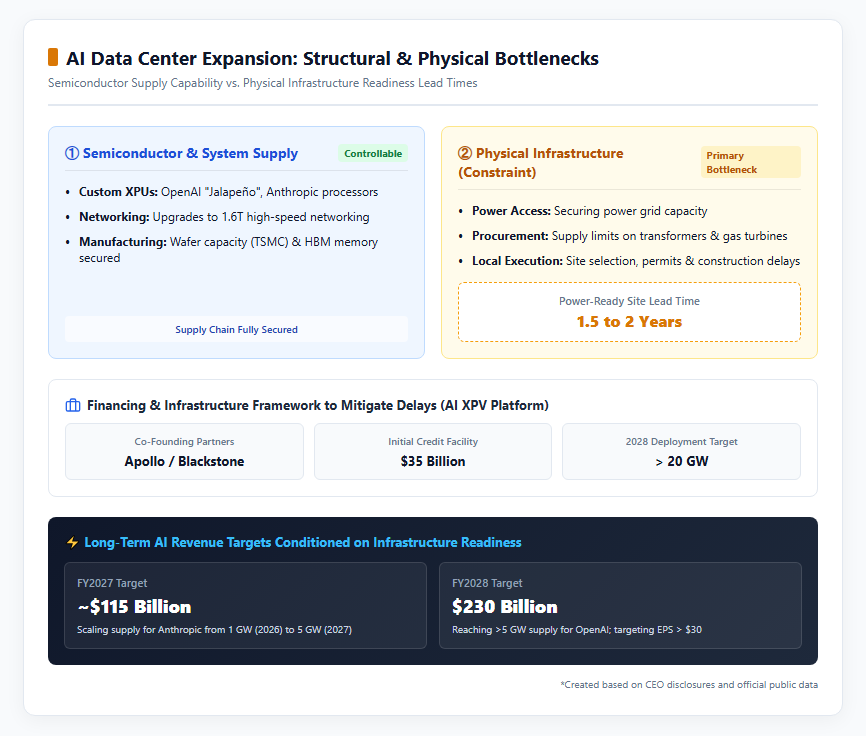
Broadcom’s long-term vision—projecting AI semiconductor revenue of approximately \$115 billion in fiscal 2027 and \$230 billion in fiscal 2028—remains heavily dependent on the pace of power site development.
Customer Concentration Risks, Growth Scenarios, and Key Watchpoints
Despite promising long-term growth prospects, Broadcom faces structural challenges related to high revenue concentration among a small group of major customers. Direct sales through a single primary distributor account for 42% of net revenue, while the top five end-demand customers represent approximately 45%, leaving Broadcom’s financial performance vulnerable to shifts in capital expenditure plans by key clients. Additionally, relying on TSMC for roughly 95% of its outsourced wafer manufacturing introduces geopolitical and supply chain risks. Nevertheless, Broadcom targets an earnings per share (EPS) exceeding \$30 in fiscal 2028, supported by robust free cash flow that funds aggressive shareholder returns through dividend increases and share buybacks. Going forward, key drivers of sustained growth will include the full-scale rollout of shipments to OpenAI and Anthropic, the upgrade cycle to 1.6 Terabit per second (1.6T) networking products, and the timely readiness of powered data center sites.
Reference Pages
- 【Broadcom FY2026 Q2 Financial Results】https://investors.broadcom.com/news-releases/news-release-details/broadcom-inc-announces-second-quarter-fiscal-year-2026-financial
- 【Broadcom FY2026 Q2 Form 10-Q (SEC)】https://www.sec.gov/Archives/edgar/data/1730168/000173016826000054/avgo-20260503.htm
- 【OpenAI and Broadcom LLM-Optimized Intelligence Processor】https://investors.broadcom.com/news-releases/news-release-details/openai-and-broadcom-unveil-llm-optimized-intelligence-processor
【#Broadcom #AISemiconductors #CustomSilicon #EarningsAnalysis #DataCenter #NVIDIA #GenerativeAI #USStocks】

コメント