Ultra-compact compute modules and AI mini PCs equipped with Intel’s latest “Lunar Lake” processors have hit the market. Driving this trend is the growing demand for real-time edge AI processing across robotics and industrial automation.
- Introducing Ultra-Compact Modules Opening the Era of Edge AI
- Processor Architecture Enabling Advanced AI Processing
- Extreme Energy Efficiency and High-Density Packaging Mechanisms
- Versatile Interfaces and Expansion via Carrier Boards
- Deployment Scope: From Industrial Automation to Robotics
- Proliferation of Edge AI Devices and Future Market Trends
Introducing Ultra-Compact Modules Opening the Era of Edge AI
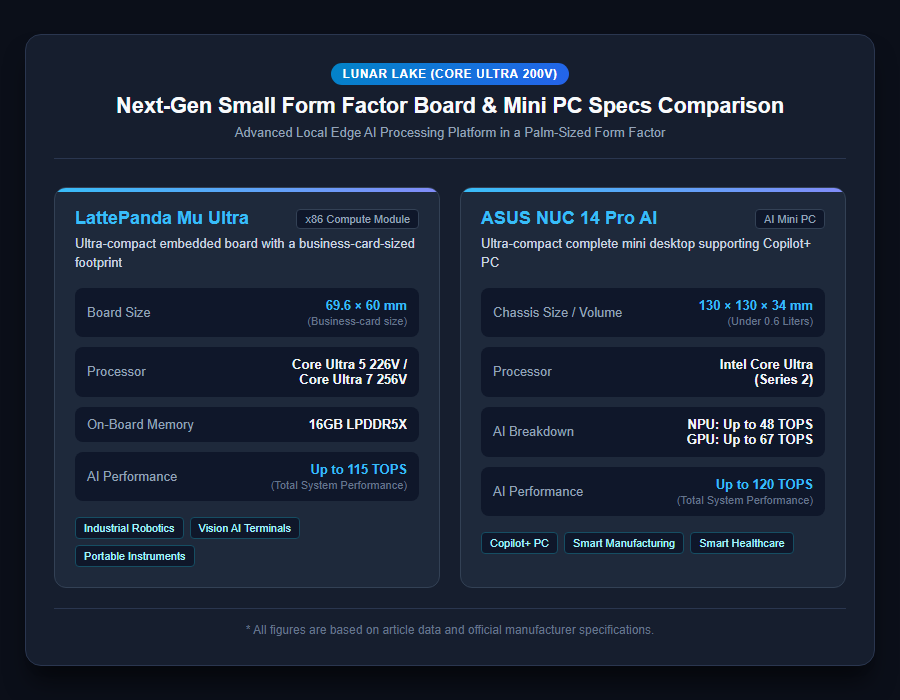
In September 2024, Intel officially announced its latest mobile SoC, the Core Ultra 200V series (codenamed Lunar Lake). Now, ultra-compact compute modules and AI mini PCs featuring this processor have entered the market. Key examples include x86 compute modules like the LattePanda Mu Ultra and small-form-factor devices such as the ASUS NUC 14 Pro AI. These systems achieve remarkably compact designs, ranging from business-card-sized board footprints of 69.6 × 60 mm to ultra-small chassis volumes under 0.6 liters (130 × 130 × 34 mm). While AI processing previously required bulky desktop PCs or power-hungry discrete graphics cards, the release of these compact boards enables advanced AI workloads to run locally on palm-sized hardware. In space- and weight-constrained environments—such as embedded controls for industrial robots, portable measuring instruments, and vision AI terminals—the arrival of these ultra-compact modules is expected to drive significant technological innovation. The image below illustrates an installation example of these latest compact boards.
Processor Architecture Enabling Advanced AI Processing
At the core of these compact boards lies the Lunar Lake processor lineup, including SKUs such as the Core Ultra 5 226V and Core Ultra 7 256V. Featuring an 8-core (4 Performance cores + 4 Efficient cores) design, the architecture eliminates hyper-threading to achieve an exceptional performance-per-watt ratio. The dedicated Neural Processing Unit (NPU) delivers up to nearly four times the AI performance of the previous generation, offering up to 48 TOPS on its own. Furthermore, the integrated Intel Arc GPU (Xe2 architecture) delivers up to 67 TOPS of graphics and compute performance, bringing the total system AI compute capability up to 115–120 TOPS across the CPU, GPU, and NPU. The board also integrates 16 GB of high-speed LPDDR5X memory directly into the package to support low-latency local AI workloads. By executing data analytics and inference locally on the terminal without relying on cloud infrastructure, devices achieve faster response times, reduced network bandwidth consumption, and enhanced data privacy.
Technical Innovations and Expandability of Compact Boards
Extreme Energy Efficiency and High-Density Packaging Mechanisms
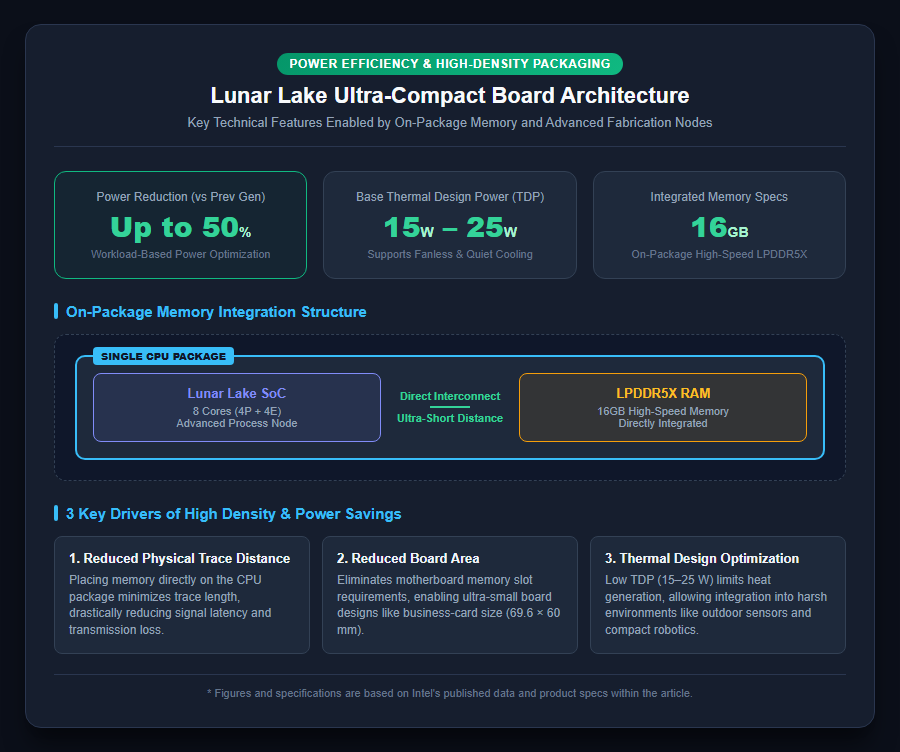
The defining strength of Lunar Lake-powered compact boards is the seamless combination of high compute capability and outstanding power efficiency. According to Intel, these processors achieve up to a 50% reduction in power consumption compared to the previous generation, depending on the workload. This exceptional energy efficiency is enabled by on-package memory architecture—where memory chips are placed directly on the CPU package—and optimized advanced semiconductor fabrication nodes. By drastically shortening physical wiring distances on the board, signal latency and transmission losses are minimized, simultaneously improving power efficiency and data transfer speeds. With Thermal Design Power (TDP) capped at 15 W to 25 W during base operation, these devices can operate using near-fanless cooling modules or quiet cooling systems with fluid dynamic bearing fans. This high-density packaging technology makes it easy to integrate AI capabilities into battery-powered portable terminals, outdoor surveillance installations, and other harsh operating environments with strict thermal constraints where traditional PCs could not be deployed. The image below shows the internal structure of this high-density board architecture.
Versatile Interfaces and Expansion via Carrier Boards
Beyond high-density integration on the compute module itself, these boards offer a rich array of input/output interfaces, enabling developers and enterprise users to expand their systems based on specific application needs. For example, pairing the module with a dedicated mini carrier board (such as the DFR1293) provides M.2 sockets for adding high-speed storage (NVMe SSDs) and wireless connectivity modules. On the wired networking front, 2.5GbE (2.5 Gigabit Ethernet) ports allow for high-speed transmission of large image files and sensor data. For display connectivity, HDMI and Thunderbolt 4 (supporting DisplayPort 2.1) allow multi-monitor outputs at 4K resolution. Additionally, high-speed interfaces such as OCuLink ports, USB 3.2 ports, Bluetooth 5.4, and Wi-Fi 7 standards are integrated for seamless connection to external graphics cards and peripheral expansion. On the software side, the boards officially support not only Windows 11 but also Linux distributions including Ubuntu 24.04 and later, offering high flexibility for industrial software development.
Real-World Applications and Future Outlook
Deployment Scope: From Industrial Automation to Robotics
The impact of Lunar Lake-powered compact boards extends far beyond the mere downsizing of personal computers; it is poised to drive transformative changes across various industrial sectors. A prime application area is smart manufacturing and industrial robotics. Compact boards can be embedded directly into vision AI inspection systems to analyze camera feeds on manufacturing assembly lines and detect product defects instantly, or serve as real-time perception and path-planning units for autonomous mobile robots (AMRs and AGVs). Beyond factories, deployment is expanding across edge computing environments—including portable diagnostic equipment in healthcare, traffic monitoring systems in smart cities, and facial recognition or purchasing behavior analysis terminals in smart banking and retail. Edge AI, which completes processing locally on the device without cloud dependency, provides high availability during network disruptions and robust security by keeping sensitive personal or operational data on-site, making it a standard choice in high-security industries.
Proliferation of Edge AI Devices and Future Market Trends
The commercial release of these ultra-compact compute modules marks a critical milestone in accelerating the rapid growth of the edge AI hardware market. Previously, size, heat generation, and power consumption posed substantial barriers to embedding AI capabilities. However, the arrival of compact, highly efficient boards that maintain full x86 compatibility enables seamless software migration without sacrificing existing codebases. From 2025 onward, PC manufacturers and industrial PC vendors are expected to launch a diverse array of modular form factors and embedded boards powered by next-generation AI processors like Lunar Lake. As sensor-integrated modules shrink further and integrate with power-efficient local AI models (LLMs and SLMs), the transition toward ambient AI—seamlessly integrated into daily life—will gain strong momentum. The ongoing miniaturization and performance scaling of AI hardware will serve as a core catalyst restructuring social infrastructure and industrial systems into smarter, more efficient frameworks.
Reference Pages
- 【Intel Core Ultra Processors (Series 2) Press Kit】https://www.intel.com/content/www/us/en/newsroom/resources/press-kit-core-ultra-series-2.html
- 【ASUS NUC 14 Pro AI Datasheet】https://www.asus.com/Websites/jp/products/7pxssbhfbl5qawai/pdf/vktgd20axva4jdux.pdf
【#LunarLake #AI #SmallFormFactor #EdgeAI #Intel #Robotics #Semiconductors #EdgeComputing】

コメント