Sumitomo Mitsui Construction Co., Ltd. has commenced reconstruction work on the Mitakekobashi Bridge in Ome City, Tokyo, marking Japan’s first use of zero-cement concrete in a prestressed concrete (PC) cable-stayed bridge. The project is driven by the need to rebuild a pedestrian bridge washed away by Typhoon Hagibis in October 2019 and by Tokyo’s push toward decarbonizing infrastructure development.
- Commencement of Mitakekobashi Reconstruction and Its History
- Recovery from Typhoon Damage and Regional Infrastructure Importance
- Adoption of Zero-Cement Concrete in Bridge Construction
- Precise Schedule Management Avoiding Flood Seasons
- Technical Capabilities Driving Infrastructure Decarbonization
- Key Milestones and Regional Benefits Leading to FY2028 Opening
Commencement of Mitakekobashi Reconstruction and Its History
In November 2025, Sumitomo Mitsui Construction Co., Ltd. officially began full-scale construction work to replace Mitakekobashi Bridge, located in the Mitake Gorge of Ome City, Tokyo. Based on a business agreement executed with the Tokyo Metropolitan Government in 2024, the Tokyo Metropolitan Public Corporation for Road Improvement and Management is carrying out the full scope of duties, ranging from design to construction procurement and oversight. Sumitomo Mitsui Construction joined the project during the Early Contractor Involvement (ECI) technical cooperation phase, formulating execution plans and evaluating technical methods. Built in 1975, the original Mitakekobashi Bridge served as a vital pedestrian crossing for local residents and tourists enjoying scenic walks along the gorge. However, in October 2019, most of its superstructure was swept away by the swelling Tama River during Typhoon Hagibis, prompting strong local calls for its prompt restoration. The current reconstruction project goes beyond simple recovery, fully incorporating cutting-edge environmental technology designed to minimize ecological impacts. A PC cable-stayed design was selected for the bridge structure, combining aesthetic harmony with eco-friendly performance as a new landmark for the region. Safety measures and environmental considerations for the surrounding area are being strictly implemented as construction moves toward a targeted opening in fiscal year 2028.
Recovery from Typhoon Damage and Regional Infrastructure Importance
As a key segment of the Mitake Gorge Promenade, Mitakekobashi Bridge provides essential pedestrian access across the Tama River. Its loss during Typhoon Hagibis in 2019 restricted river crossings, inconveniencing local residents and interrupting tourist routes. The Mitake area is a renowned outdoor sports hub for hiking, bouldering, and kayaking, making the bridge’s absence a major challenge for local commerce and tourism. Ahead of main construction activities, an information session for local business owners and residents was held in October 2025 to communicate safety measures and restricted zone operations. To ensure safety during construction, access to parts of the right bank is currently restricted, while the left-bank promenade and surrounding commercial facilities remain fully open to minimize the impact on community activities. Temporary flush restrooms have also been installed near the site for visitors and climbers. Rebuilding this infrastructure with enhanced disaster resilience holds immense value for both local safety and regional economic vitality.
Japan’s First Zero-Cement Technology and Advanced Engineering
Adoption of Zero-Cement Concrete in Bridge Construction
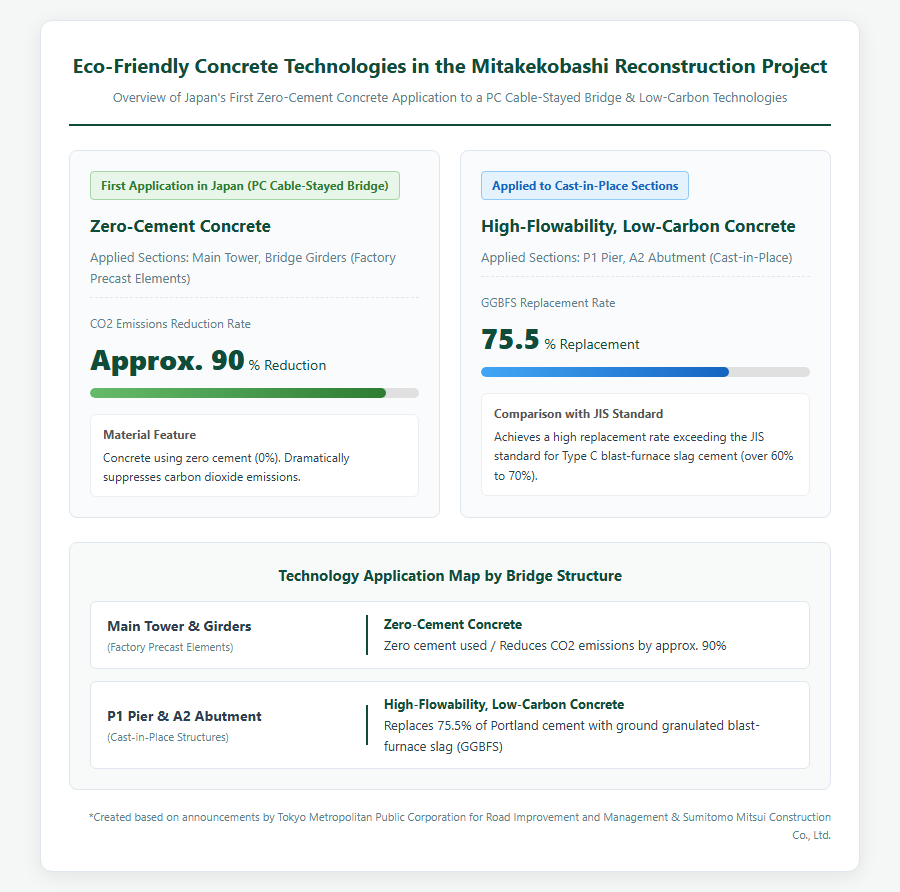
The hallmark of this project is the full implementation of eco-friendly concrete, which drastically reduces environmental impact. While traditional Portland cement emits substantial amounts of carbon dioxide during manufacturing, this project significantly cuts cement usage. For cast-in-place structures such as the P1 pier and A2 abutment, a high-flowability, low-carbon concrete is used, replacing 75.5% of the Portland cement with ground granulated blast-furnace slag (GGBFS). This replacement rate exceeds the JIS standard for Type C blast-furnace slag cement (greater than 60% up to 70%), representing a pioneering application in Japanese bridge engineering. Furthermore, factory-made precast components for the main tower and bridge girders utilize zero-cement concrete, reducing CO2 emissions by approximately 90%. Applying zero-cement concrete to a PC cable-stayed bridge is a groundbreaking first in Japan, marking a milestone for decarbonization in the construction sector. The diagram below illustrates the structural layout and environmental technologies integrated into this project.
The deployment of such innovative materials is attracting widespread attention across the industry as a benchmark model for sustainable infrastructure.
Precise Schedule Management Avoiding Flood Seasons
Constructing a bridge across the turbulent Tama River requires rigorous schedule management tailored to seasonal weather and river level fluctuations. In particular, in-river construction is completely suspended during the summer and autumn flood seasons when water levels rise sharply. Since breaking ground in November 2025, the construction team has strategically scheduled operations during non-flood periods. As of September 2026, the construction of the P1 pier and A2 abutment using high-flowability, low-carbon concrete has been completed, and work on the girder bridge along Yoshino Highway is progressing smoothly. Beginning in November 2026 during the non-flood window, full-scale erection of the bridge girders atop the P1 pier will commence. To reduce on-site construction time and ensure consistent quality, precast elements manufactured off-site are being extensively utilized for the main tower and sections of the girders. The fabrication of these zero-cement precast components is proceeding systematically in factories prior to precise site erection. By synchronizing off-site prefabrication with non-flood construction windows, high-quality, safe bridge construction is maintained under challenging natural conditions.
Sumitomo Mitsui Construction’s Expertise and Future Outlook
Technical Capabilities Driving Infrastructure Decarbonization
Sumitomo Mitsui Construction is a leading mid-tier general contractor in Japan, renowned for its top-tier track record in prestressed concrete bridge engineering. The company has consistently spearheaded environmentally conscious civil engineering technologies, such as developing ultra-durable bridge deck slabs using aramid fiber reinforcements. The Tokyo Metropolitan Government is actively pursuing its “Carbon Half” target—aiming to cut greenhouse gas emissions by 50% by 2030—and its broader “Zero Emission Tokyo” vision, creating an escalating demand for decarbonized public infrastructure. The low-carbon and zero-cement concrete technologies delivered by Sumitomo Mitsui Construction directly align with these administrative policy objectives. In recent years, the company has undertaken structural management reforms to recover from material price inflation and project losses in its building division, focusing on its highly profitable civil engineering core. Establishing cement-substitution technology not only enhances the company’s competitive advantage but also serves as a catalyst accelerating the decarbonization shift across the broader construction industry.
Key Milestones and Regional Benefits Leading to FY2028 Opening
The Mitakekobashi reconstruction project is entering crucial execution phases ahead of its target completion in May 2028 (fiscal year 2028). Key technical operations, including girder erection scheduled from November 2026, off-site precast assembly, and cable tensioning characteristic of cable-stayed bridges, will unfold sequentially. Throughout the construction period, traffic management measures during crane operations and temporary parking restrictions at the Mitake Exchange Center (starting around October 2026) will remain in place to minimize local disruption. Designed to harmonize with the scenic beauty of Mitake Gorge, the new Mitakekobashi Bridge is expected to serve as an iconic regional landmark. Once completed, the full restoration of the promenade loop will boost visitor convenience and stimulate the local economy. As a flagship model for decarbonized infrastructure and a vital asset for local disaster preparedness and tourism, the construction process and ultimate completion in 2028 will continue to draw significant attention.
References
- 【Commencement of Mitakekobashi Reconstruction Work!】https://www.tmpc.or.jp/01_news/press.html?itemid=874&dispmid=2794
- 【Sumitomo Mitsui Construction Co., Ltd. Official Site】https://www.smcon.co.jp/
【#SumitomoMitsuiConstruction #Mitakekobashi #InfrastructureDevelopment #DecarbonizedSociety #ZeroCementConcrete #Tokyo #PublicWorks #CivilEngineering】


コメント