Saint Marc Holdings announced the acquisition of the TsuruTonTan business from Kato Pleasure Group for 12.8 billion yen. The deal is driven by a strategy to capture growing inbound tourist demand through premium Japanese dining and establish a powerful new growth brand under its medium-term management plan.
- Details of the Major ¥12.8 Billion M&A Transaction
- Structure of the Corporate Split and Business Succession via a New Subsidiary
- Asset Valuation: 16 Restaurants, Noodle Production, and E-Commerce Operations
- Investment Strategy for Establishing a “Third Flagship Brand” in the Mid-Term Plan
- Capitalizing on Inbound Tourism and Accelerating Global Expansion
- KPG’s Strategic Choice: Brand Portfolio Optimization and Focus on Resort Leisure
- Industry Polarization and the Future of Strategic Consolidation
Details of the Major ¥12.8 Billion M&A Transaction
On September 17, 2026, Saint Marc Holdings Co., Ltd.—operator of major food service concepts including Saint Marc Cafe and Namamen Senmon Kamakura Pasta—announced its agreement to acquire the premium udon dining business “Men-sho no Kokorotsukushi TsuruTonTan” from Kato Pleasure Group. The acquisition price is set at 12.8 billion yen, marking one of the largest M&A transactions in the Japanese restaurant sector in recent years.
TsuruTonTan opened its first location in Soemoncho, Osaka, in 1989 and has cultivated a unique position as a high-end udon restaurant chain over the past 37 years. The brand is renowned for its authentic broth brewed from Hokkaido Rishiri kelp and Makurazaki dried bonito from Kagoshima, its freshly made, cut, and boiled noodles prepared in each kitchen, and its sophisticated, location-specific architectural concepts. Operating in prime domestic destinations such as Roppongi, Ginza, Shibuya, Haneda Airport, and Karuizawa, as well as international hubs like New York and Hawaii, the brand commands immense popularity among celebrities, tourists, and dining enthusiasts.
For the fiscal year ending March 2026, the business transferred generated 6.135 billion yen in revenue. Beyond tangible store assets, the transaction encompasses a comprehensive acquisition of brand equity, operational systems, and proprietary culinary expertise. Through this strategic deal, Saint Marc Holdings aims to integrate a high-performing flagship concept into its restaurant portfolio.
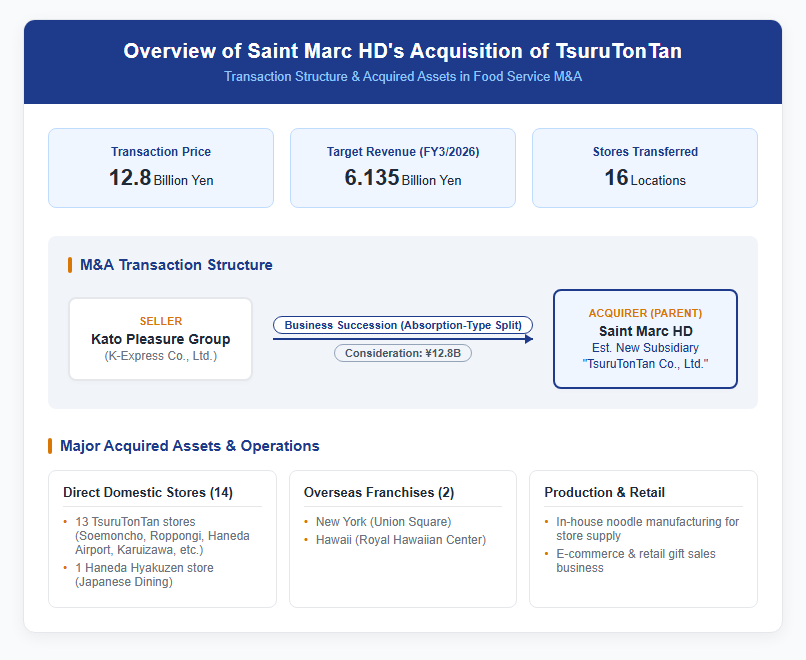
Please refer to the diagram below.
Structure of the Corporate Split and Business Succession via a New Subsidiary
The business succession is structured as an absorption-type corporate split. Under the agreement, Saint Marc Holdings will establish a wholly owned subsidiary, which will subsequently absorb the TsuruTonTan business currently operated by K-Express Co., Ltd., a member company of Kato Pleasure Group.
According to the transaction timeline, Saint Marc Holdings will incorporate a new wholly owned subsidiary, tentatively named TsuruTonTan Co., Ltd. (capitalized at 100 million yen and headquartered in Shimogyo Ward, Kyoto), on September 30, 2026. On the same day, the formal absorption-type split agreement will be signed with K-Express, with the final operational transfer scheduled to take effect on December 1, 2026.
Saint Marc Holdings will pay 12.8 billion yen as split consideration to deliver a seamless transfer of rights, operational assets, and contractual obligations to the new entity. Under corporate accounting standards, the deal will be classified as a business combination via acquisition. Details regarding purchase price allocation and goodwill recognition are currently being finalized.
Operating under a holding company structure, Saint Marc Holdings has a proven track record of scaling acquired brands like Saint Marc Cafe and Kamakura Pasta while preserving their distinct operational identities. The newly established entity, TsuruTonTan Co., Ltd., will follow a similar governance model, leveraging existing talent and store-level expertise while receiving corporate development and management support from the parent holding company.
Asset Valuation: 16 Restaurants, Noodle Production, and E-Commerce Operations
The transaction encompasses a broad range of operational assets, spanning domestic and international store networks, central manufacturing operations, and direct-to-consumer sales channels.
The deal includes 16 restaurant locations in total: 14 directly operated domestic units and 2 overseas franchise locations. The domestic footprint consists of 13 TsuruTonTan udon restaurants (located in Soemoncho, Kitashinchi, and Honmachi in Osaka; Roppongi, Shinjuku, Shibuya, Haneda Airport, and Ginza in Tokyo; and Karuizawa in Nagano), along with 1 traditional Japanese dining concept, “Nihon no Shun no Aji Haneda Hyakuzen.” Internationally, 2 franchised units located in Union Square, New York, and Royal Hawaiian Center, Hawaii, will be transferred.
Beyond physical dining operations, the acquisition covers the specialized noodle manufacturing business that supplies restaurant kitchens, as well as the retail and mail-order gift business offering packaged udon products. The direct-to-consumer gift sales channel effectively captures seasonal gifting demand, such as mid-year (Ochugen) and year-end (Oseibo) presents, functioning as a high-margin business that extends the brand’s culinary experience into consumer households.
This integrated asset structure—combining in-house noodle production, high-spend flagship dining locations, and established retail channels—provides a highly resilient foundation for future multi-channel expansion.
Growth Strategy at Saint Marc HD and Reinforcement of Japanese Dining Categories
Investment Strategy for Establishing a “Third Flagship Brand” in the Mid-Term Plan
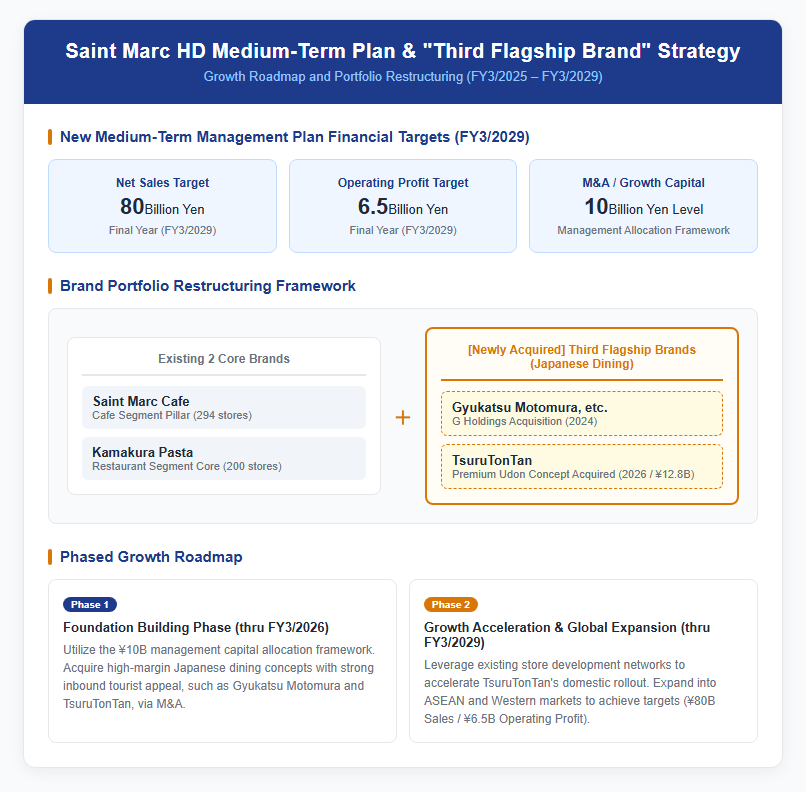
Saint Marc Holdings formulated a new medium-term management plan covering the five-year period from FY3/2025 through FY3/2029, targeting 80 billion yen in net sales and 6.5 billion yen in operating profit in its final year. Establishing a “third flagship brand” represents a central pillar of this corporate growth framework.
Historically, the company has operated around two main pillars: its cafe segment led by “Saint Marc Cafe” (294 stores as of March 2024) and its restaurant segment anchored by “Namamen Senmon Kamakura Pasta” (200 stores as of March 2024). However, building a third high-margin, highly scalable concept has become critical to unlocking long-term shareholder value and market expansion.
In its medium-term plan, Saint Marc HD designated the period through FY3/2026 as a foundation-building phase, establishing a 10 billion yen management capital allocation framework specifically for strategic M&A and brand acquisitions. The transaction for TsuruTonTan represents an assertive execution of this dedicated investment framework.
Following its 2024 acquisition of G Holdings Co., Ltd.—operator of the popular “Gyukatsu Motomura” beef cutlet chain—Saint Marc HD has actively targeted category-leading, high-growth external brands. Integrating TsuruTonTan substantially advances the group toward its medium-term revenue and profitability benchmarks.
Please refer to the diagram below.
Capitalizing on Inbound Tourism and Accelerating Global Expansion
A key catalyst behind Saint Marc HD’s acquisition of TsuruTonTan is the strategic alignment with Japan’s expanding inbound tourism market and the opportunity to accelerate its global footprint.
In 2024, Japan welcomed a record 36.87 million international visitors, driving significant consumer spending across urban dining and tourism districts. Demand for authentic Japanese culinary experiences remains exceptionally robust. TsuruTonTan, famous for its signature oversized serving bowls, elegant Japanese interiors, and multi-lingual hospitality, commands immense popularity among international travelers, drawing long lines daily at high-traffic hubs like Haneda Airport, Roppongi, and Ginza.
Furthermore, TsuruTonTan serves as a powerful engine for international growth. With established flagship restaurants in New York and Hawaii, the brand already enjoys strong recognition in Western markets. By combining TsuruTonTan’s brand prestige with Saint Marc HD’s corporate infrastructure, site development network, and existing overseas operational channels in Southeast Asia, the group plans to expand not only across major Japanese metropolitan areas but also into ASEAN markets and key Western cities.
Strategic Realignment at Kato Pleasure Group and M&A Trends in the Food Service Sector
KPG’s Strategic Choice: Brand Portfolio Optimization and Focus on Resort Leisure
The seller, Kato Pleasure Group (KPG), is a total hospitality development company founded in 1962 that operates hotels, luxury ryokans, the “Fufu” luxury resort brand, spas, and entertainment venues. KPG employs 4,552 people and handles an annual gross transaction volume of 52 billion yen.
For KPG, TsuruTonTan was a signature brand nurtured over 37 years since opening its first Soemoncho location in 1989. However, KPG maintains an optimal scaling policy for each of its operational concepts and concluded that TsuruTonTan had reached its full potential under single-company ownership. To unlock the brand’s broader global potential, KPG determined that transferring the business to a major food service corporate operator with extensive capital and chain infrastructure was the optimal path forward.
KPG will redirect the capital and management resources unlocked by this transaction toward its core competencies: luxury resort developments (such as expanding the “Fufu” brand and the Pleasure Resort Izu Akazawa Onsen) and strategic M&A in regional hospitality assets (such as acquiring Kyoya Shuzo, a historic shochu distillery). This deal highlights a sophisticated portfolio strategy—developing and scaling a brand before transferring it to a major corporate enterprise at the optimal stage of market expansion.
Industry Polarization and the Future of Strategic Consolidation
Japan’s restaurant industry is navigating severe structural polarization. While total industry sales have surpassed pre-pandemic levels to reach record highs, soaring raw material costs, rising utility expenses, and ongoing labor shortages have pushed small and independent operator bankruptcies to historic peaks.
In this economic climate, while independent operators increasingly seek business sales, well-capitalized food service conglomerates are executing aggressive consolidation strategies to capture market share. Recent high-profile deals—including Zensho Holdings’ acquisition of Lotteria and Saint Marc HD’s takeover of G Holdings—reflect this accelerating consolidation wave across the sector.
For corporate restaurant groups, acquiring established brands with strong public recognition and loyal customer bases offers a lower-risk, faster entry into high-growth dining categories compared to organic brand creation. Parent companies can generate substantial post-merger synergies by unifying purchasing, streamlining logistics, and deploying store-level digital transformation (DX). Saint Marc HD’s acquisition of TsuruTonTan stands as a landmark deal in this industry transformation, with market analysts closely watching its post-merger operational integration and accelerated brand rollout.
References
- [Kato Pleasure Group Press Release] https://prtimes.jp/main/html/rd/p/000000223.000050120.html
【#SaintMarcHoldings #TsuruTonTan #KatoPleasureGroup #RestaurantIndustry #MA #BusinessSuccession #InboundTourism】

コメント