By September 18, 2026, Shizuoka Prefectural Police referred a man to prosecutors for modifying newspaper pages using generative AI and posting false content online. This action comes amid growing societal risks driven by the rapid sophistication of image generation AI and the viral spread of deepfakes.
- Charges of Business Obstruction via Fake Image Posts and Details of the Arrest
- Sophistication of Generative AI Technology and Increasingly Convincing Layout Tampering
- Societal Disruption and Economic Damage Inflicted by Fake Images
- Capabilities and Limitations of Fact-Checking AI
- Legal Framework for Business Obstruction, Portrait Rights, and Publicity Rights
- EU AI Act and Trends in Japanese Legal Regulations & Transparency Obligations
Charges of Business Obstruction via Fake Image Posts and Details of the Arrest
By September 18, 2026, Shizuoka Prefectural Police referred a 48-year-old male resident of Hamamatsu City, Shizuoka Prefecture, to prosecutors on suspicion of business obstruction. The suspect allegedly used generative AI to manipulate page images of the Shizuoka Shimbun and posted false content on social media, disrupting the newspaper publisher’s operations. The case underscores an environment where general users can easily generate and edit high-quality images. The man manipulated authentic newspaper layouts and headline styles to craft deceptive images that appeared to be genuine news reports, subsequently spreading them across the internet. Such actions extend beyond mere pranks; they severely damage the social credibility of news organizations and risk misleading the public. Police conducted digital image forensics and traced post pathways, ultimately identifying the suspect.
The diagram below illustrates the overview of the incident and its diffusion pathways on social media.
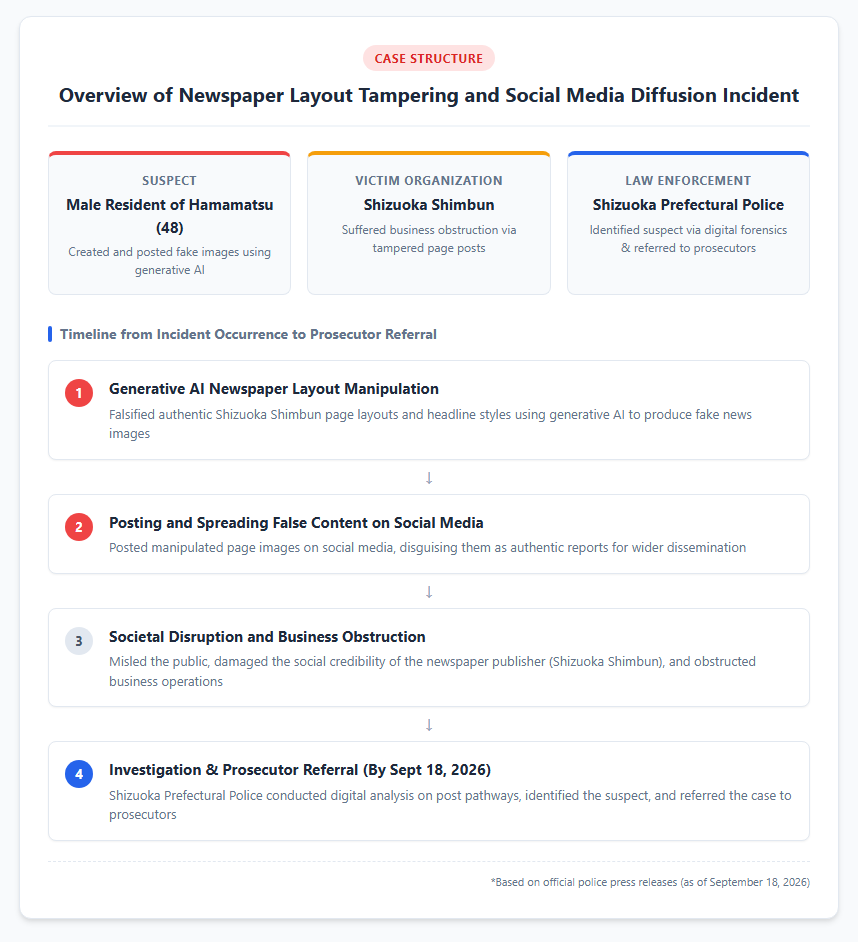
Posting fabricated information that exploits the trusted format of printed newspapers carries a high risk of triggering social unrest, prompting law enforcement to take a firm stance against such offenses.
Sophistication of Generative AI Technology and Increasingly Convincing Layout Tampering
With the rapid evolution of image generation AI and editing tools, individuals without professional design skills can now produce images virtually indistinguishable from authentic ones. Traditional image editing software required technical expertise and significant time to alter text and layouts. In contrast, generative AI enables rapid alterations through simple text prompts and automated synthesis features. In this incident, details such as font textures, paper creases, and noise processing were replicated with high precision, making it difficult for average readers to spot the forgery at a glance.
Abuse of this advanced manipulation technology exhibits several distinct characteristics:
- Initial skepticism is lowered because logos and page designs of established news outlets are directly reused
- Artificial traces of tampering remain minimal due to the AI’s ability to render realistic fonts and textures
- Content can be instantly replicated and redistributed online, spreading across a wide audience in a short period
Exploiting highly credible news formats as a cover for deception preys on the psychological vulnerabilities of social media users, posing a critical technical challenge to the overall credibility of the media.
Generative AI Deepfakes and Societal/Economic Risks
Societal Disruption and Economic Damage Inflicted by Fake Images
Fake images and deepfakes generated by AI cause far more than individual defamation or corporate business disruption; they exert a profound impact on social infrastructure and financial markets. In the United States, an AI-generated image depicting a massive explosion near the Pentagon went viral on Twitter. After being misidentified as breaking news by outlets such as CNN, the fake image caused the Dow Jones Industrial Average to temporarily plummet by nearly 80 dollars and sent ripples through foreign exchange markets. Similarly, during the 2016 Kumamoto earthquake in Japan, a hoax image claiming a lion had escaped from a local zoo circulated on social media, stoking fear among residents and overwhelming zoo staff with desperate inquiries.
The figure below compares the diffusion speed of fake news with that of true news.
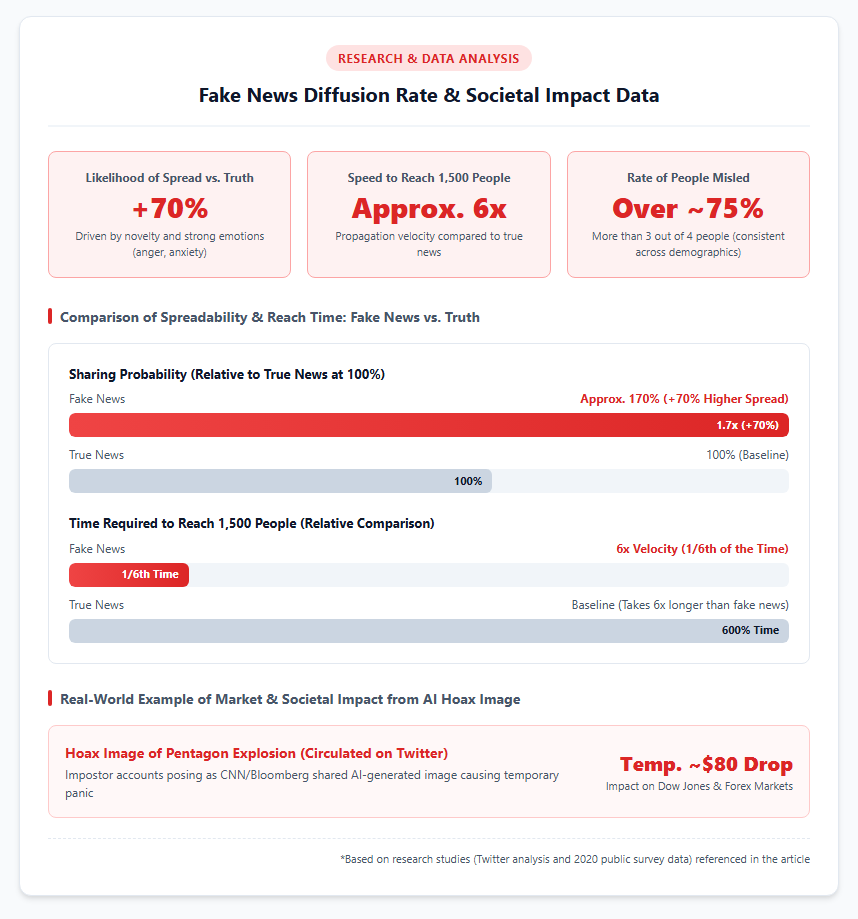
Research data reveals that fake news spreads approximately 70% more readily than accurate information because it triggers strong emotional responses like novelty, anger, or anxiety. Furthermore, fake news reaches 1,500 people roughly six times faster than true news. Surveys also indicate that over 75% of people fail to spot fake news and accept it as true, highlighting a widespread vulnerability that spans all age groups and demographics.
Capabilities and Limitations of Fact-Checking AI
To combat the exponential increase in false information, automated fact-checking systems powered by AI are being developed and deployed. However, recent peer-reviewed scientific papers highlight significant technical limitations and risks associated with language model-based fact-checking. Experiments conducted by a research team at Lahore University of Management Sciences using a dataset of 5,000 verified claims across 47 languages revealed substantial disparities in answer accuracy depending on model scale and algorithmic design.
Key challenges and behavioral patterns observed in fact-checking AIs include:
- Smaller AI models exhibit lower fact-checking accuracy yet display disproportionately high confidence in their answers (a phenomenon echoing the Dunning-Kruger effect)
- Larger models, such as GPT-4, achieve higher accuracy overall but demonstrate a higher rate of withholding judgment when uncertain
- Accuracy drops significantly for low-resource languages (such as those in the Global South) compared to high-resource languages like English
- Susceptibility to generating incorrect outputs increases when prompted with leading questions, such as “Is this a lie?”
AI-driven fact-checking should serve primarily as a supportive tool rather than a total replacement for human verification and critical analysis.
Legal Responsibilities and Standards for Infringement
Legal Framework for Business Obstruction, Portrait Rights, and Publicity Rights
Creating and publishing content via generative AI carries strict legal consequences under both criminal and civil law. Modifying newspaper pages or spreading false information can constitute criminal offenses such as fraudulent or forcible obstruction of business, punishable by imprisonment or fines. Furthermore, using AI to automatically generate, composite, or commercialize likenesses of real individuals or public figures can infringe upon portrait rights or publicity rights.
Legal research, including studies by Taichi Kakinuma of Kobe University, outlines the following evaluation criteria regarding legal liability for AI-generated likenesses:
- Portrait Rights Infringement (Narrow Sense): Evaluated comprehensively based on six factors: identity with a real person’s appearance, degree of connection (relevance) to the real person, manner of use (e.g., defamatory contexts such as adult content or criminal framing), subjective elements (negligence regarding duty of verification), illegality in acquiring source data, and the presence of disclaimers
- Publicity Rights Infringement: Established when a person’s name or likeness, which possesses customer-attracting power, is used unauthorizedly for commercial products or advertisements; negligence is recognized if the user fails to fulfill a verification duty, regardless of the degree of underlying dataset connection
- Tool Provider Liability: Tool creators (dataset or trained model developers) incur legal liability for aiding infringement only if they provide items posing a substantial risk of infringement, knowing or having reason to know of the risk, without taking reasonable preventive measures
Even when generated using legally acquired training materials, AI outputs can still be deemed illegal depending on how they are utilized, requiring users to exercise high legal caution.
EU AI Act and Trends in Japanese Legal Regulations & Transparency Obligations
To counter the proliferation of deepfakes and misinformation resulting from AI misuse, international regulatory frameworks are rapidly taking shape. In 2024, the European Union enacted the EU AI Act, the world’s first comprehensive AI regulation, with transparency obligations under Article 50 coming into effect on August 2, 2026. This regulation mandates that AI systems generating or manipulating synthetic image, video, audio, or text content must attach machine-readable identifiers (such as watermarks or encryption) and clearly disclose that the content is artificially generated or manipulated (deepfake). Non-compliant companies face severe penalties of up to 15 million euros or 3% of their global annual turnover.
Regulatory and industry developments in Japan include:
- The Agency for Cultural Affairs released “Ideas Regarding AI and Copyright” in March 2024, clarifying potential copyright infringement when unauthorized data extraction occurs from paid databases or APIs
- The Nihon Shinbun Kyokai (Japan Newspaper Publishers and Editors Association) issued a statement in July 2024 requesting legislative revisions to address unauthorized news content usage and erroneous answer generation by Retrieval-Augmented Generation (RAG) search engines
- Major news publishers including The Yomiuri Shimbun, The Asahi Shimbun, and The Nikkei filed lawsuits against US startup Perplexity, alleging copyright infringement for retrieving, processing, and outputting their article data without authorization
As technology advances, legal reforms and guideline revisions continue to unfold, pointing toward a future where legal regulations and technical transparency measures (such as digital watermarking) work in tandem to enforce proper AI usage and curb fake information.
References
- [Kobe University Academic Result Repository: “Infringement of Rights by Use of Automatically Generated Human Portraits Using AI Technology”] https://hdl.handle.net/20.500.14094/D1007977
- [Scientific Reports: “Large language models show Dunning-Kruger-like effects in multilingual fact-checking”] https://www.nature.com/articles/s41598-026-39046-w
- [EUR-Lex: “Regulation (EU) 2024/1689 (EU AI Act)”] https://eur-lex.europa.eu/eli/reg/2024/1689/oj/eng
- [Japan Newspaper Publishers and Editors Association: “Statement on Unauthorized Use of News Content in Generative AI”] https://www.pressnet.or.jp/statement/ai/240717_15523.html
【#GenerativeAI #Deepfakes #FakeNews #BusinessObstruction #EUAIAct #Copyright #InformationSecurity】

コメント