On October 2, 2026, ELYZA, a KDDI subsidiary, released two Japanese reasoning models based on “LLM-jp-4,” developed by the National Institute of Informatics (NII), free of charge under the Apache 2.0 license. This comes against the backdrop of the rapidly growing importance of high-quality, domestically produced Japanese reasoning models in the domestic enterprise market, where ensuring data sovereignty and on-premises operation are required.
- Key Points of the Announcement and Background of the Development Structure
- Differences in Specifications and Structure Between the Two Released Inference Models
- Features of the Reasoning Capability (Thinking) and the Harmony Format
- Comprehensive scores across 20 benchmarks and comparison with LLM-jp-4.1
- The capability gap with global cutting-edge models and frontier reasoning models
- The New Research Organization “ELYZA RSI Research” and the Reality of Autonomous Development
- Customer Center Operations Benchmarking, Practical Application, and FinOps Perspectives
Key Points of the Announcement and Background of the Development Structure
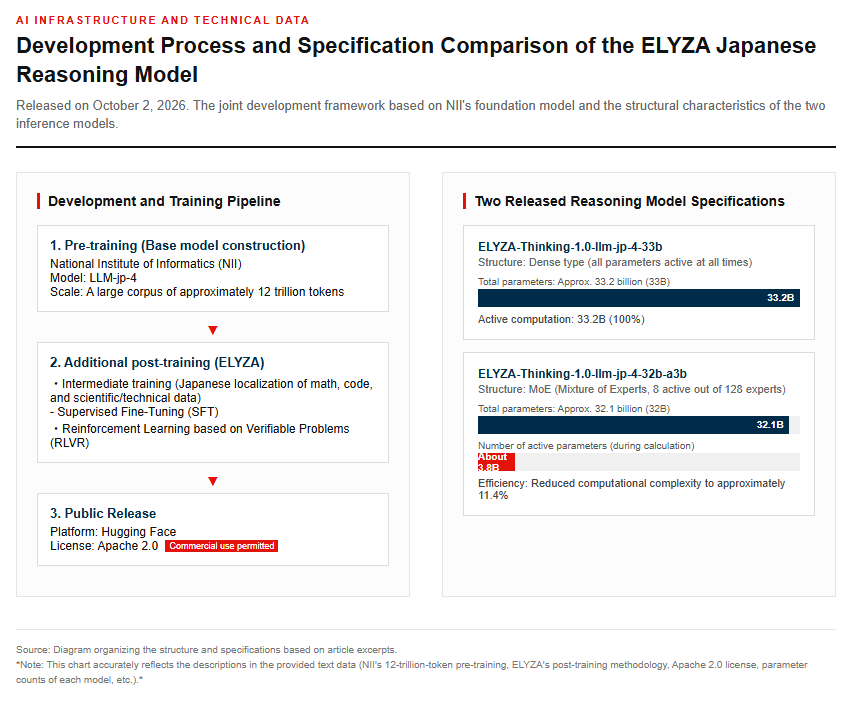
ELYZA, an AI development company in the KDDI Group, released two new AI models on October 2, 2026: “ELYZA-Thinking-1.0-llm-jp-4-33b” and “ELYZA-Thinking-1.0-llm-jp-4-32b-a3b.” Both models are available on the open-source platform Hugging Face and are distributed under the Apache 2.0 license, which permits commercial use and modification. Rather than being pre-trained from scratch by ELYZA, both models are built upon the “LLM-jp-4” series—a domestic large language model pre-trained from scratch on a large-scale corpus of approximately 12 trillion tokens by the National Institute of Informatics (NII). ELYZA applied additional post-training to this base model, including mid-training using localized Japanese data in mathematics, coding, and scientific and technological domains, supervised fine-tuning (SFT), and reinforcement learning with verifiable rewards (RLVR). Immediately following their release, some media outlets described them as “fully domestic,” but more accurately, it is a joint development framework where ELYZA applied successive rounds of post-training to the domestic pre-trained model developed by NII.
- Main Development Structure and Distribution Format:
- Developer: ELYZA, Inc. (KDDI Group)
- Publication Date: October 2, 2026
- Base model: National Institute of Informatics (NII) “LLM-jp-4” (pre-trained on 12 trillion tokens)
- Post-training method: Intermediate training + Supervised Fine-Tuning (SFT) + Reinforcement Learning with Verifiable Rewards (RLVR)
- License: Apache 2.0 (commercial use, modification, and redistribution permitted)
Differences in Specifications and Structure Between the Two Released Inference Models
The two newly released models differ significantly in their internal structures and computational characteristics, allowing for selection according to operational objectives. The Dense-type “ELYZA-Thinking-1.0-llm-jp-4-33b,” in which all parameters are constantly active, has a total parameter count of approximately 33.2 billion (33B). Meanwhile, the Mixture of Experts (MoE)-type “ELYZA-Thinking-1.0-llm-jp-4-32b-a3b,” which dynamically switches specialized parts, has a total parameter count of approximately 32.1 billion, yet by selecting and activating 8 out of 128 experts per token, its actual computational workload is kept to an active count of approximately 3.8 billion (3.8B). Please refer to the figure below.
Both models boast a context length of 65,536 tokens (approx. 64K), and their recommended sampling parameters are set to a temperature of 0.6 and top_p of 0.95. As for the operating environment, vLLM is officially recommended, with support also available for Transformers and SGLang. Note that ELYZA itself does not provide a cloud API and only distributes the weights, meaning that adopting companies are required to self-host or build a private cloud environment. Regarding memory requirements, approximately 64 to 66 GB is needed for storage in bfloat16 precision, but 4-bit quantization reduces this to about 16 to 17 GB, making local operation on a single 24GB-class consumer GPU also verifiable.
Features of the Reasoning Capability (Thinking) and the Harmony Format
ELYZA-Thinking-1.0 is a “think before answering” style reasoning model that performs internal step-by-step thinking before generating a response. While the older Qwen2.5-32B-based model released in May 2025 used <think> tags in its output, the 2026 LLM-jp-4-based model adopts the harmony format, which outputs the thinking process and the final answer separated into distinct channels. It lacks the ability to switch the amount of thinking (effort) during inference, and is designed to always generate responses through a thinking process. Furthermore, although it comes equipped with standard Function Calling capabilities to invoke external tools, it does not support parallel tool calling to execute multiple tools simultaneously, meaning agent designs must be configured to call tools sequentially, one at a time.
- Main functional constraints and operational considerations of the model:
- Switching thinking intensity: Because the thinking process is always active, a response wait time occurs even for short questions.
- Tool integration: Supports single function calling, does not support parallel calling.
- Input format: Text only (multimodal inputs such as images or audio are not supported)
- Security: Requires applying
trust_remote_code=Trueto allow code execution
Benchmark evaluation and performance comparison with global models
Comprehensive scores across 20 benchmarks and comparison with LLM-jp-4.1
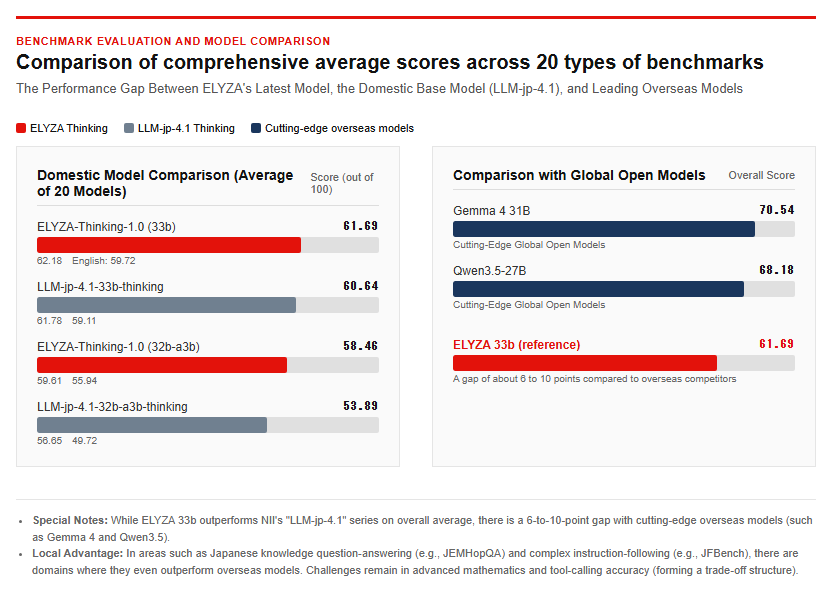
In evaluations conducted by ELYZA based on 20 types of benchmarks, the Dense-type 33b model recorded an overall average score of 61.69 (rounded to 61.7), and the MoE-type 32b-a3b model recorded an overall average score of 58.46 (rounded to 58.5). These results outperformed the overall average of the Thinking models in the “LLM-jp-4.1” series (33b version: 60.64, 32b-a3b version: 53.89) announced by the National Institute of Informatics (NII) on September 28, 2026. Looking at the detailed scores by capability, the ELYZA 33b demonstrates high superiority in Japanese knowledge question-answering (JEMHopQA: 73.85, JamC-QA: 66.35), instruction-following capability (M-IFEval-ja: 85.84, JFBench: 39.02), and code generation (LiveCodeBench v6: 60.23). On the other hand, it falls short of LLM-jp-4.1 in difficult mathematics (AIME 2024+2025: 68.85) and tool-calling accuracy (BFCL v4: 38.73), revealing a trade-off structure with clear strengths and weaknesses.
- Overall Average Score Comparison (ELYZA Published Values):
- ELYZA-Thinking-1.0-llm-jp-4-33b: 61.69 (Japanese average 62.18 / English average 59.72)
- LLM-jp-4.1-33b-thinking: 60.64 (Japanese average 61.78 / English average 59.11)
- ELYZA-Thinking-1.0-llm-jp-4-32b-a3b: 58.46 (Japanese average 59.61 / English average 55.94)
- LLM-jp-4.1-32b-a3b-thinking: 53.89 (Japanese average 56.65 / English average 49.72)
The capability gap with global cutting-edge models and frontier reasoning models
In comparison with the latest overseas open models, ELYZA 33b’s overall average of 61.69 falls short by about 6 to 10 points compared to overseas competitors such as Gemma 4 31B (70.54) and Qwen3.5-27B (68.18). However, in specific domains such as Japanese multi-document question answering (JEMHopQA) and complex instruction-following (JFBench), it demonstrates a localized superiority that significantly outperforms Gemma 4 and Qwen3.5. Please refer to the figure below.
In comparison with frontier reasoning models such as OpenAI o1 and o3, it comes close by scoring 96.00% on the high school math-level MATH-500 benchmark, but this is due to the ceiling effect of the metric, and a significant reasoning gap still remains in Math Olympiad-level (AIME) and PhD-level STEM knowledge (GPQA). The true value of this model lies not in competing with global models in pure, extreme logical reasoning, but in its practical positioning as a Sovereign AI that enables advanced Japanese dialogue and instruction-following to be deployed on-premises while maintaining data sovereignty in enterprise environments such as finance and healthcare, where confidential data cannot be transmitted outside the country.
Establishment of an “AI for AI Development” Research Organization and Its Impact on Enterprise Adoption
The New Research Organization “ELYZA RSI Research” and the Reality of Autonomous Development
On October 2, 2026, the same day the model was released, ELYZA announced the establishment of a new research organization, “ELYZA RSI Research,” dedicated to pursuing “AI-driven AI development” and Recursive Self-Improvement (RSI). The organization aims to build an advanced development pipeline in which AI agents autonomously and repeatedly improve and evaluate base models and operational control mechanisms (harnesses). In the development process of ELYZA-Thinking-1.0, the company reportedly utilized its internal training infrastructure to complete the entire process—ranging from intermediate training to reinforcement learning and evaluation—while limiting human intervention to just 1 to 2 person-days. However, ELYZA itself explains that the current achievements do not represent the realization of RSI itself, but are positioned as foundational technology research leading up to it. Additionally, as the first step in its vertical AI business leveraging these research outcomes, the company has begun rolling out the voice conversational AI agent “ELYZA Voice Agent.”
- ELYZA RSI Research: Vision and Current Status:
- Goal: Establishment of an autonomous improvement and evaluation cycle for model harnesses by AI agents
- Achievement this time: Completed ultra-efficient post-recording, limiting human man-hours to about 1 to 2 person-days
- Development Stage: Elemental technology research toward RSI (not the achievement of fully automated AI development)
Customer Center Operations Benchmarking, Practical Application, and FinOps Perspectives
Along with the model release, ELYZA published “ELYZA Agent Tasks: Customer Service”—an AI agent evaluation benchmark targeted at Japanese customer center operations—on GitHub. According to the company’s harness improvement experiment using a self-improving agent, the completion rate for inquiry response tasks on unknown test data improved by 18.6 percentage points, from 34.3% to 52.9%, and inference costs were successfully reduced by 67% (though this measurement was conducted by ELYZA itself and serves as reference information rather than third-party verification). As the recent adoption of AI agents causes token consumption to swell to about 1,000 times that of conventional chat, companies are required to practice “FinOps for AI” to optimize usage and expenditures. Deploying a Japanese high-efficiency inference model under the Apache 2.0 license in a dedicated local or on-premises environment serves as an extremely effective enterprise AI strategy that simultaneously achieves strict data governance maintenance and dramatic reductions in cloud API pay-as-you-go costs.
Reference page
- ELYZA-Thinking-1.0-llm-jp-4-33b (Hugging Face)
- ELYZA-Thinking-1.0-llm-jp-4-32b-a3b (Hugging Face)
- [ELYZA Official Announcement (PR TIMES)] https://prtimes.jp/main/html/rd/p/000000082.000047565.html
- elyza-agent-tasks-customer-service (GitHub)
[#ELYZA #LLMjp4 #JapaneseLLM #ReasoningModel #Apache20 #GenerativeAI #OpenWeights]
コメント