U.S. semiconductor giant NVIDIA has officially denied reports regarding shipment plans for its new AI language processing unit designed for the Chinese market. This comes amid the U.S. government’s repeated tightening of export controls against China and the resulting rapid progress in domestic production of AI semiconductors within China.
- The Information’s Report and Nvidia’s Official Rebuttal
- The Truth Behind the Reported New Semiconductor and Groq’s Licensed Technology
- The evolution of successive export controls and the export ban extending even to “H20”
- The loss of a massive market accounting for 20% and its direct impact on business performance
- Successive rollouts of domestic alternatives, such as Huawei’s “Ascend 910C”
- Remote Access via Southeast Asia and Future Regulatory Trends
The Information’s Report and Nvidia’s Official Rebuttal
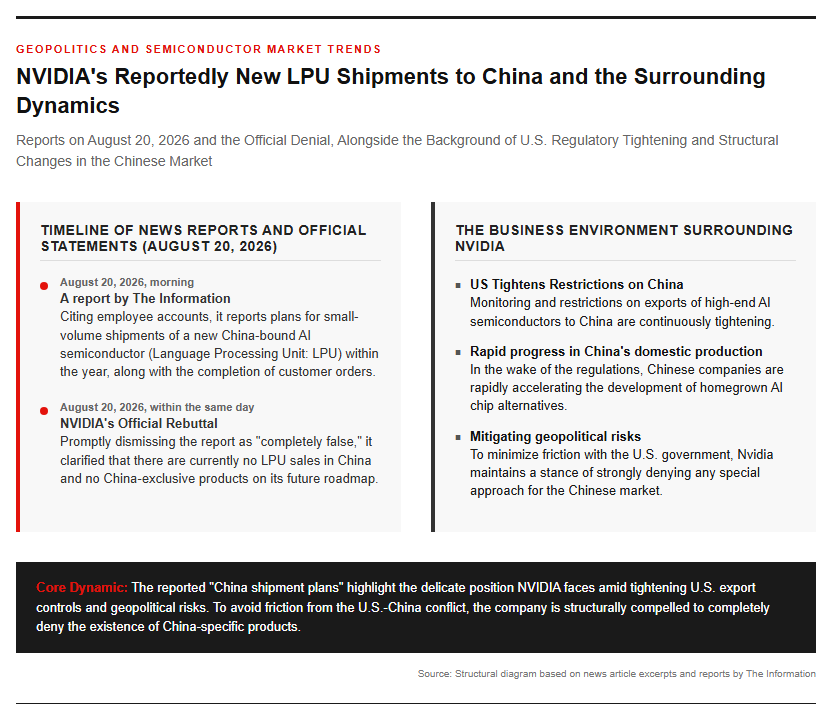
On August 20, 2026, U.S. tech media outlet The Information reported, citing two Nvidia employees, that the company plans to begin small-scale shipments of AI chips designed for Chinese customers later this year. The report went as far as to claim that some customers have already placed orders for the products. However, Nvidia issued an official statement on the same day denying the claims. A company spokesperson called The Information’s report completely false, explicitly stating that Nvidia is not currently selling language processing units in the Chinese market and that no China-exclusive products exist on the company’s future roadmap. This swift denial is believed to be heavily driven by an intent to avoid further geopolitical friction with the U.S. government regarding export controls to China. The figure below illustrates the situation surrounding Nvidia’s business in China.
The Truth Behind the Reported New Semiconductor and Groq’s Licensed Technology
According to The Information, the reported new semiconductor is a type of AI accelerator known as a language processing unit. The technology reportedly adopts an architecture licensed from Grov, an AI chip startup. Combined with traditional graphics processors, the inference-focused design dramatically increases the response speed of AI chatbots and other applications. It was also reported that the product complies with current U.S. export controls, and that its software has been modified to work with other processors available in China, following restrictions that prevent the next-generation AI system, Vera Rubin, from being exported there due to U.S. regulations. Although NVIDIA has completely denied the product development and shipping plans themselves, market interest remains high regarding the possibility that the company has been exploring technology specialized in accelerating inference processing.
NVIDIA’s Plight Caused by Tightened US Export Controls on China
The evolution of successive export controls and the export ban extending even to “H20”
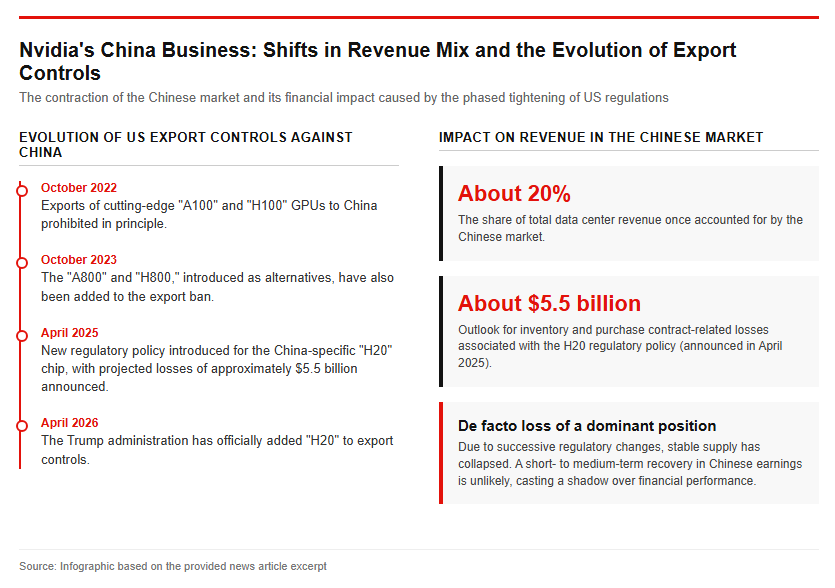
In October 2022, the U.S. Department of Commerce effectively banned the export of cutting-edge GPUs, the A100 and H100, to China. In response, NVIDIA developed the downgraded A800 and H800 chips to maintain its foothold in the Chinese market; however, tightened regulations in October 2023 subjected these to the embargo as well. Although the company subsequently introduced the H20 and other China-exclusive chips with further reduced specs, the Trump administration added the H20 to the export control list in April 2026. Through such step-by-step measures, the U.S. government has steadily closed loopholes, and because the rules change almost as soon as NVIDIA develops compliant products, the company continues to suffer massive losses. These repeated regulatory shifts make the stable supply of products impossible, fundamentally undermining NVIDIA’s strategy in China.
The loss of a massive market accounting for 20% and its direct impact on business performance
The Chinese market was once a vital, massive market accounting for approximately 20% of NVIDIA’s total data center revenue. However, due to repeated tightening of U.S. export controls, the company is effectively losing its dominant position in this market. In fact, following new regulatory policies regarding the H20 announced in April 2025, the company projected it would incur approximately $5.5 billion in inventory and purchase commitment-related losses. Analysts also warn that the exclusion of direct revenue from China risks causing third-quarter earnings forecasts to fall significantly short of market expectations. While NVIDIA is attempting to capture global AI demand and compensate by ramping up production of next-generation architectures like Blackwell, revenue from China—which once sustained the company—shows no sign of recovering in the short to medium term, casting a shadow over the outlook for its stock price and financial performance. The chart below illustrates the changes in NVIDIA’s revenue composition.
The “De-Nvidia” Trend and the Rise of Domestic Chips in China
Successive rollouts of domestic alternatives, such as Huawei’s “Ascend 910C”
The supply gap left by NVIDIA products has created a crucial opportunity for domestic Chinese semiconductor manufacturers. Chinese telecommunications giant Huawei has begun mass-shipping its Ascend 910C AI accelerator, which is based on a proprietary architecture. The chip is reported to deliver roughly 60% to 80% of the performance of NVIDIA’s high-end H100 model in specific AI inference tasks. Additionally, Baidu-backed Kunlunxin has introduced the P800, and Cambricon has rolled out the Siyuan 590 to the market in quick succession. Once dominating 95% of China’s AI chip market, NVIDIA’s share is projected to drop to around 50% in 2025, and by 2026, the combined market share of NVIDIA and AMD is expected to plummet to roughly 10%, with the market being largely replaced by domestic chips. Major Chinese tech companies are rapidly building independent, NVIDIA-free ecosystems to ensure their survival.
Remote Access via Southeast Asia and Future Regulatory Trends
While domestic chips are rising rapidly, Chinese AI companies are also seeking alternative ways to secure cutting-edge computing power. This involves remotely renting NVIDIA’s advanced chips (such as the GB300)—which are restricted from direct purchase—from data centers in Southeast Asia and other Asian regions, including Malaysia, Thailand, and Japan. Current U.S. export controls target the physical ownership and transportation of chips, making remote access via networks a legal loophole. In response, the U.S. House of Representatives has already passed the Remote Access Security Act to regulate remote access, and future focal points include Senate approval and the establishment of strict customer verification rules. Behind NVIDIA’s denial of a product roadmap for China lies the U.S.-China geopolitical tug-of-war over these legal loopholes and increasingly stringent regulatory oversight.
Reference Page
- [U.S. Department of Commerce Bureau of Industry and Security (BIS) October 7, 2022 Export Administration Regulations Amendment Federal Register Notice] https://www.govinfo.gov/content/pkg/FR-2022-10-13/pdf/2022-21658.pdf
[#Semiconductors #AIChips #NVIDIA #USChinaTechSupremacy #AIInference #GeopoliticalRisk]
📊 We can also create a visual chart detailing the market share trends comparing NVIDIA’s sharp decline in China and the development roadmaps of local semiconductor companies like Huawei. Let us know if you would like one.

コメント