The Ministry of Land, Infrastructure, Transport and Tourism (MLIT) has proposed considering stricter taxation on the short-term flipping of newly constructed condominiums in its FY2027 tax reform requests. This initiative is driven by a rapid rise in speculative transactions detached from actual residential demand and skyrocketing condominium prices, particularly in central Tokyo.
- Ministry Requests Stricter Capital Gains Taxation on Short-Term Flipping
- The Rapid Surge in Short-Term Flipping in Central Tokyo
- Current Capital Gains Tax Rates and Dormant Surcharge Provisions
- Industry Voluntary Measures and Constitutional Limits on Property Rights
- Real-Demand Buyers and Market Liquidity Impacts
- Key Points to Watch in Future Policy Design and Tax Outlines
Ministry Requests Stricter Capital Gains Taxation on Short-Term Flipping
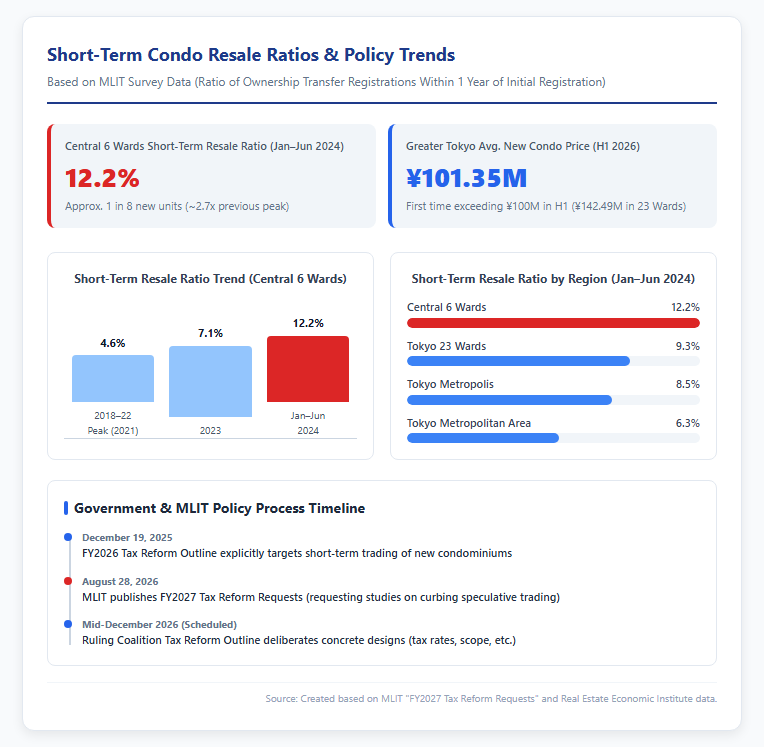
On August 28, 2026, the Ministry of Land, Infrastructure, Transport and Tourism (MLIT) released its FY2027 tax reform requests, highlighting policy measures to address soaring prices of new condominiums as a primary agenda item. Specifically, the ministry stated it will study and implement necessary measures to curb speculative transactions not backed by real residential demand. This policy direction did not emerge out of nowhere; the FY2026 tax reform outline released on December 19, 2025, had already explicitly noted the need for tax measures regarding short-term trading of new condominiums. Following MLIT’s detailed investigations into market conditions, the policy has now advanced to the formal tax reform request stage. Concrete designs regarding tax categories and rates will be deliberated in the ruling party’s tax research commission toward the end of the year. The government’s objective is to foster an environment where actual homebuyers can purchase residences more easily. For a visual illustration of market trends, please refer to
.
The Rapid Surge in Short-Term Flipping in Central Tokyo
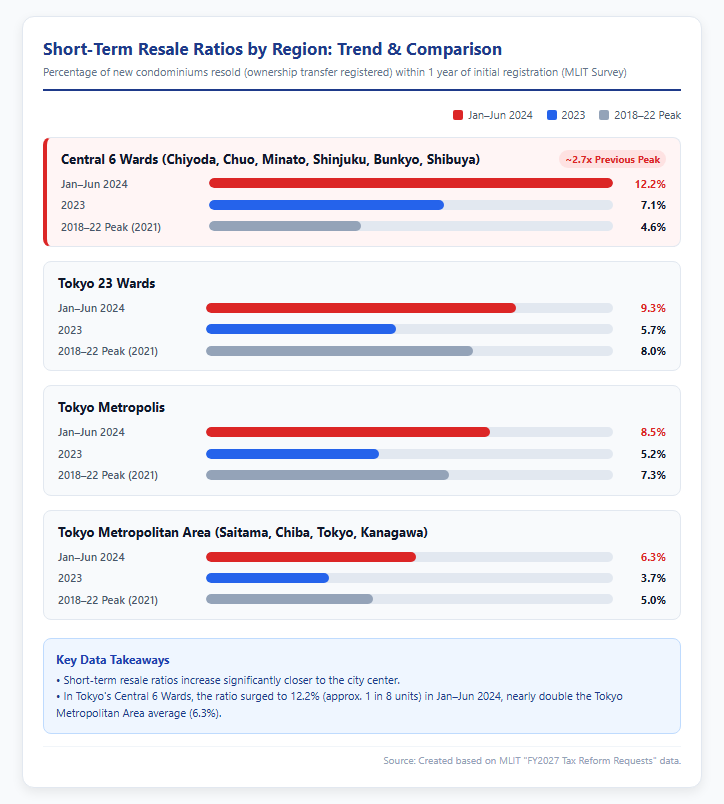
The primary catalyst for government intervention is data showing a sharp rise in short-term flipping in central Tokyo. According to MLIT surveys, the proportion of new condominiums resold within one year of initial ownership registration reached 12.2% in Tokyo’s central 6 wards during the January–June 2024 period. This represents a steep increase from 7.1% in 2023 and is approximately 2.7 times the previous peak of 4.6% recorded in 2021 (the highest level observed between 2018 and 2022). Across Tokyo’s 23 wards, the ratio stood at 9.3%, and for the entire Tokyo Metropolitan Area, 6.3%, clearly demonstrating that short-term resales become more prevalent closer to the city center. With roughly 1 in 8 new condominiums in central Tokyo being resold within a single year, speculative capital inflows—alongside rising construction material and labor costs—are viewed as artificially inflating prices. These transactions drive up housing costs and rents, severely hindering genuine homebuyers from relocating. For regional data on short-term resale ratios, please refer to
.
Tax Increase Mechanisms and Existing Legal Frameworks
Current Capital Gains Tax Rates and Dormant Surcharge Provisions
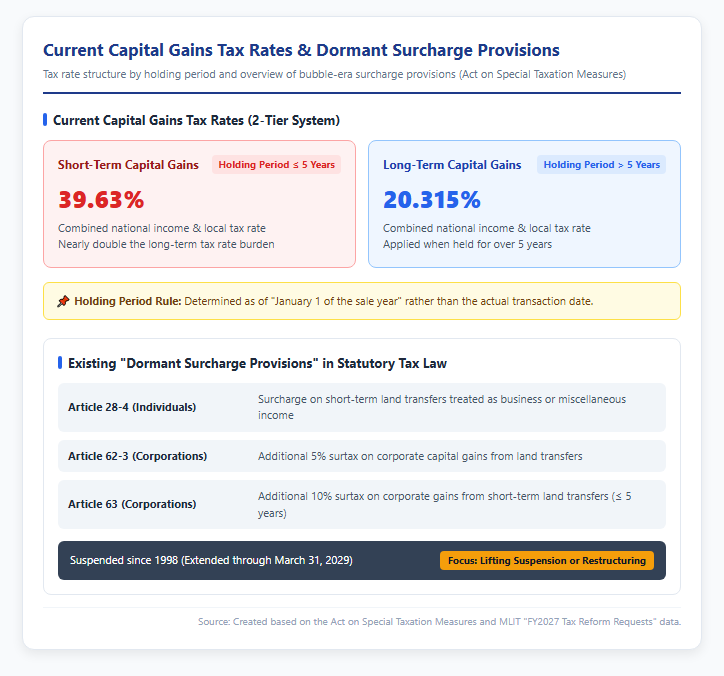
Capital gains tax on real estate sales in Japan is determined by ownership duration as of January 1 of the sale year. Short-term capital gains (ownership of 5 years or less) are subject to a combined national income tax and local tax rate of 39.63%, nearly double the 20.315% rate applied to long-term capital gains (ownership of over 5 years). However, because short-term flipping continues to climb even under the 39.63% rate, authorities have concluded that current taxation provides insufficient deterrence. Notably, Japanese tax law already contains heavy surcharge provisions enacted during the asset bubble era—specifically Article 28-4 of the Act on Special Taxation Measures for individuals, as well as Articles 62-3 and 63 for corporations. These statutory provisions were suspended in 1998 following land price declines, and their suspension has been repeatedly extended through March 31, 2029. Rather than enacting entirely new legislation, lifting the suspension or restructuring these existing dormant provisions represents a major focal point. For a diagram illustrating tax rates and holding periods, please refer to
.
Industry Voluntary Measures and Constitutional Limits on Property Rights
Ahead of formal tax reforms, private-sector voluntary restrictions are already moving forward. Following Tokyo’s Chiyoda Ward making an unprecedented request in July 2025 for a 5-year resale restriction, the Real Estate Association of Japan announced counter-measures on November 25, 2025. The association established three primary pillars: capping the number of units registered or purchased per entity, strictly enforcing matching names between applications and registrations, and prohibiting sales activities between contract signing and property delivery. Major developers such as Mitsui Fudosan Residential and Sumitomo Realty & Development have also independently introduced resale prevention clauses and purchase quantity limits. However, under constitutional protections of property rights, restricting a buyer’s right to dispose of private property after delivery and title transfer presents substantial legal hurdles. Consequently, industry measures remain restricted to the pre-delivery phase, making governmental tax and legislative action essential for regulating post-delivery resales. For an overview of voluntary measures and legal boundaries, please refer to
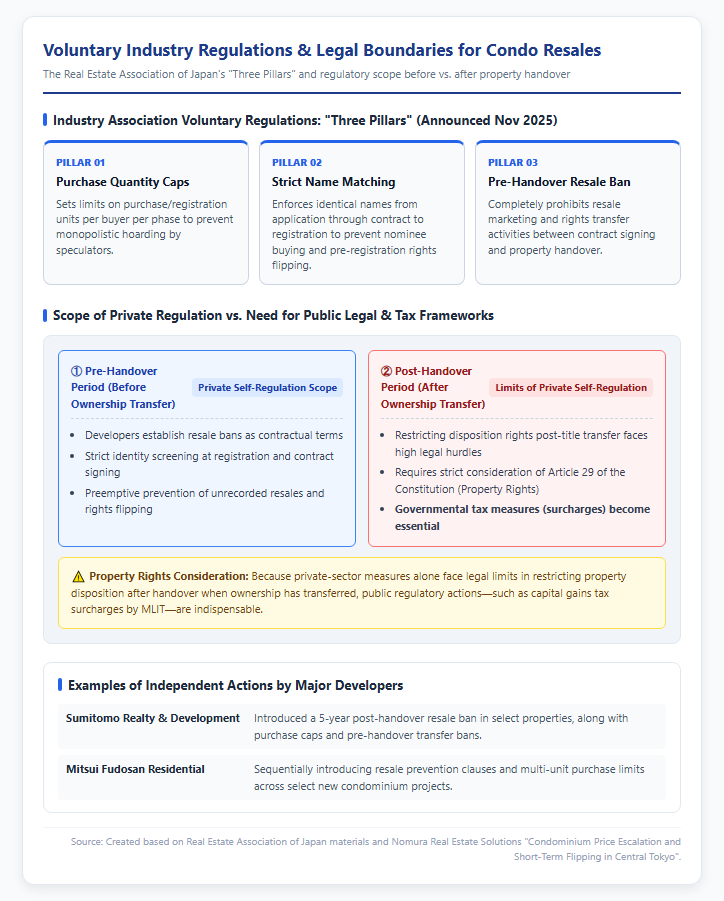
.
Market and Resident Impacts and Future Challenges
Real-Demand Buyers and Market Liquidity Impacts
In the first half of 2026, the average price of newly built condominiums in the Tokyo Metropolitan Area reached 101.35 million yen, surpassing the 100 million yen threshold for the first time in a first-half period. In Tokyo’s 23 wards, average prices reached 142.49 million yen, creating immense affordability barriers for typical homebuyers. If tax increases and purchase limits successfully curb speculative demand, reduced competition in purchase lotteries and moderated price escalation could help restore access for real-demand buyers. Conversely, real estate experts warn that aggressive tax hikes risk dampening liquidity and normal transactions in the pre-owned condominium market. Furthermore, properties held vacant purely for short-term resale profit hinder homeowners’ association consensus-building and delay major building maintenance projects. For an overview of real-demand versus speculative market dynamics, please refer to
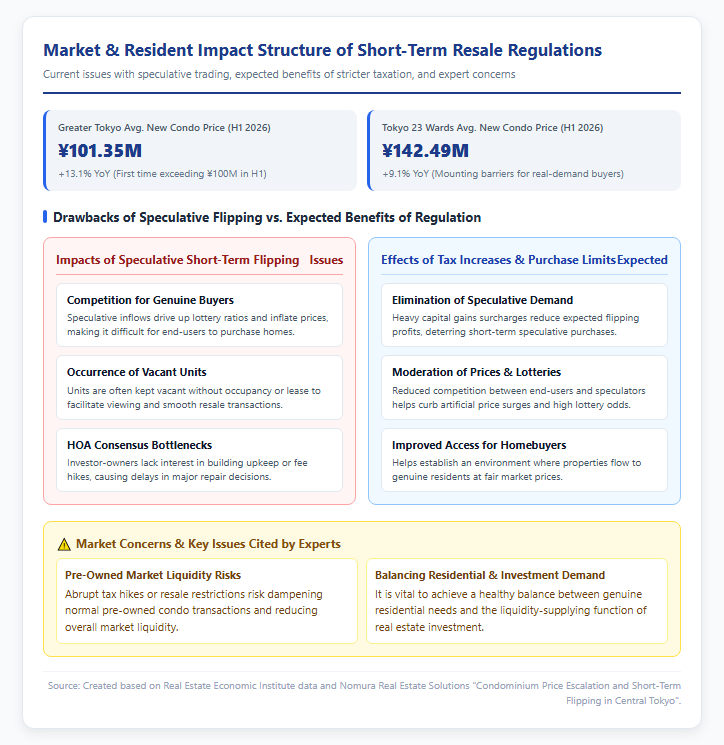
.
Key Points to Watch in Future Policy Design and Tax Outlines
The primary focus now turns to the ruling party’s tax reform outline scheduled for publication in mid-December 2026. MLIT’s current request remains qualitative, stating only that necessary studies will be conducted and appropriate measures taken, without detailing specific tax rates, additional charges, or property eligibility scope. Critical unresolved questions include whether regulations will target new condominiums exclusively or expand to pre-owned units and detached houses, and whether the targeted holding period will be set at 1 year or 5 years. Property-owning individuals and corporations are advised to audit their holding periods using the January 1 benchmark date. How effectively policymakers balance curbing speculative transactions with maintaining healthy market liquidity will be closely monitored.
References
- 【The Real Estate Association of Japan: “Initiatives Regarding Speculative Short-Term Resale of Condominiums”】https://www.fdk.or.jp/k_etc/tankitenbai.html
【#NewCondominiums #ShortTermFlipping #TaxIncrease #MLIT #TaxReform #RealEstatePrices #RealEstateAssociation #CapitalGainsTax】

コメント