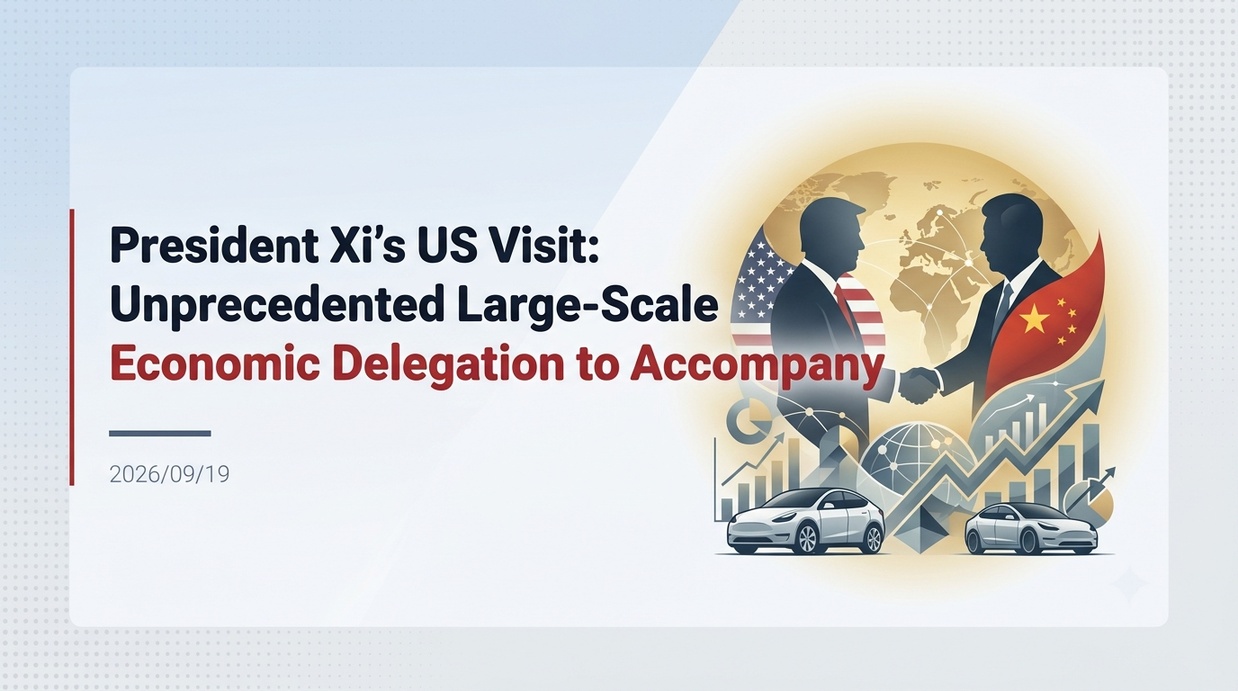
Chinese President Xi Jinping will be accompanied by a massive economic delegation of technology and finance executives during his visit to the United States. Driven by the principle of reciprocity ahead of the U.S.-China summit, the move aims to project equal diplomatic standing between the two nations.
- Major Technology and Finance Executives Gather for a High-Profile Mission
- Reciprocity and the Legacy of Trump’s May Visit to China
- Inclusion of Sanctioned Entities Sparks White House Reluctance
- Uncertain Negotiation Paths Across AI, Tariffs, and Rare Earths
- Shifting U.S.-China Business Environment and Corporate Adaptation
- Persistent Structural Rivalry and the Future of Economic Security
Major Technology and Finance Executives Gather for a High-Profile Mission
Ahead of the U.S.-China summit scheduled for September 24, 2026, the Chinese government is finalizing preparations for a large-scale business delegation to accompany President Xi Jinping on his visit to the United States. The Ministry of Commerce of China has already begun reaching out to major corporations, with official invitations expected to be issued within days following visa approvals by the U.S. Department of State. Business executives under consideration span a broad range of sectors—including technology, finance, electric vehicles, and aerospace—led by industry giants such as electric vehicle maker BYD and battery manufacturer CATL. The dispatch of this economic mission is intended not merely as a ceremonial gesture of goodwill, but as a deliberate demonstration to the world of the deep economic ties between the two nations. Please refer to the delegation structure image below.
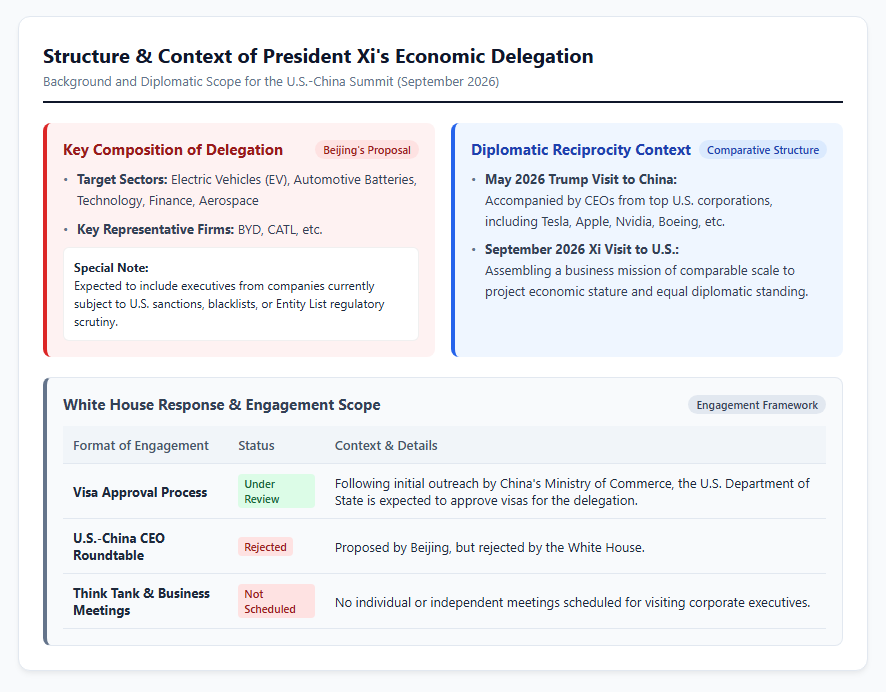
On the other hand, the White House has reportedly rejected Beijing’s proposal for a U.S.-China CEO Roundtable. Furthermore, no individual meetings have been scheduled for the visiting executives with U.S. think tanks or major business organizations. Despite these diplomatic restrictions, China aims to showcase its economic prominence and strong determination in negotiations by bringing a formidable lineup of private-sector leaders.
Reciprocity and the Legacy of Trump’s May Visit to China
The motivation behind Beijing assembling such an extraordinarily large economic delegation lies in the precedent set by U.S. President Donald Trump’s visit to China in May 2026. At that time, President Trump arrived in Beijing accompanied by CEOs from top American corporations, including Tesla, Apple, Nvidia, and Boeing. In responding to President Xi’s return visit, the Chinese government seeks to match that scale and prominence, thereby thoroughly upholding diplomatic reciprocity.
Both Washington and Beijing have placed a strong emphasis on reciprocity throughout the preparation process, demanding an equal footing not only in diplomatic protocol but also in the scale of business delegations. By parading the leaders of its flagship industries, Beijing aims to demonstrate resilience against unfair U.S. economic pressure, using its corporate footprint as a leverage card in negotiations over market access and tariff reductions. Beneath the surface of deepening bilateral rivalry lies a shared underlying recognition that maintaining channels for economic dialogue remains essential.
The Sanctioned Firms Dilemma and Core Summit Agendas
Inclusion of Sanctioned Entities Sparks White House Reluctance
One of the most contentious aspects of the delegation’s assembly is the potential inclusion of executives from Chinese firms currently under U.S. sanctions, blacklists, or entity list regulatory scrutiny. President Xi’s strategic intent in bringing these restricted business leaders echoes President Trump’s May visit to Beijing, which included U.S. executives impacted by Chinese market access and environmental regulations.
However, strong concerns persist within the U.S. Department of Defense and mainstream Republican circles regarding the reception of corporate leaders affiliated with entities sanctioned on national security grounds. The ongoing visa review process by the U.S. Department of State and White House efforts to curb the scope of commercial engagements reflect these internal political frictions. While Beijing hopes to leverage the visit to seek breakthroughs in lifting sanctions and easing regulatory burdens, intense friction is anticipated even in preliminary discussions given the deep-seated wariness toward China in Washington.
Uncertain Negotiation Paths Across AI, Tariffs, and Rare Earths
Prior to the summit on September 24, 2026, preparatory talks will take place in New York from September 20 to 21 between U.S. Treasury Secretary Scott Bessent, U.S. Trade Representative Jamieson Greer, and Chinese Vice Premier He Lifeng. The primary agenda covers a wide range of issues, including artificial intelligence (AI) governance, tariff reviews, the lifting of rare earth export controls, and the expansion of agricultural trade. Please refer to the negotiation framework image below.
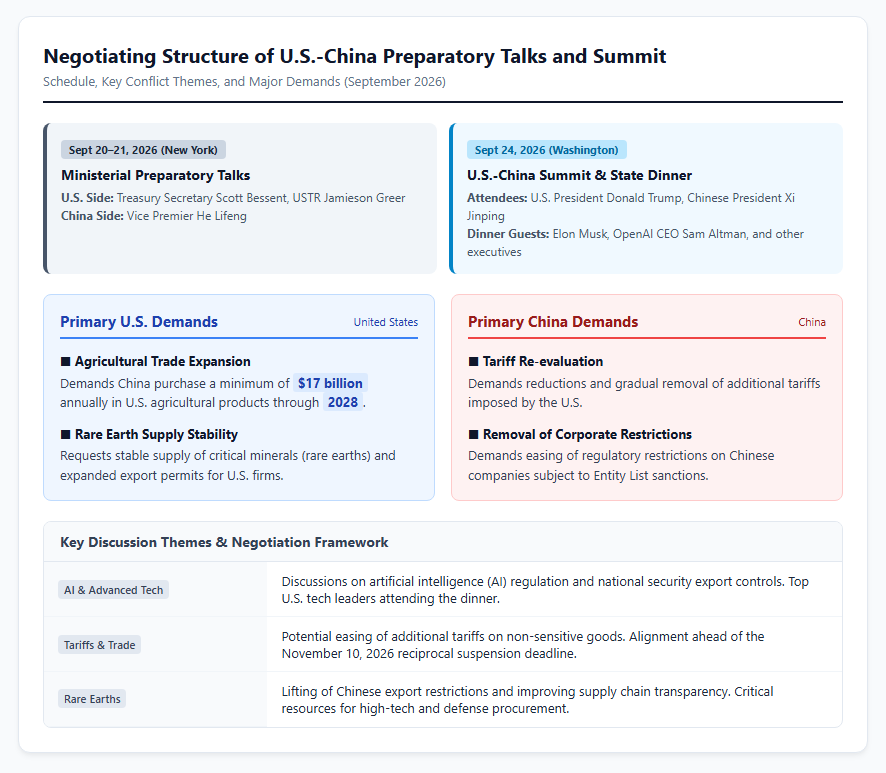
The United States is pushing China to guarantee stable supplies of rare earth minerals and commit to purchasing a minimum of \$17 billion annually in U.S. agricultural products through 2028. Conversely, Beijing is demanding further tariff cuts and the removal of discriminatory restrictions against Chinese enterprises. Although prominent U.S. tech leaders—including Elon Musk and OpenAI CEO Sam Altman—are expected to attend the state dinner on September 24, high technical barriers and national security considerations surround advanced technology, leading observers to remain cautious about any dramatic breakthroughs.
Industry Impact and Long-Term Outlook
Shifting U.S.-China Business Environment and Corporate Adaptation
Despite the high-profile economic delegation, practical uncertainty across the U.S.-China business landscape remains unresolved. Based on agreements reached during the October 2025 negotiations in Kuala Lumpur, both nations temporarily suspended key reciprocal restrictions—such as the U.S. 50% Affiliates Rule and China’s retaliatory measures. However, this suspension period is set to expire on November 10, 2026. As the deadline approaches, global enterprises are being forced to re-examine their transaction counterparties’ capital structures and supply chains.
Many suppliers and procurement departments are urgently building data frameworks to trace Bill of Materials (BOM) origins and ownership chains. While U.S. decoupling policies continue to advance, the 2025 U.S. goods trade deficit with China has not shrunk significantly, highlighting the difficulty of rapidly severing structural economic interdependence. Consequently, even as businesses monitor potential short-term tariff relief from the summit, they are actively pursuing operational adjustments, including the construction of dual supply chains to hedge against the potential resumption of regulatory enforcement.
Persistent Structural Rivalry and the Future of Economic Security
The upcoming summit underscores a transition in U.S.-China relations from outright friction to a framework of “managed competition.” Within the Trump administration, policy volatility is heightened by internal divisions between the “New Right”—which prioritizes Western Hemisphere defense and pragmatic economic deals—and traditional conservatives advocating for continued military containment of China. Meanwhile, China under Xi Jinping is accelerating domestic technology development and securing geopolitical strategic space, leading to a steady decline in mutual structural complementarity.
The ultimate focus rests on whether dialogue facilitated by this large economic delegation can yield tangible, if limited, agreements such as tariff reductions on non-sensitive goods and trade promotion. The strategic maneuvering surrounding the November 2026 regulatory suspension deadline and the ongoing battle for technological supremacy in semiconductors and AI are set to persist. International stakeholders, including Japanese corporations, must establish autonomous economic security strategies and sophisticated risk management systems rather than relying solely on the volatile decisions of U.S. and Chinese leadership.
Reference Pages
- [Understanding International Relations Through the U.S.-China Summit: The Shift in U.S. China Policy] https://faportal.deloitte.jp/report/articles/2195
【#USChinaSummit #XiJinping #PresidentTrump #EconomicDelegation #TradeFriction #EconomicSecurity】

コメント