On September 15, 2026, AI startup TypeSafe AI launched early access for “Jev,” a novel AI model that produces structured decisions without generating natural language text. This comes in response to the growing issue of traditional language models consuming excessive time and cost on unnecessary prose generation.
- The “System One Model” Category and Development Background
- Three Input/Output Primitives for Structured Decisions
- “RLCD” Training and Parallel Sampling Mechanics
- Quantitative Comparison with Frontier LLMs Across Four Key Metrics
- Five Insertion Points and Two-Stage Architecture
- Implementation Caveats and the Evolution of AI Architecture
The “System One Model” Category and Development Background
On September 15, 2026, startup TypeSafe AI launched early access for “Jev,” a novel AI model designed to output typed decision results without generating text. Co-founder Diogo Almeida, a former OpenAI researcher who contributed to foundational RLHF and InstructGPT work (which laid the groundwork for ChatGPT), unveiled the model after nearly two years in stealth development. The company secured \$40 million in a seed round led by DCVC.
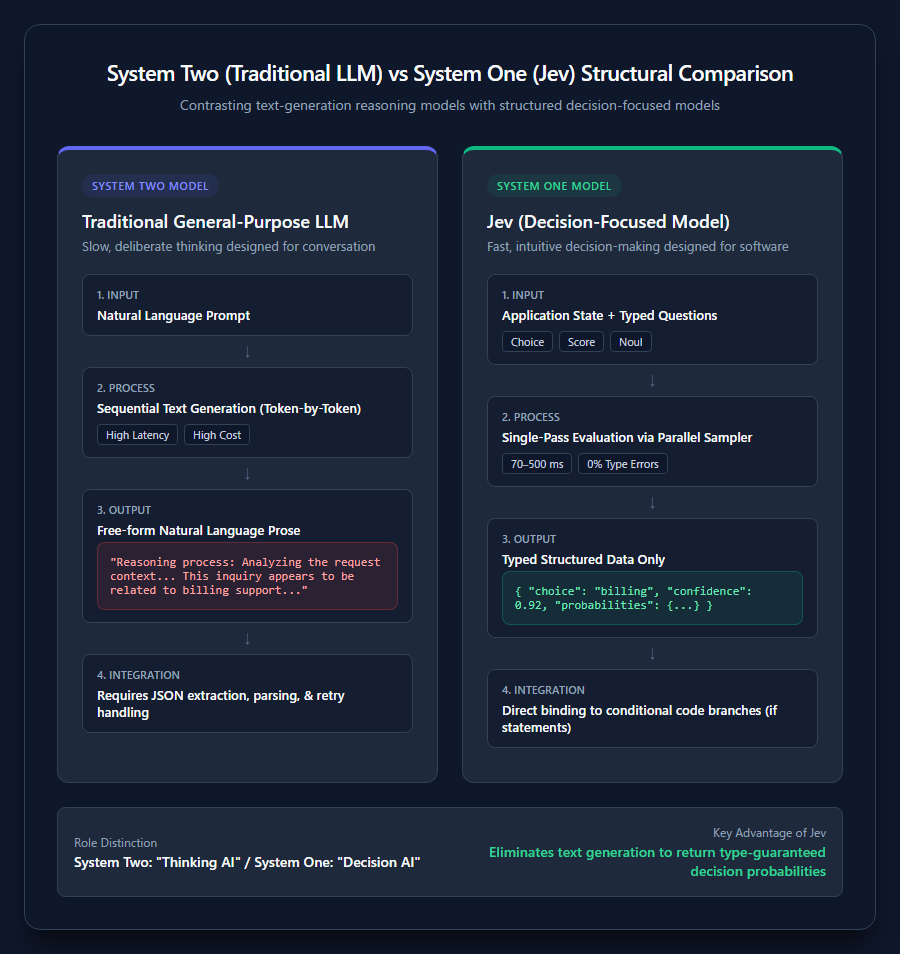
Traditional general-purpose Large Language Models (LLMs) operate by sequentially generating natural language text token-by-token. While exceptional at complex reasoning and composition, they incur unnecessary latency and cost when executing simple tasks like classification or approval due to their output of prose and explanations. TypeSafe AI categorizes these conventional LLMs as “System Two” (analogous to slow, deliberate thinking), while defining Jev as a “System One Model”—a new category representing fast, intuitive decision-making. By intentionally foregoing human-readable text generation, Jev serves as a specialized intelligence component embedded directly within software architectures. The figure below illustrates the overall architecture and data flow of a System One model.
Three Input/Output Primitives for Structured Decisions
Jev receives application state (such as natural language text or JSON objects) as input and returns structured outputs for predefined, typed questions. The model’s input/output formats are classified into three basic primitives: “Choice,” “Score,” and “Noul.”
- Choice: An exclusive classification format that selects the single most appropriate option from up to 255 candidates. Used for tasks like routing support tickets or classifying documents, it returns the selected option alongside the full probability distribution across all choices and an overall confidence score.
- Score: An evaluation format that rates inputs along a 2-to-10-stage scale. It evaluates metrics like customer frustration or code quality, outputting a continuous score weighted by probability rather than a discrete label, accompanied by a confidence level.
- Noul: A Yes/No determination format that evaluates whether a given proposition is true. For questions such as “Is the user requesting a refund?”, it returns a single real-number probability between 0 and 1.
The defining feature common to all three primitives is that they completely eliminate free-form responses at the type-definition level. This removes the need for text parsing, JSON validation, and retry logic in conventional LLM pipelines, allowing returned values to be directly integrated into program conditional branches (if statements).
Ultra-Fast, Ultra-Low-Cost Technology and Performance Benchmarks
“RLCD” Training and Parallel Sampling Mechanics
Behind Jev’s dramatic speed and cost advantages over traditional LLMs are fundamental technical innovations in inference structure and training methodology. Unlike autoregressive models that process outputs token-by-token, Jev utilizes a parallel sampler that evaluates all outputs in a single query pass. This significantly reduces computational overhead during inference.
For post-training, TypeSafe AI introduced a new reinforcement learning technique called “RLCD” (Reinforcement Learning for Calibrated Decisions). Unlike RLHF (which optimizes for human preference) or RLVR (which optimizes for programmatically verifiable correctness), RLCD aims to optimize “probability calibration”—ensuring that predicted probabilities statistically align with actual long-term accuracy. For instance, when the model outputs an 80% confidence level, that decision proves to be correct 80% of the time in statistical practice. The figure below compares RLCD’s calibration curve against conventional reinforcement learning methods.
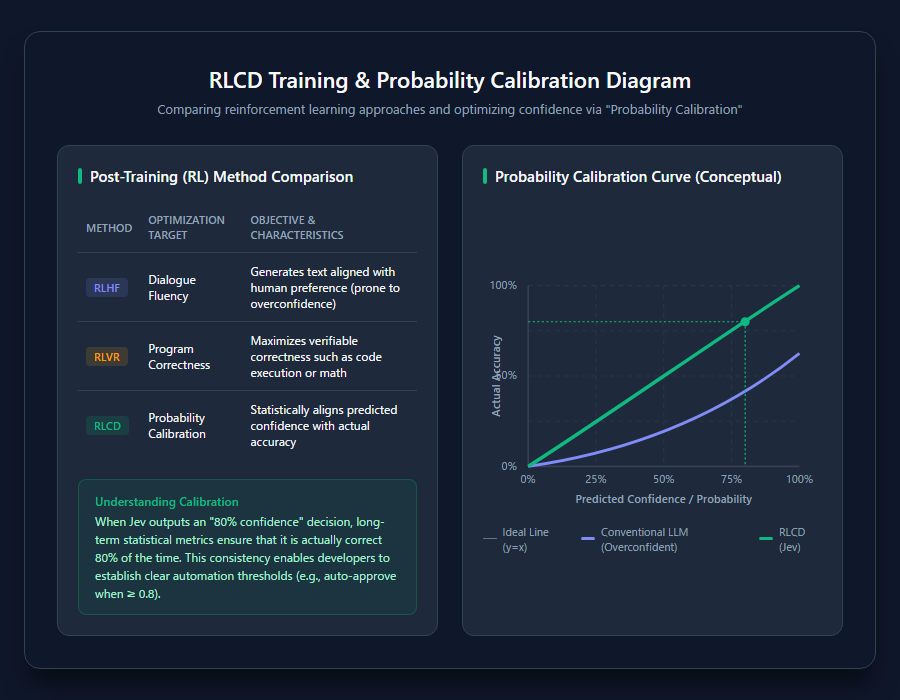
Through this optimization, predicted probabilities and confidence scores function as reliable signals of uncertainty, enabling developers to establish clear, automated threshold logic within their applications.
Quantitative Comparison with Frontier LLMs Across Four Key Metrics
Based on TypeSafe AI’s published workflow evaluation data, comparing Jev with leading frontier LLMs across four metrics highlights its distinct positioning:
- Latency (Response Time): Jev’s end-to-end response time ranges from 70 to 500 milliseconds (averaging ~0.4 seconds). Compared to GPT-5.6 Terra (10.1 seconds) and Claude Opus 5 (37.8 seconds), this represents a 20x to 200x speedup.
- Cost (Pricing): Input pricing is set at \$0.042 per million tokens (\$0.042/1M), with output tokens being completely free. The cost per case is approximately \$0.0004, making it roughly 1/40th to 1/400th the cost of frontier LLMs.
- Structured Output Error Rate: Because text generation is eliminated and the output space is mathematically constrained, the error rate due to schema violations or type mismatches is 0%.
- Accuracy (Reference Label Agreement): Across four benchmarked business workflows, Jev achieved an average accuracy of 67.8%. This places it on par with GPT-5.6 Terra (67.9%), though behind higher-tier models like GPT-5.6 Sol (74.1%) and Claude Opus 5 (73.1%).
These quantitative benchmarks demonstrate that while Jev does not match the accuracy of top-tier LLMs, it delivers mid-tier intelligence at orders-of-magnitude faster speeds and lower costs.
Pipeline Integration and Future Outlook
Five Insertion Points and Two-Stage Architecture
Jev is designed not as a wholesale replacement for existing AI systems, but as a specialized component to be inserted into specific “decision nodes” within business pipelines. Five primary integration points include:
- Replacing LLM-as-a-judge workflows (accelerating evaluation and scoring)
- Agent routing nodes (selecting the next tool or sub-agent)
- Pre-RAG query classification and document filtering
- Content moderation and security guardrail verification
- Batch classification pipelines for large datasets
In production environments, leveraging Jev’s calibrated probabilities in a “two-stage architecture” (Human-in-the-loop / Model-in-the-loop) proves highly effective. For example, Jev performs initial screening on incoming data; cases where confidence meets or exceeds 0.8 are processed automatically at high speed. Only ambiguous cases with confidence below 0.8 are escalated to high-accuracy models like GPT-5.6 Sol or Claude Opus 5, or to human reviewers. This hybrid approach drastically reduces execution time and cost while maintaining overall system accuracy.
Implementation Caveats and the Evolution of AI Architecture
When considering Jev, organizations must account for specific limitations inherent to its design. First, because Jev cannot output free-form natural language text or explanations, it is unsuitable for tasks like user-facing response generation or report writing. Second, while type errors and schema violations are prevented structurally, semantic errors (selecting the wrong valid choice) can still occur. Additionally, as of September 2026, the model remains in early access, requiring production deployments to pin specific model versions (e.g., jev-1.13.0) and maintain fallback routes for API redundancy.
Looking ahead, enterprise AI architecture is shifting away from relying solely on a single monolithic LLM toward a clear division of labor. “System Two” models handle deep reasoning and composition, “System One” models perform ultra-fast classification and verification, and deterministic code manages precise business logic. Layering these components together forms a highly reliable, cost-effective foundation for next-generation automation.
Reference Pages
- 【TypeSafe AI – Introducing System One Models & Jev】https://typesafe.ai/blog/introducing-system-one-models-and-jev
- 【TypeSafe AI – Jev Documentation】https://docs.typesafe.ai/introduction
- 【Vercel – TypeSafe AI’s Jev now available on AI Gateway】https://vercel.com/changelog/typesafe-ai-jev-now-available-on-ai-gateway
【#Jev #TypeSafeAI #SystemOneModel #RLCD #AI #GenerativeAI #StructuredOutputs #AIInfrastructure】


コメント