Oyabe City in Toyama Prefecture submitted a supplementary budget proposal to its city council adding 600 million yen to the construction cost for its new municipal office, following a failed bidding process. The cost increase stems from rising material prices, severe labor shortages, and elevated contractor quotes driven by the impact of the Noto Peninsula Earthquake.
- Failed Bidding and the Evolution of Project Costs Leading to the 600 Million Yen Budget Increase
- Architectural Design, Functional Integration, and Energy-Efficiency Initiatives of the New Building
- Escalating Material Prices, Labor Costs, and the Hokuriku Construction Market
- Struggling Local Governments Across Japan Reevaluate Municipal Office Plans
- Municipal Bond Issuance and Measures to Suppress Actual Debt Burden
- Upcoming Re-Tender and the Challenges of Sustainable Public Infrastructure Development
Failed Bidding and the Evolution of Project Costs Leading to the 600 Million Yen Budget Increase
On September 15, 2026, Oyabe City in Toyama Prefecture submitted a supplementary budget proposal to the city council, adding 600 million yen to the construction cost for its new municipal hall project. The original bidding for the construction, held in August 2026, ended in failure after all participating contractors withdrew their bids. Following this bid cancellation, the city reviewed its estimated cost and decided to increase the project budget to enable a swift re-tender.
Oyabe City’s current main office building is 60 years old and faces severe structural issues, including insufficient earthquake resistance and advanced deterioration of facility infrastructure. To address these vulnerabilities, the city formulated a main office redevelopment plan. However, driven by sharp inflation and surging building material costs in recent years, the total project budget has undergone repeated upward revisions.
When the basic design was finalized in August 2025, the estimated total project cost was approximately 6.76 billion yen. By June 2026, the final implementation design report saw that figure rise by about 370 million yen to roughly 7.13 billion yen due to rising material expenses. Key components included approximately 5.94 billion yen for new building construction, 260 million yen for demolishing the existing office, 380 million yen for exterior landscaping, and 430 million yen for fixtures and furniture. The latest 600 million yen supplementary budget represents a difficult decision to break the bidding deadlock and secure the start of construction, pushing the total project expenditure higher still.
Architectural Design, Functional Integration, and Energy-Efficiency Initiatives of the New Building
The planned new office building for Oyabe City features a four-story reinforced concrete structure equipped with a base-isolation seismic system to strengthen its function as a disaster management headquarters. The new main building will cover a total floor area of 6,294 square meters—about 1.1 times the size of the current facility. Additionally, the complex will include a 129-square-meter garage facility and a 139-square-meter canopy structure.
In terms of functional layout, administrative services that are currently scattered across separate buildings—such as welfare department offices—will be consolidated into the new building, enhancing citizen convenience and optimizing operational efficiency. Furthermore, advanced energy-efficient design principles have been incorporated throughout the structure to minimize environmental impact and lower long-term maintenance costs. For instance, the window area has been intentionally limited compared to conventional public buildings to reduce thermal exchange with the outdoors.
Please refer to the following layout diagram for visual details on the planned appearance and spatial configuration of the new main building.
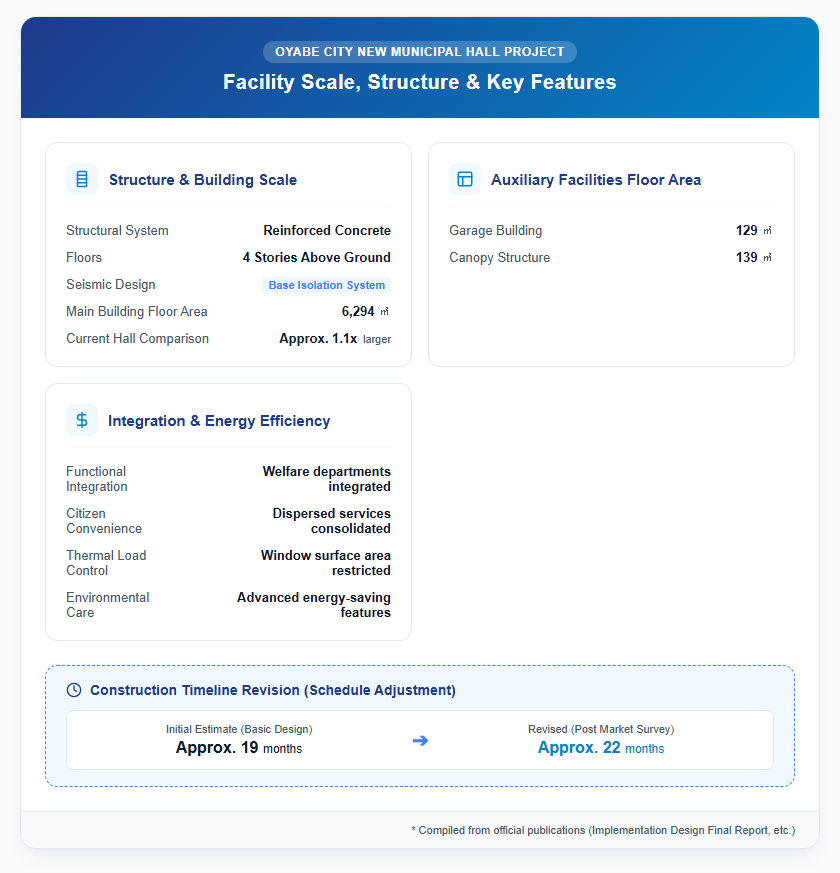
Regarding the project timeline, the construction phase—originally estimated at approximately 19 months during the basic design stage—was extended to roughly 22 months to reflect feedback from market sounding surveys with industry contractors and site verification analyses. Following approval of the supplementary budget by the city council, the city aims to re-issue the construction tender by the end of September 2026 to ensure an expedited groundbreaking.
Soaring Construction Material Costs and Nationwide Revisions to Municipal Hall Projects
Escalating Material Prices, Labor Costs, and the Hokuriku Construction Market
Behind Oyabe City’s cost expansion and bid failure lies a dramatic surge in construction costs affecting the entire industry. Essential public works materials—such as ready-mix concrete, aggregates, cement, and structural steel—have seen successive price hikes driven by rising raw material costs, logistics expenses, and electricity rates.
Looking at the construction material market in Toyama Prefecture, the Toyama Aggregate Sales Co-operative Union implemented a uniform price increase of 300 yen per ton across all product types to pass on rising quarry development and fuel expenses to buyers. Similarly, ready-mix concrete co-operatives in various districts are negotiating price increases of 1,000 to 3,000 yen per cubic meter, maintaining a firm stance on price hikes.
Compounding these challenges are chronic shortages of skilled tradespeople, an aging workforce, and rising labor unit costs fueled by labor reforms. In the Hokuriku region specifically, a sharp surge in demand for materials and labor driven by post-disaster reconstruction following the 2024 Noto Peninsula Earthquake has further tightened contracting conditions for both public and private sectors. As a result, a growing disparity between public sector price caps and realistic market quotes has led to frequent bid withdrawals and failed tenders across the region.
Struggling Local Governments Across Japan Reevaluate Municipal Office Plans
Oyabe City is far from alone in being forced to overhaul its municipal office plans due to soaring material and labor costs. Local governments across Japan are grappling with bloated project budgets and tender failures, forcing difficult political and financial choices.
In Kumamoto City, estimated construction costs for a new city hall jumped from initial projections to 88.5 billion yen—more than double within just two years of basic concept formulation—prompting an expert panel review amid deep concern from the city council and residents. In Hokota City, Ibaraki Prefecture, rising costs led authorities to halt the original construction project altogether to reevaluate facility scale and reduce costs. Likewise, Koganei City in Tokyo suffered two consecutive failed tenders in 2025 due to gaps between estimated and market prices, ultimately postponing construction slated for fiscal 2026 to reassess market trends.
Aging municipal buildings over 40 years old pose immediate safety risks due to seismic deficiencies and inadequate emergency response capabilities, making construction delays a direct threat to public safety. Yet, ballooning budgets draw severe public backlash against “over-specified” or “luxurious” government facilities. Postponing projects risks even higher future construction costs, placing local governments across the nation in a painful dilemma between urgent public safety needs and strict fiscal boundaries.
Financial Impact on Oyabe City, Future Outlook, and Key Focus Points
Municipal Bond Issuance and Measures to Suppress Actual Debt Burden
The substantial addition to project costs for the new office building exerts significant pressure on Oyabe City’s municipal finances. While the city recorded a net positive balance of 857.92 million yen in its fiscal 2025 general account settlement, outstanding municipal bond debt stands at 16.84 billion yen. With multiple capital-intensive projects overlapping—including a 482.9 million yen bond issuance for school lunch center facilities and various disaster recovery bonds—concerns are growing over an excessive debt burden on future generations.
To manage these tight financial constraints, Oyabe City has implemented strategic measures to mitigate the net fiscal impact. As of the June 2026 final implementation design report, the city planned to cover approximately 6.70 billion yen of the total 7.13 billion yen budget through local bonds, with the remaining 430 million yen funded by municipal reserves, such as the office building construction fund. In utilizing local bonds, the city maximized the proportion of specialized bond programs that receive high rates of reimbursement from the central government via local allocation tax grants.
Through this restructured financing strategy, the city’s actual net burden (on a principal repayment basis) was initially calculated to drop by approximately 180 million yen compared to basic design estimates, capping it at roughly 1.50 billion yen.
Please refer to the following chart illustrating the city’s revenue and expenditure structure as well as municipal bond debt trends.
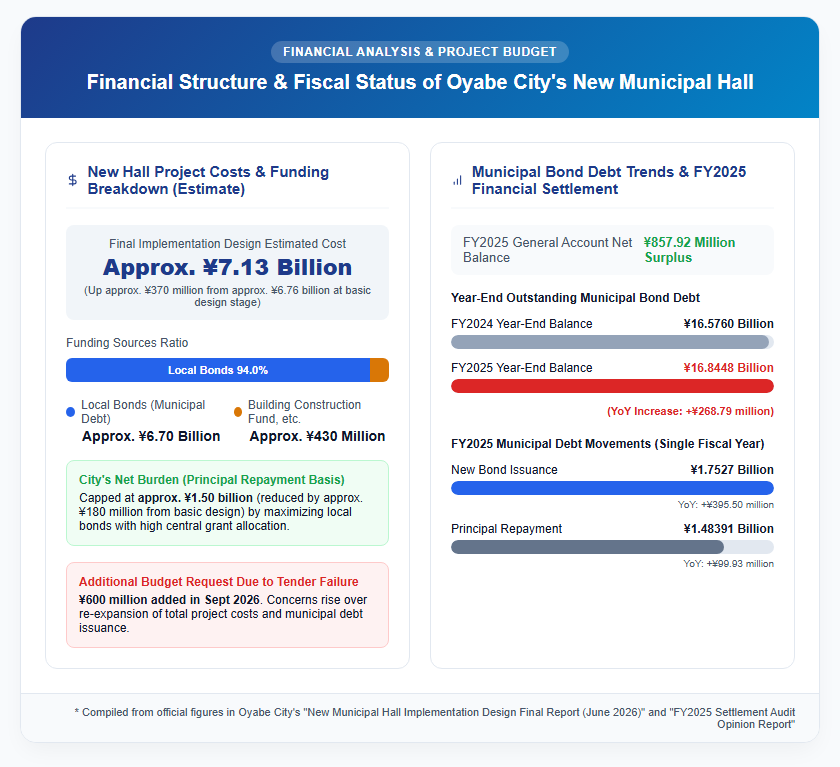
However, with the newly proposed 600 million yen supplementary budget, a re-examination of the financial roadmap is essential to determine how much the city’s debt issuance and net fiscal burden will re-expand.
Upcoming Re-Tender and the Challenges of Sustainable Public Infrastructure Development
With the addition of 600 million yen in construction funding, the upcoming re-tender at the end of September 2026 represents a critical milestone in determining whether Oyabe City can successfully secure a general contractor. While the city maintains an emphasis on cost control by reusing existing equipment and adjusting specifications, securing a stable construction arrangement amidst volatile market conditions remains a key challenge.
This situation reflects a broader structural challenge facing public infrastructure development in an era of population decline. Future municipal office projects will increasingly require a departure from conventional public procurement—adopting “compact facility” designs that strip away redundant features, leveraging Private Finance Initiatives (PFI), and utilizing “performance-based procurement” where specific construction methodologies are delegated to contractors.
Furthermore, as digital transformation (DX) in local government expands “contactless administrative services,” the physical space requirements for future municipal offices may fundamentally shift. How Oyabe City balances securing a robust disaster management center with avoiding excessive debt for future generations will serve as a compelling case study for local governments nationwide.
Reference Pages
- 【(June 2026) Final Report on the Implementation Design for the New Main Office Building】https://www.city.oyabe.toyama.jp/shiseijyouhou/1003255/1006300/1007837.html
【#OyabeCity #MunicipalHall #ConstructionCostInflation #FailedBidding #LocalGovernmentFinance #PublicWorks #LocalGovDX】


コメント