Generative Partners Inc. has officially launched “AX BPO,” a new business process outsourcing service that combines AI agents with dedicated human staff. This service directly addresses a critical operational bottleneck: despite adopting RPA and generative AI, many companies still fail to achieve full automation due to vendor format discrepancies and exception handling, ultimately leaving staff trapped in manual labor.
- Overview of “AX BPO,” a Next-Generation BPO Service Launched in September 2026
- A Hybrid Structure of AI and Human Labor Overcoming the Limits of RPA and AI
- Flexible Integration Eliminating the Need for New Tools or Core System Modifications
- Dedicated Human Staff Handling Format Variations and Exception Processing
- Maintenance and Operational Gaps in Japan, a Global Leader in RPA Penetration
- Eliminating Operational Shutdown Risks Driven by Staff Transfers and Individual Dependency
- Global AI BPO Market Trends Projected to Reach $49.6 Billion by 2033
- Paradigm Shift and Outlook: Moving from “AI vs. Human” to “AI + Human”
Overview of “AX BPO,” a Next-Generation BPO Service Launched in September 2026
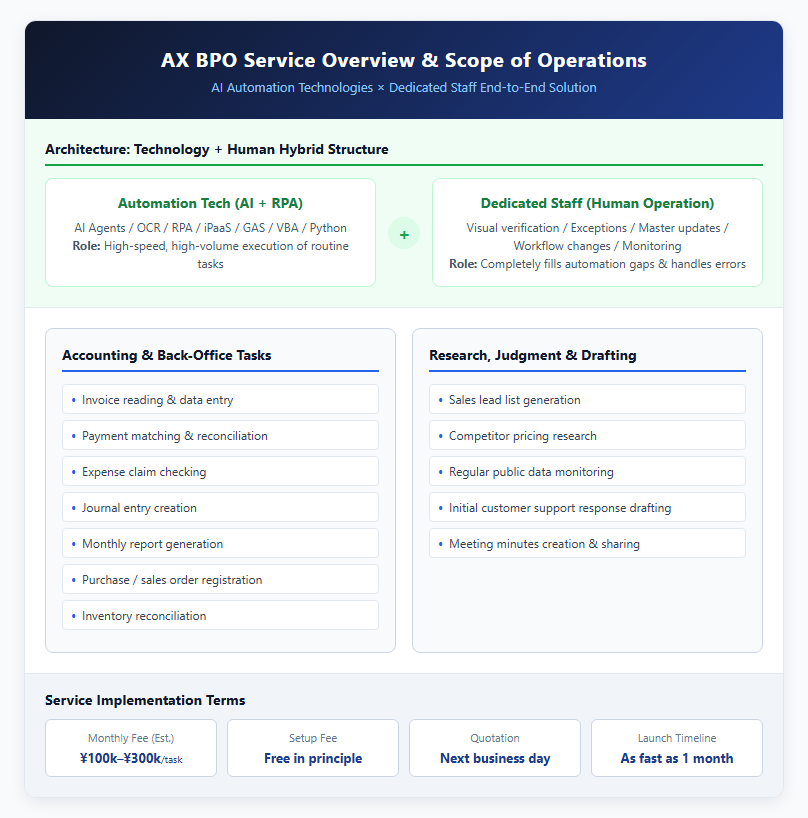
On September 16, 2026, Generative Partners Inc. launched “AX BPO,” an end-to-end business automation solution that merges automation technologies like AI agents with hands-on processing by dedicated staff. The service aims to bridge the automation gaps inherent in conventional BPO and RPA tools, enabling true end-to-end automation of back-office operations. Its scope spans a wide array of tasks, including invoice processing and entry, payment matching, expense claim checking, journal entry creation, monthly report generation, purchase order registration, and inventory reconciliation. Moving beyond routine data entry and compilation, the service also covers complex tasks requiring research, judgment, and document generation—such as creating sales lead lists, monitoring competitor pricing, conducting regular public data checks, drafting initial customer support responses, and synthesizing meeting minutes. Pricing is set at an estimated 100,000 to 300,000 yen per month per business task, with initial setup fees waived in principle. The service features a rapid deployment process where clients can receive a quote as early as the next business day following an initial consultation and launch full operations in as little as one month.
The figure below outlines the scope of operations covered by AX BPO.
A Hybrid Structure of AI and Human Labor Overcoming the Limits of RPA and AI
Conventional operational automation initiatives frequently relied on standalone deployments of modern tools such as RPA or generative AI. In practice, however, organizations repeatedly encountered a scenario where, despite introducing automation tools, operations ultimately relied on human intervention. Although the advent of generative AI and AI agents significantly expanded the horizons for automated document drafting and complex reasoning, automated workflows still grind to a halt whenever AI confidence falls short of 100% or exceptional data arises. AX BPO targets this exact vulnerability—areas where technology alone cannot complete the job—by employing a hybrid architecture that integrates AI agents, RPA, iPaaS, and Python with execution by a dedicated human team. Standard high-volume tasks are executed rapidly by AI and automated programs, while dedicated staff handle exception patterns and judgment calls requiring human review. As a result, businesses are freed from the risks of AI misinterpretations or RPA script failures, receiving only verified, final deliverables.
Technical and Operational Strengths Allowing Integration Without Changing Existing Systems
Flexible Integration Eliminating the Need for New Tools or Core System Modifications
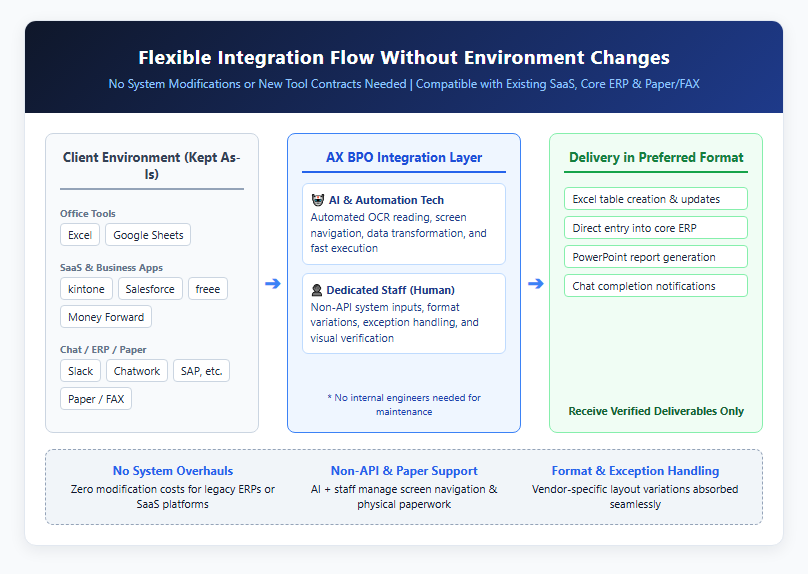
Introducing new business automation or BPO services typically mandates modifying legacy core systems or subscribing to costly new SaaS platforms, creating significant cost and timeline barriers. A defining feature of AX BPO is its ability to seamlessly utilize a client’s existing IT environment without requiring structural changes. Specifically, it natively supports standard office tools like Google Sheets and Microsoft Excel, major SaaS platforms such as kintone, Salesforce, freee, and Money Forward, communication channels like Slack and Chatwork, as well as enterprise ERP systems represented by SAP. Furthermore, it easily ingests analogue workflows involving physical paperwork or faxes that have not been digitized. Even when internal systems lack API endpoints, AI and dedicated staff interact directly via screen operations and data conversion, allowing enterprises to eliminate the risk and burden of major IT infrastructure overhauls.
The figure below illustrates the processing flow for integrating with various existing systems and tools.
Dedicated Human Staff Handling Format Variations and Exception Processing
In daily corporate operations, the primary obstacles to automation are format variations across suppliers and unexpected exceptions. For instance, in invoice processing, variations in layout or field names across vendors—or handwritten notes added in specific months—frequently trigger errors in conventional OCR and RPA tools. Under AX BPO, dedicated staff from the provider directly absorb and process these volatile steps, handling exceptions and verifying incomplete data. Moreover, when operational procedures or rules change due to business expansion or regulatory revisions, Generative Partners manages system redesigns and daily performance monitoring. This eliminates the need for clients to retain in-house engineers for tool reconfiguration or programming, fully relieving operational staff from the stress of maintenance and updates.
RPA Adoption in Japan and Structural Challenges Faced by Automation In the Field
Maintenance and Operational Gaps in Japan, a Global Leader in RPA Penetration
Japan stands out globally as a leader in RPA adoption, boasting a market depth and penetration rate relative to its economic scale that rivals the United States as one of the largest in the world. While domestic RPA tools developed into a distinct industry, severe operational challenges have surfaced in the post-implementation phase. In many organizations, RPA scripts break whenever unpredicted system UI updates or vendor invoice formatting changes occur, placing a heavy maintenance burden on operational teams. Similarly, even when deploying AI-driven optical character recognition or data extraction tools, the probabilistic nature of AI produces occasional errors, trapping workers in double-handling where humans must re-verify every single output. Leaving these automation gaps unaddressed results in structural inefficiency, where licensing costs for software tools and internal labor expenses overlap.
Eliminating Operational Shutdown Risks Driven by Staff Transfers and Individual Dependency
Another major risk in BPO and RPA management is the operational black-boxing that occurs when key internal personnel transfer or resign. Complex RPA scripts or macros built by individual employees often become unmaintainable once the creator leaves, leading to abandoned tools and a regression to manual labor. Leveraging a fully managed service like AX BPO consolidates operational workflows, management, and institutional knowledge within an external specialized team. Even in the event of staff turnover or sudden resignations, operations continue seamlessly without quality degradation or lost knowledge, ensuring a sustainable operational framework. Enterprises can thus concentrate their internal talent on core initiatives, fundamentally mitigating business risks associated with back-office labor shortages and recruiting hurdles.
The Rapidly Growing AI BPO Market and Its Impact on Enterprise DX
Global AI BPO Market Trends Projected to Reach $49.6 Billion by 2033
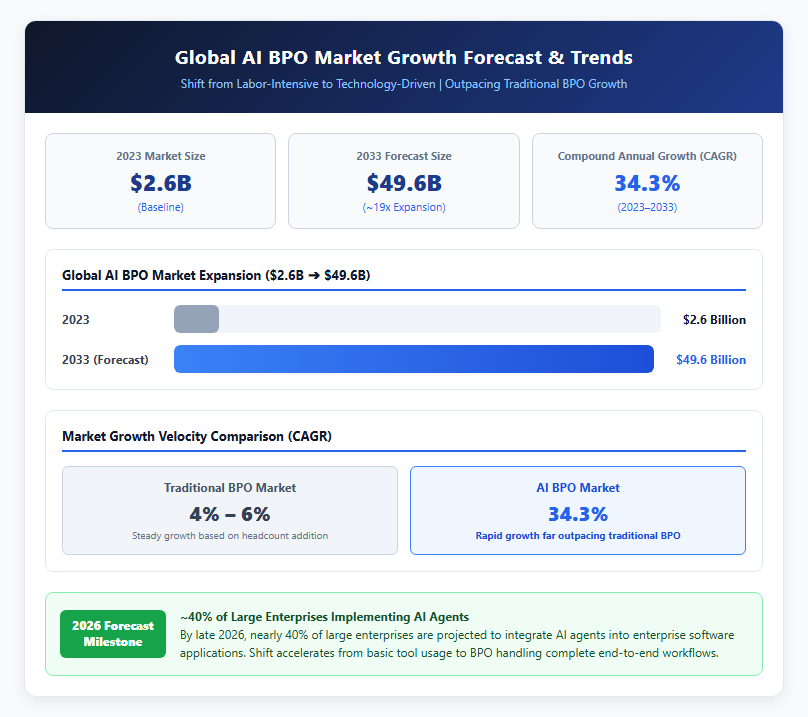
The shift from traditional labor-intensive BPO to technology-driven BPO centered on AI and AI agents represents a major macro trend occurring globally as well as in Japan. Market research indicates that the global AI BPO market is projected to expand from \$2.6 billion in 2023 to \$49.6 billion by 2033, growing at a compound annual growth rate (CAGR) of 34.3%. This far outpaces the CAGR of the traditional BPO market (approximately 4% to 6%). By late 2026, nearly 40% of large enterprises are expected to embed AI agents into their corporate applications, driving a surge in demand for AI BPO as a key mechanism to simultaneously boost efficiency and reduce costs. The market is transitioning from traditional cost structures based on simple headcount addition to scalable models that use an AI automation layer to control cost escalation as transaction volumes grow.
The figure below conceptually illustrates the projected growth trends for the global AI BPO market.
Paradigm Shift and Outlook: Moving from “AI vs. Human” to “AI + Human”
The rapid evolution of generative AI and AI agents briefly fueled expectations of total automation, where machines would replace human labor entirely. In real-world business environments, however, tasks requiring regulatory compliance, subjective evaluation, and human adaptability inevitably remain, highlighting the clear limits of pure mechanization. The conversation has consequently shifted from a binary choice of “AI or Human” to designing “AI + Human” collaborative frameworks that explicitly define where AI automation ends and human oversight begins. Next-generation outsourcing models, epitomized by AX BPO, offer a pragmatic approach: rather than forcing legacy processes into rigid software tools, a specialized team assumes responsibility for the entire workflow, including non-automatable exceptions. Moving forward, the key to success in corporate Digital Transformation (DX) and AI Transformation (AX) will not be the sheer number of tools deployed, but how effectively organizations optimize their end-to-end business operations.
Reference Pages
- [Generative Partners Inc. Press Release] https://prtimes.jp/main/html/searchrlp/company_id/184908
- [AX BPO Official Service Site] https://ax-bpo.jp
【#AXBPO #GenerativePartners #AIBPO #BusinessAutomation #RPA #GenerativeAI #DX #BackOffice】
コメント