OpenAI has officially launched “ChatGPT for Financial Services,” a specialized solution tailored for financial institutions. Powered by the flagship GPT-6 Astra model and native integration with professional financial data, the platform is rapidly accelerating the automation of complex analytical and deck-creation workflows across Wall Street.
- Key Highlights and Strategic Partnerships with Morgan Stanley and Evercore
- Direct Integration of Financial Datasets with the Frontier Model GPT-6 Astra
- Proprietary Template Outputs and Enterprise-Grade Governance Controls
- Overworked Junior Bankers and the Secret Initiative “Project Mercury”
- Risks of “Cognitive Atrophy” and the Erosion of Traditional Apprenticeship
- Escalating Vertical AI Competition with Anthropic and Market Impact
- Amplified Financial Shock Risks and the Future of Responsible AI Adoption
Key Highlights and Strategic Partnerships with Morgan Stanley and Evercore
On September 10, 2026, OpenAI officially announced “ChatGPT for Financial Services,” a specialized solution designed specifically for the financial sector. Built upon the foundation of OpenAI’s enterprise platform, ChatGPT Work, the service is engineered to automate complex, routine workflows in investment banking and equity research. OpenAI developed the platform in close collaboration with design partners Morgan Stanley and Evercore. Working alongside both investment banks highlighted the primary operational challenge facing bankers: securing reliable, instant access to financial data and generating high-quality deliverables. The resulting product addresses these pain points directly, enabling users to execute complex financial analyses and assemble pitchbooks in minutes—tasks that previously required hours of manual labor. ChatGPT for Financial Services has quickly emerged as a transformative operational foundation for financial institutions.
Direct Integration of Financial Datasets with the Frontier Model GPT-6 Astra
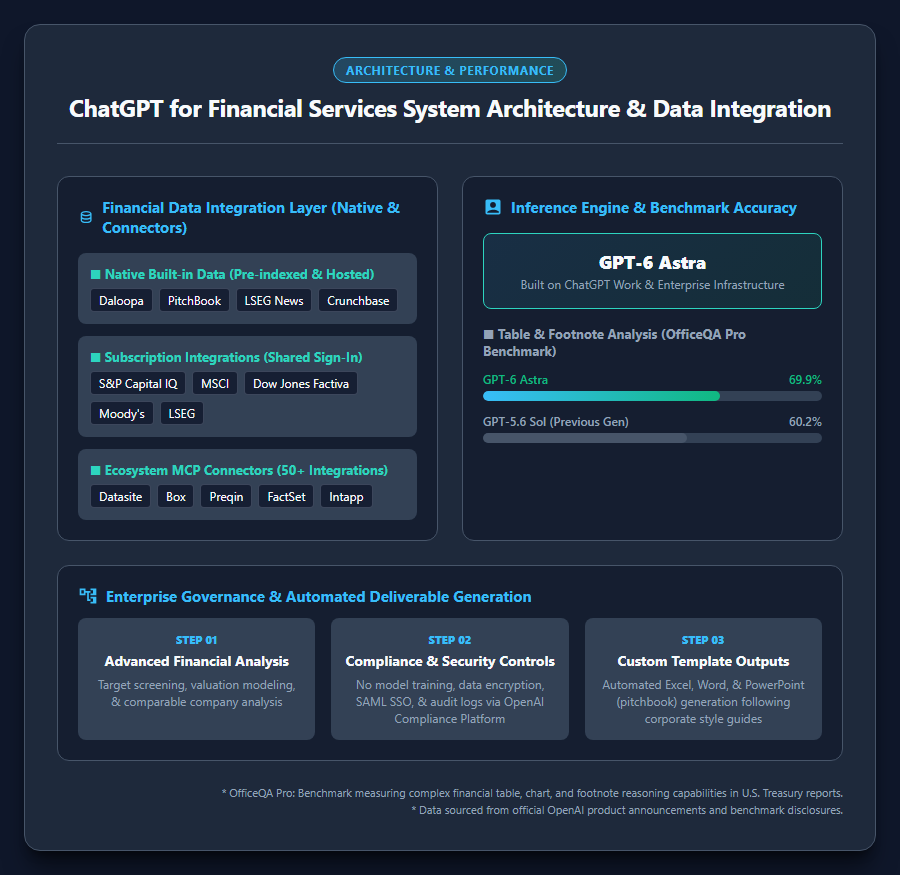
At the core of the service is OpenAI’s latest flagship model, GPT-6 Astra. On the OfficeQA Pro benchmark, which measures an AI’s ability to locate and analyze complex financial tables, figures, and footnotes in U.S. Treasury reports, GPT-6 Astra achieved an accuracy score of 69.9%, significantly outperforming the 60.2% recorded by the previous-generation GPT-5.6 Sol model. The platform’s defining technical advantage lies in its native integration with leading financial data providers. Datasets from Daloopa, PitchBook, LSEG News, and Crunchbase are pre-indexed and hosted directly on OpenAI’s infrastructure, granting users instant access to earnings call transcripts, financial statements, and private company data without requiring separate subscriptions or connector setups. Furthermore, the platform features granular citation capabilities, allowing analysts to trace extracted figures and claims back to original filings and footnotes for full auditability. The diagram below illustrates the system’s overall data integration architecture.
Proprietary Template Outputs and Enterprise-Grade Governance Controls
In professional financial workflows, presenting analytical findings accurately in a firm’s custom format is essential. ChatGPT for Financial Services addresses this requirement by providing an administrative portal where institutions can publish custom Microsoft Excel, Word, and PowerPoint templates and style guides. As a result, AI-generated valuation models, research notes, and client pitchbooks automatically align with the firm’s branding and formatting standards. On the security and compliance front, the platform builds on the enterprise infrastructure of ChatGPT Enterprise, incorporating SAML SSO, SCIM provisioning, and role-based access control. Customer business data is excluded from model retraining by default and encrypted both at rest and in transit. Workspace logs can also be exported to existing audit workflows via the OpenAI Compliance Platform.
Structural Transformation of Wall Street Workflows and Human Capital Development
Overworked Junior Bankers and the Secret Initiative “Project Mercury”
Nick Turley, Vice President of Product at OpenAI, likened the new service to a modern counterpart of Microsoft Excel—the spreadsheet software that revolutionized Wall Street in the 1980s. Historically, junior analysts and associates at investment banks have worked grueling 100-hour workweeks compiling company profiles, aggregating financial data, and assembling M&A pitch decks. Enabling AI to execute these multi-step processes in minutes is the result of “Project Mercury,” a covert training initiative at OpenAI. Under Project Mercury, OpenAI contracted former investment bankers to train the model directly on financial modeling and presentation creation. By streamlining tasks from target company screening to data extraction and auto-formatted PowerPoint generation, the platform aims to relieve junior bankers of routine manual burdens and allow them to focus on strategic negotiation and client relations.
Risks of “Cognitive Atrophy” and the Erosion of Traditional Apprenticeship
While the dramatic gains in efficiency have been widely welcomed, industry leaders have expressed growing concern regarding the impact on financial talent development. Wall Street has long relied on an apprenticeship model where junior bankers develop sharp financial intuition and analytical rigor through the painstaking process of manual data collection, financial modeling, and verification. Overreliance on AI for foundational tasks risks causing “cognitive atrophy,” where junior staff lose the critical thinking skills required to evaluate complex financial structures. Furthermore, without a deep understanding of underlying assumptions, junior bankers may struggle to audit and validate AI-generated outputs. As financial institutions embrace automation, balancing productivity gains with the long-term cultivation of human judgment and internal oversight represents a critical management challenge.
Competitive Landscape, Systemic Financial Risks, and Future Outlook
Escalating Vertical AI Competition with Anthropic and Market Impact
OpenAI’s launch reflects a broader battle among major AI vendors for dominance in vertical industry solutions. Competitor Anthropic previously launched “Claude for Financial Services,” featuring specialized agent workflows integrated with data providers such as Moody’s and S&P Capital IQ. Meanwhile, Google Cloud is expanding financial AI agent partnerships with institutions like Deutsche Bank, and Perplexity has introduced tools for specialized analysis teams. For OpenAI, valued at \$840 billion, penetrating the financial sector is a pivotal element of its enterprise revenue expansion ahead of a prospective initial public offering. The rollout is already reshaping the broader industry landscape, as evidenced by stock price drops among traditional financial data providers like FactSet following the announcement.
Amplified Financial Shock Risks and the Future of Responsible AI Adoption
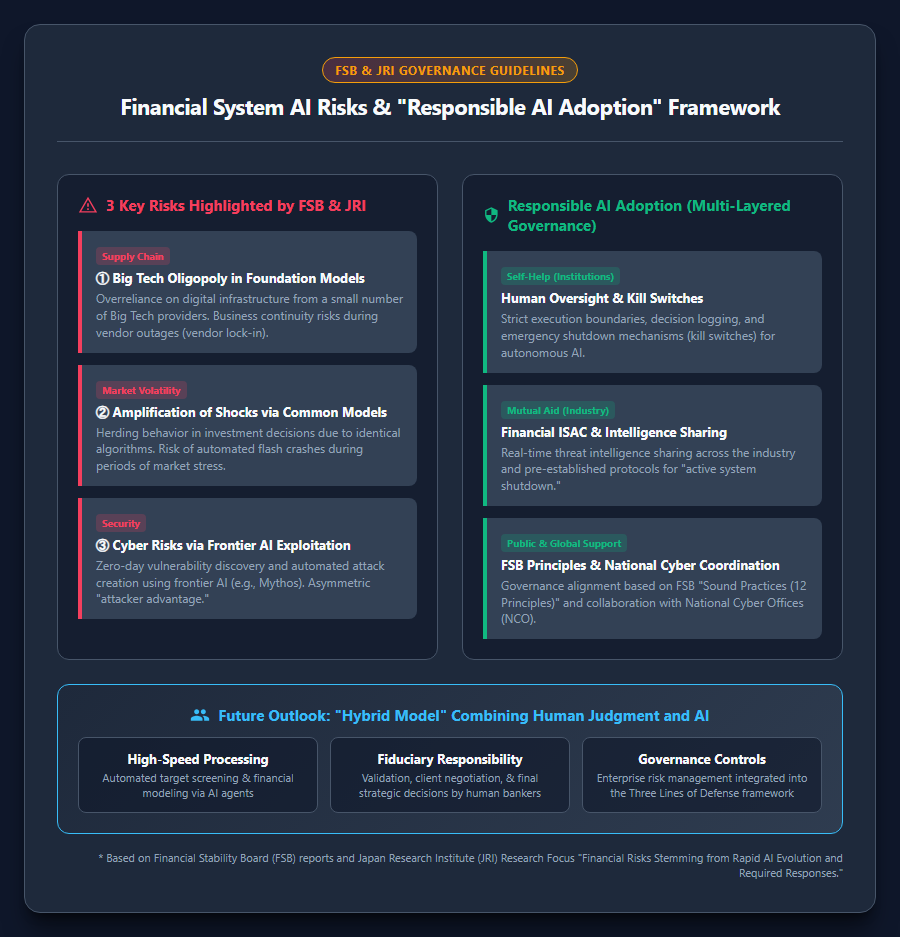
While AI adoption promises substantial productivity gains, international bodies like the Financial Stability Board (FSB) and research institutions like the Japan Research Institute have highlighted significant systemic risks. Key concerns include supply chain concentration resulting from overreliance on a small number of big-tech infrastructure providers. Furthermore, widespread adoption of identical underlying AI models could lead to herd behavior in investment decisions, increasing market volatility and potentially triggering automated flash crashes during periods of stress. In response, regulators such as Japan’s Financial Services Agency and the FSB are advocating for “Responsible AI Adoption,” emphasizing multi-layered governance frameworks, strict operational boundaries, and mandatory human oversight to ensure market stability. The diagram below outlines the multi-layered AI governance and risk management approaches adopted by financial institutions.
Reference Pages
- [OpenAI Introducing ChatGPT for Financial Services] https://openai.com/index/introducing-chatgpt-financial-services/
【#OpenAI #ChatGPT #FinancialAI #InvestmentBanking #GPT6Astra #WallStreet #AIGovernance #FinTech】
コメント