On September 16, 2026, Rakuten Group, Inc. announced the establishment of a new subsidiary, “Rakuten Cross-Border EC (China) Co., Ltd.,” in Hangzhou, Zhejiang Province, China. Driven by a surge in gross merchandise sales from overseas merchants on Rakuten Ichiba—growing at an average annual rate of over 30%—the move aims to significantly bolster merchant recruitment and operational support for Chinese sellers.
- Establishment of Rakuten Cross-Border EC (China) Co., Ltd. and an End-to-End Support System
- Rapid Growth of Overseas Merchants on Rakuten Ichiba Driven by Chinese Sellers
- Lessons from the Past “Lakuotan” Exit and the Strategic Shift to Inbound Cross-Border E-Commerce
- Geopolitical and Industrial Value of Hangzhou as the First Cross-Border E-Commerce Comprehensive Pilot Zone
- Shifts in the Competitive Landscape for Small Home Appliances and Outdoor Goods
- Concrete Strategies to Avoid Price Wars and Win on Quality and Service
Establishment of Rakuten Cross-Border EC (China) Co., Ltd. and an End-to-End Support System
On September 16, 2026, Rakuten Group, Inc. announced the establishment of a new local subsidiary, Rakuten Cross-Border EC (China) Co., Ltd., in Hangzhou, Zhejiang Province, China, aiming to reinforce its cross-border e-commerce operations on its online shopping mall, Rakuten Ichiba. Officially registered on August 24, 2026, the new entity is headed by Zhou Yang as its representative. Its core mandate encompasses attracting Chinese merchants to Rakuten Ichiba and providing end-to-end operational support after onboarding. During the pre-entry phase, the company actively conducts seminars to educate potential sellers on Japanese market dynamics, business practices, and emerging consumer trends. Once onboarded, bilingual e-commerce consultants fluent in Japanese and Chinese deliver hands-on, step-by-step guidance covering everything from store setup to promotional execution. Furthermore, through its Merchant Support Center in Hangzhou, the company offers practical e-commerce management training and comprehensive backing—helping merchants leverage major promotional events like “Rakuten Super SALE” and “Okaimono Marathon” to build brand awareness and cultivate repeat customers. This establishes an all-in-one infrastructure designed to nurture merchants from initial onboarding to sustained growth.
Rapid Growth of Overseas Merchants on Rakuten Ichiba Driven by Chinese Sellers
Rakuten Ichiba has been continuously enhancing its shopping environment to ensure that Japanese consumers can purchase overseas products with the same peace of mind and security as domestic goods. In addition to rigorous seller screening during onboarding, Rakuten offers buyer protection through its “Rakuten Anshin Shopping Service” in the event of transaction disputes. As a result of these trust-building measures, the number of overseas merchants on Rakuten Ichiba—primarily from China, South Korea, and the United States—has grown steadily, surpassing 1,000 storefronts in 2025. Moreover, gross merchandise sales (GMS) generated by overseas sellers maintained an impressive compound annual growth rate of over 30% from 2020 through 2025. As illustrated in the figure below, the merchant count has maintained a strong upward trajectory.
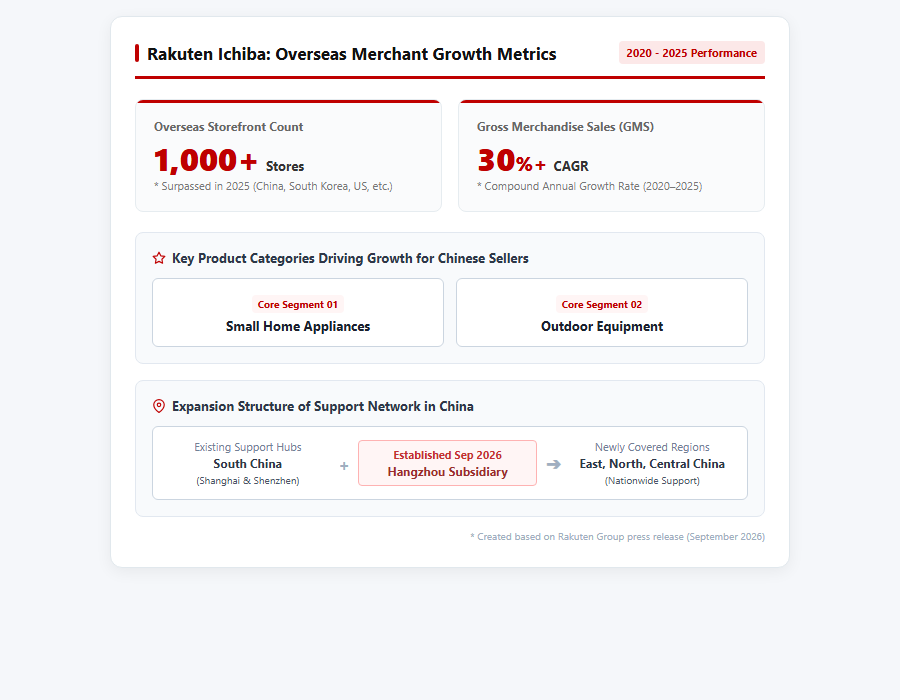
Chinese merchants, in particular, have delivered robust sales performance in categories such as small home appliances and outdoor gear, serving as the primary growth engine for the overall cross-border e-commerce segment. While Rakuten previously supported sellers in South China through Shanghai Shanghai-Shokai E-Commerce Co., Ltd. and its Shenzhen branch, the establishment of this new Hangzhou hub significantly expands its support network into East, North, and Central China.
A Historical Turn in Rakuten’s China Strategy and the Strategic Value of Hangzhou
Lessons from the Past “Lakuotan” Exit and the Strategic Shift to Inbound Cross-Border E-Commerce
Rakuten’s engagement in the Chinese market gained momentum with the establishment of its Shanghai office in 2011. However, looking back further, Rakuten launched a joint venture with search giant Baidu in 2010 to create “Lakuotan,” a localized Chinese version of Rakuten Ichiba. At that time, an influx of venture capital fueled an intense e-commerce bubble and fierce price-cutting wars. Coupled with strategic misalignments between Rakuten—which prioritized profitability—and its partner—which favored rapid market share expansion at all costs—Lakuotan was forced to shut down in May 2012 after just two years. Learning from this painful setback, Rakuten pivoted its strategy away from direct expansion by bringing its own platform into China. Instead, it shifted toward an inbound cross-border e-commerce model, inviting Chinese sellers with strong manufacturing and supply chain capabilities onto Japan’s “Rakuten Ichiba” to connect them directly with Japanese consumers. Following key milestones—such as receiving investment from Tencent in 2021, opening a Hangzhou liaison office the same year, and establishing a Hangzhou branch in August 2025—this phased strategy culminated in the incorporation of the new local entity.
Geopolitical and Industrial Value of Hangzhou as the First Cross-Border E-Commerce Comprehensive Pilot Zone
Hangzhou, Zhejiang Province—where the new company is located—holds the distinction of being designated as China’s very first “Cross-Border E-Commerce Comprehensive Pilot Zone” in 2015. Centered around Hangzhou’s Binjiang District, the city features a dense cluster of e-commerce platforms, payment processors, international logistics providers, digital marketing agencies, and third-party operations providers, serving as the paramount hub of China’s cross-border e-commerce industry. By establishing an independent corporate entity in Hangzhou’s thriving industrial ecosystem—building upon its prior focus on Shanghai and South China (including Shenzhen)—Rakuten vastly expands its reach to top-tier manufacturers and brand owners across East, North, and Central China. As shown in the mapping below, a framework for close collaboration with major industrial clusters is now fully in place.
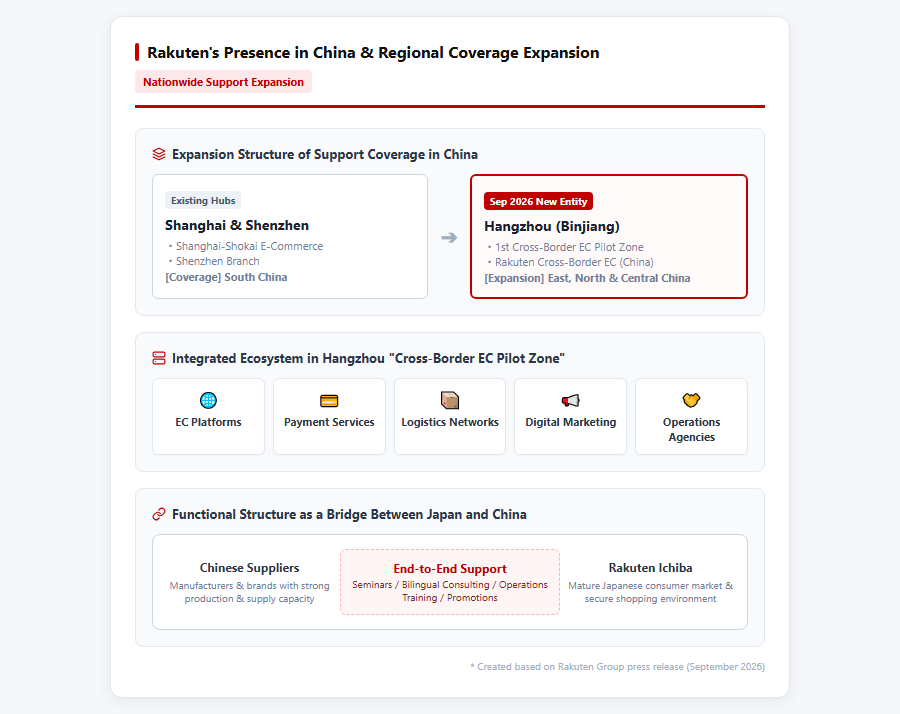
The new entity is expected to act as a vital bridge connecting highly competitive Chinese suppliers with Japan’s mature consumer market.
Impact on the Domestic E-Commerce Market and Survival Strategies for Japanese Merchants
Shifts in the Competitive Landscape for Small Home Appliances and Outdoor Goods
The increasing influx of Chinese merchants onto Rakuten Ichiba, paired with sophisticated operational support, introduces a shift in the business environment that domestic Japanese sellers cannot afford to ignore. In product categories where Chinese sellers hold a distinct advantage—such as small home appliances, outdoor equipment, and daily goods—domestic sellers are likely to see a dramatic change in the competitive lineup during search results and major sale events. Historically, overseas sellers faced hurdles including awkward Japanese text, inadequate customer support, and unfamiliarity with promotional campaign mechanics. However, as these operational weaknesses are mitigated through hands-on consulting and structured merchant training provided by the new entity, domestic merchants will face a growing number of international competitors featuring polished product pages alongside aggressive price competitiveness. Consequently, relying solely on price-to-price comparisons for identical products will become an increasingly difficult strategy for Japanese merchants.
Concrete Strategies to Avoid Price Wars and Win on Quality and Service
In response to these shifting market dynamics, domestic sellers must pivot toward strategies that highlight non-price value propositions. The following actionable steps are particularly effective:
- Clearly highlight fast domestic shipping and meticulous packaging standards near the top of product pages
- Display domestic customer support contact points, manufacturer warranties, and clear return/exchange policies using visual elements to build pre-purchase trust
- Create bundled offerings, include proprietary Japanese instruction manuals, or offer custom gift wrapping to make direct price comparisons difficult
- Maintain high customer review ratings and fast inquiry response times to boost overall storefront trust scores
Regarding the placement of trust-building elements on product pages, optimizing the layout as shown in the diagram below is highly recommended.
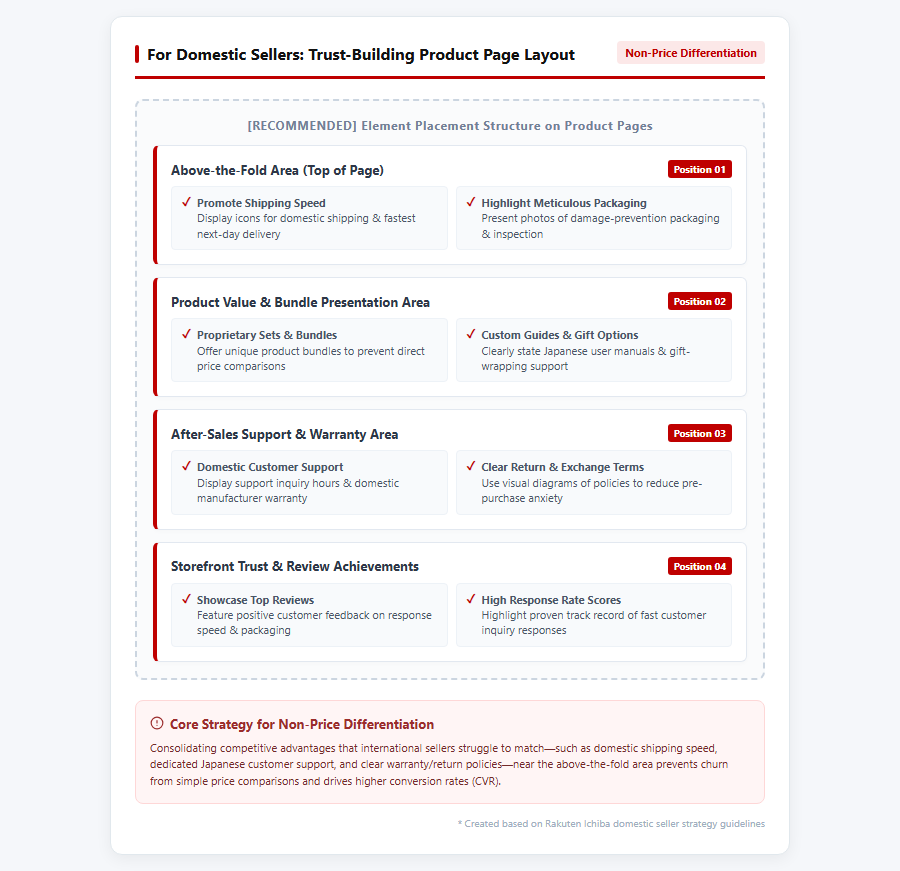
Rather than getting dragged into destructive price wars, delivering a superior, localized customer experience unique to domestic merchants holds the key to sustaining long-term sales growth.
Reference Pages
- 【Rakuten Establishes New Company “Rakuten Cross-Border EC (China) Co., Ltd.” in Hangzhou to Support Onboarding and Operations for Chinese Merchants on “Rakuten Ichiba”】https://corp.rakuten.co.jp/news/press/2026/0916_01.html
【#Rakuten #RakutenIchiba #CrossBorderEC #ChinaBusiness #ECMall #Hangzhou】


コメント