FlashLabs Inc. has introduced a new feature for its AI inference gateway, OrcaRouter, enabling bi-directional transfer of AI agent execution logs between local and cloud environments. This update responds to the growing need to unify execution logs scattered across development environments and communication channels, significantly streamlining debugging and validation workflows.
- Background and the Realization of Local-to-Cloud Log Portability
- Seamless Data Syncing via Two Simple Commands
- Capturing Distinct Data Layers on Local Devices vs. Network Pathways
- Analysis and Validation Powered by the “orca-trace v0” Open Specification
- Privacy Protection and Dedicated Low-Privilege API Keys
- Technical Roadmap and Impact on AI Agent Operations
Background and the Realization of Local-to-Cloud Log Portability
OrcaRouter, an AI inference gateway developed by the US-based AI research organization Continuum AI and exclusively distributed in Japan by FlashLabs Inc., launched a new bi-directional log transfer feature in September 2026. This functionality integrates seamlessly with OrcaReplay, an open-source tool designed for recording AI agent execution. As AI agents increasingly handle complex, autonomous tasks, dev teams face a critical need for visibility into what these agents actually do during execution. Previously, local execution logs and cloud gateway logs were siloed. Developers had to manually download and upload files through browser forms to sync data between environments—a tedious process that discouraged frequent validation. To solve this bottleneck, a CLI-driven integration mechanism was built. The diagram below illustrates the data synchronization flow between local and cloud environments.
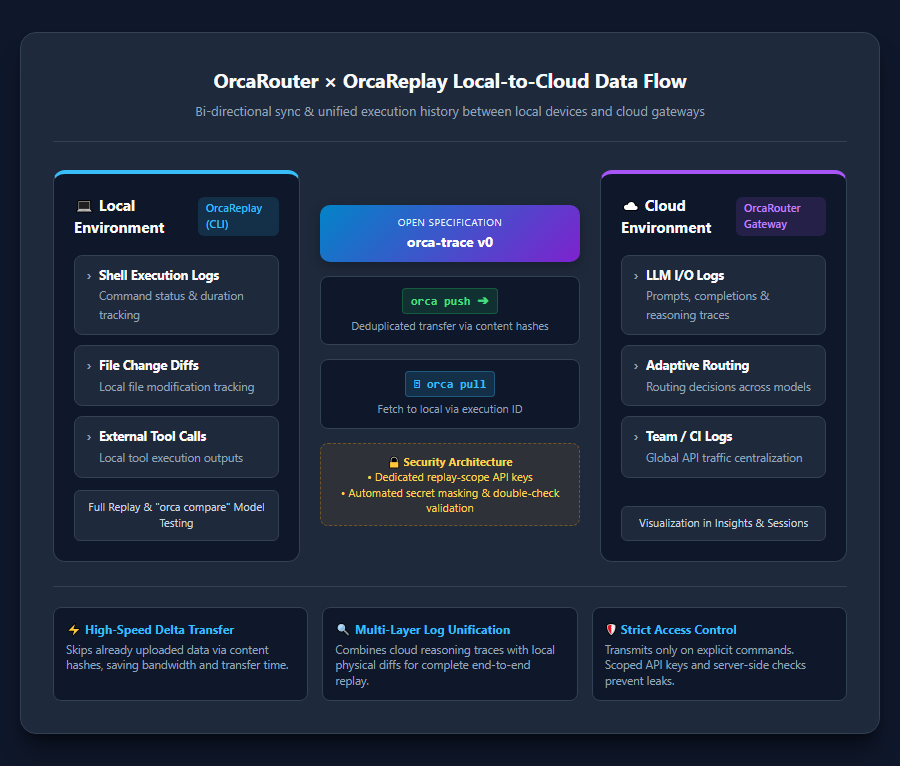
This update centralizes fragmented logs and dramatically improves test reproducibility.
Seamless Data Syncing via Two Simple Commands
At the heart of this integration are two powerful CLI commands: orca push (to upload local logs to the cloud) and orca pull (to fetch cloud logs to the local machine). Executing orca push targets recent agent action logs and related metadata recorded locally, transmitting them efficiently based on unique content-derived hash values. Duplicate data is automatically skipped, saving significant bandwidth and transfer time. On the flip side, the orca pull command takes an execution identifier to instantly pull past logs or team-shared session data from the cloud dashboard’s “Insights” or “Sessions” views directly into the local environment. By eliminating clumsy browser-based file management, developers can manage complete bi-directional data flow straight from the command line.
Dual-Layer Visibility and Integrated Analysis Mechanics
Capturing Distinct Data Layers on Local Devices vs. Network Pathways
Accurately tracing AI agent behavior requires observing different layers of information captured at different execution points. On the local developer machine, OrcaReplay logs physical system-level events—such as shell command success/failure, execution latency, local file diffs, and external tool call results. Meanwhile, on the cloud side, OrcaRouter acts as an inline gateway, collecting Large Language Model (LLM) prompts and completions, adaptive routing decisions across multiple models, and global API traffic across CI pipelines and team workflows. Examining either layer in isolation makes it difficult to connect cause and effect—that is, understanding what an LLM decided and how that decision impacted the local system. Bi-directional transfer unifies both layers, enabling deep, end-to-end root-cause analysis that links model reasoning directly to local system outcomes.
Analysis and Validation Powered by the “orca-trace v0” Open Specification
Execution logs generated across both local and cloud environments adhere to “orca-trace v0”, an open, unified trace specification. As a result, whether a trace is uploaded from a local machine or downloaded from the cloud, it can be inspected and replayed using the exact same tools and commands. Once logs are pulled locally, developers can replay past agent runs completely offline without triggering additional LLM API charges. Furthermore, leveraging OrcaReplay’s orca compare feature allows developers to branch an agent session from an intermediate conversation step and re-evaluate it using different LLM models under identical initial conditions. The following diagram details the multi-step analysis workflow powered by this unified format.
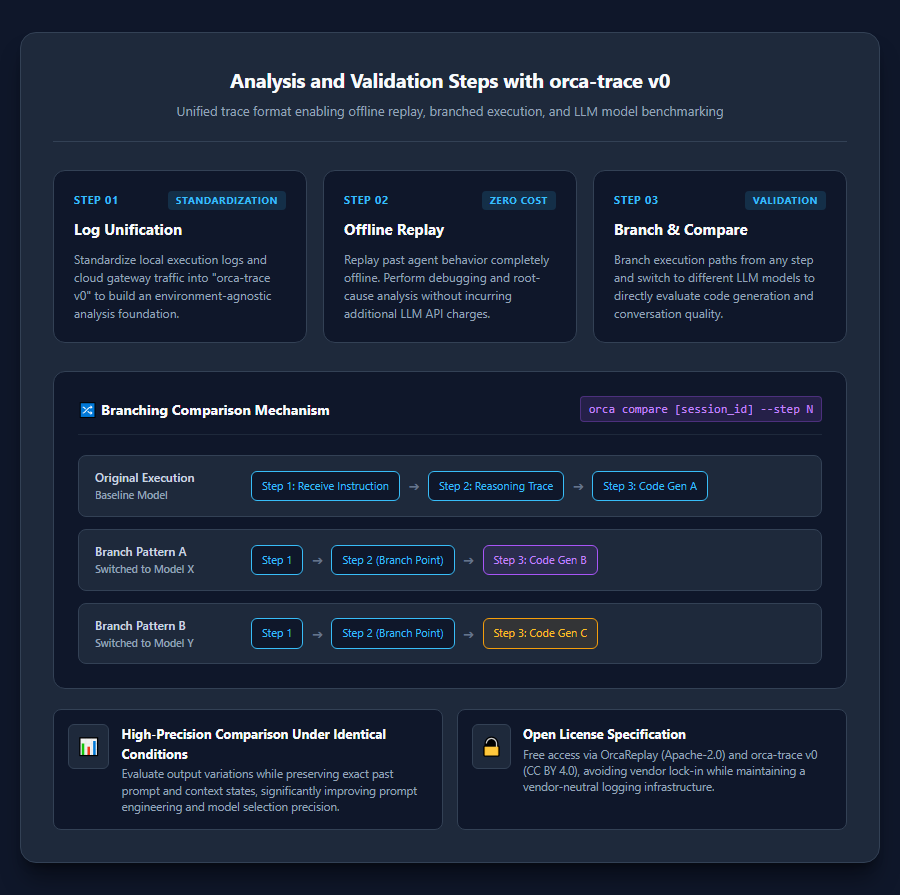
This equips developers with a highly reproducible environment to benchmark model performance and refine prompt engineering.
Robust Security Architecture and Future Outlook
Privacy Protection and Dedicated Low-Privilege API Keys
Because AI agent execution logs frequently contain sensitive assets like source code, local file paths, and environment variables, the transfer mechanism is built with stringent security and privacy controls. First, the default cloud sync destination is left unconfigured, ensuring no execution data is transmitted unless explicitly configured by the user. Second, authentication relies on dedicated API keys restricted strictly to the replay scope, preventing key misuse for model inference or proxying. Third, local write pathways incorporate automated masking to sanitize passwords, API tokens, and secret strings before saving logs. Finally, cloud servers re-verify data hash values upon ingestion and conduct secondary automated scans for plaintext secrets, rejecting any payloads that trigger security alerts.
Technical Roadmap and Impact on AI Agent Operations
The combination of the open-source OrcaReplay CLI (licensed under Apache-2.0) and the open orca-trace v0 specification (licensed under CC BY 4.0) establishes a neutral logging standard for the broader AI agent ecosystem. Developers running Node.js 20 or higher can install the toolkit with a single npm i -g orcareplay command without incurring vendor lock-in. Looking ahead, support will expand to additional AI agent interfaces alongside Claude Code, Codex CLI, and Grok CLI, accompanied by enhanced team collaboration features. As autonomous agent adoption accelerates through 2026, seamless log portability and offline reproducibility will serve as foundational infrastructure for governance and debugging. Establishing a shared execution audit trail between development and operations teams will prove crucial for scaling reliable AI agents in production.
Reference Pages
- [OrcaRouter Launches Feature for Bi-Directional Transfer of AI Agent Execution Logs Between Local and Cloud] https://prtimes.jp/main/html/rd/p/000000091.000138449.html
- [OrcaReplay GitHub Repository] https://github.com/Continuum-AI-Corp/OrcaReplay
- [OrcaRouter Official Site] https://www.orcarouter.ai/ja
【#AIAgents #OrcaRouter #OrcaReplay #LLM #OpenSource #DevTools】

コメント