Senator John Curtis, a Utah Republican, has requested that the Senate Judiciary Committee launch a formal congressional investigation into Donald Trump Jr., the president’s eldest son. Driven by growing ethical concerns over alleged Russian oligarch financing for his wedding celebrations and the Trump family’s extensive financial transactions, the move reflects rising discontent with the administration and deepening rifts within the Republican Party ahead of the November 2026 midterm elections.
- Key Developments: Republican Senator John Curtis Demands Congressional Inquiry
- Allegations Over Russian Oligarch Funding for Trump Jr.’s Wedding
- Comparisons to the Hunter Biden Investigation and Deepening GOP Rifts
- Conflict-of-Interest Suspicions Surrounding DoD Contracts and Venture Investments
- Over 3,600 Q1 2026 Stock Trades Prompt Deepening Ethics Concerns
- Future Outlook: The 2026 Midterm Elections and the Fate of Congressional Oversight
Key Developments: Republican Senator John Curtis Demands Congressional Inquiry
On September 22, 2026, Senator John Curtis, a Republican representing Utah, dispatched an official letter to Senate Judiciary Committee Chairman Chuck Grassley (R) and Ranking Member Dick Durbin (D), requesting subpoenas for Donald Trump Jr. In his letter, Curtis urged a thorough probe into Trump Jr.’s business dealings, relationships with foreign figures, gifts received, and whether his proximity to his father, the President, was leveraged for personal financial gain. It is extremely rare for a sitting Republican senator to publicly demand a rigorous congressional inquiry into the family of a president from his own party, sending shockwaves through Washington. The request goes beyond routine policy disagreements, highlighting open criticism from within GOP ranks regarding the administration’s ethics and potential abuses of power. The following diagram illustrates public interest in congressional oversight procedures.
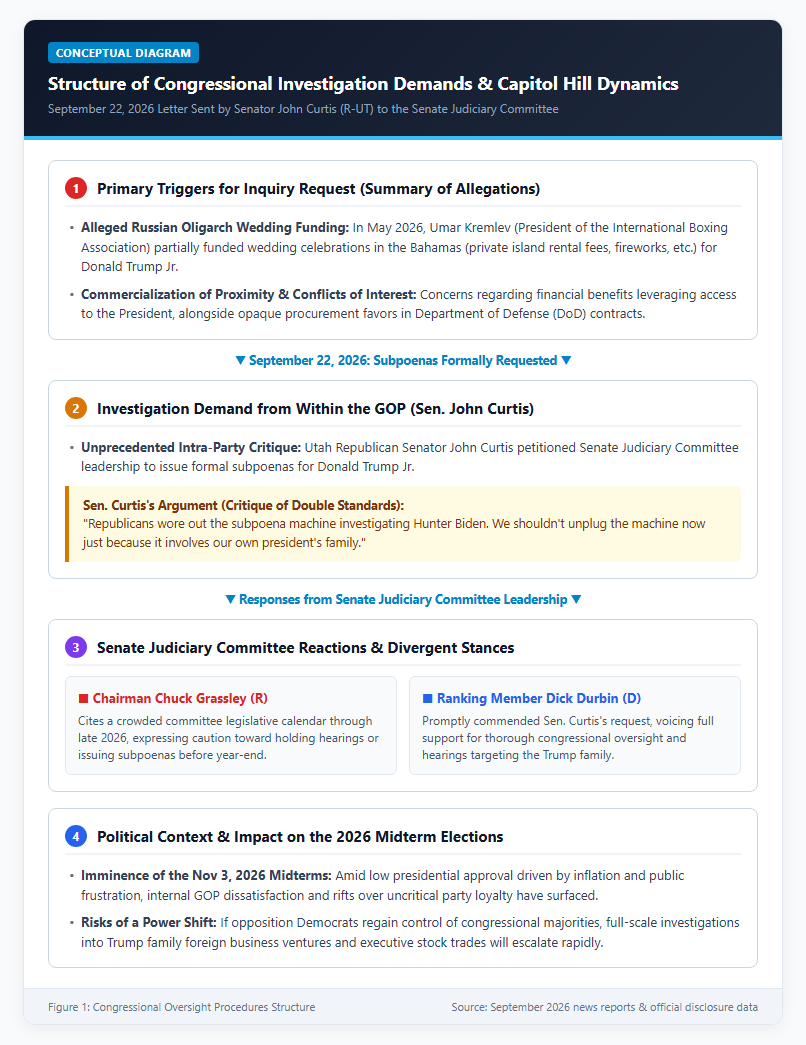
While Senator Durbin, a Democrat, quickly commended Curtis’s request and expressed support for an inquiry, committee staff voiced caution regarding scheduling hearings before the end of 2026, citing a crowded legislative calendar.
Allegations Over Russian Oligarch Funding for Trump Jr.’s Wedding
The immediate catalyst for the investigation demand was a September 2026 report by the investigative outlet ProPublica. According to the report, Umar Kremlev, a Russian oligarch close to President Vladimir Putin and president of the International Boxing Association, funded portions of the lavish May 2026 wedding celebrations in the Bahamas for Trump Jr. and Bettina Anderson, including private island rental fees and fireworks displays. Suspicion was further fueled after the event when Bettina Anderson publicly expressed gratitude on social media, describing Kremlev as a dear friend who generously hosted two days of post-wedding festivities. In response, President Trump—who did not attend the celebration—defended his son, asserting that wedding gifts are entirely permissible and common, while claiming that the funds would ultimately be reimbursed. Nevertheless, substantial financial backing from a prominent figure linked to the Kremlin has drawn sharp condemnation as potential influence-peddling and improper benefit-conferring. Trump Jr. has previously faced scrutiny over contacts with Russian figures, including the 2016 Trump Tower meeting with a Russian attorney; this latest episode of opaque financing has once again put his foreign entanglements under intense parliamentary and public spotlight.
Comparisons to the Hunter Biden Investigation and Deepening GOP Rifts
In social media posts and video remarks, Senator Curtis emphasized that while a toaster is a standard wedding gift, an island party paid for by an oligarch close to Putin is a completely different matter. He further noted that Republicans previously “wore out the subpoena machine” investigating the overseas business dealings of Hunter Biden, the son of former President Joe Biden, arguing that the party should not “unplug the machine” now that its own president’s family is involved. The argument centers on a critique of double standards, stressing that the public will not tolerate applying different ethical measures depending on which party controls the White House. Ahead of the crucial November 3, 2026 midterm elections—and with the Republican Party facing sagging approval ratings fueled by persistent inflation, high gasoline prices, and growing public dissatisfaction over military interventions in Iran—apprehension regarding the Trump administration is spreading across GOP ranks. Curtis’s sharp criticism, coming from a senator first elected in 2024, aligns with a growing movement among conservative lawmakers questioning excessive party loyalty, making it a symbolic indicator of GOP fragmentation heading into the midterms.
Trump Family Business Dealings and Their Far-Reaching Political and Market Impact
Conflict-of-Interest Suspicions Surrounding DoD Contracts and Venture Investments
Ethical scrutiny surrounding the Trump family extends well beyond the wedding party controversy. In January 2026, Senator Elizabeth Warren and other lawmakers sent a formal letter of inquiry to Defense Secretary Pete Hegseth regarding lucrative Department of Defense (DoD) contracts and loans awarded to entities affiliated with Trump Jr. In November 2024, Trump Jr. joined venture capital firm 1789 Capital as a partner; between April and November 2025, startup companies backed by the fund secured government contracts totaling over \$70 million. Specifically, AI semiconductor developer Cerebras Systems obtained \$45 million in defense contracts, quantum chip developer PsiQuantum received \$10.8 million, and rocket engine maker Firehawk Aerospace secured \$49 million. Furthermore, Unusual Machines, a drone company where Trump Jr. serves as an advisor and major shareholder, secured a \$12.8 million contract in September 2025, while Vulcan Elements, a manufacturer of rare-earth magnets, received a record \$620 million loan from the DoD’s Office of Strategic Capital (OSC). Given that Trump Jr. was involved in vetting high-level Defense Department personnel during the presidential transition and actively advocated for drone budget expansions, allegations of cronyism and improper self-enrichment have rapidly intensified.
Over 3,600 Q1 2026 Stock Trades Prompt Deepening Ethics Concerns
From an economic and financial perspective, President Trump’s own extensive stock trading activity has emerged as a major flashpoint. According to an analysis of the President’s financial disclosure filings (Form 278-T) submitted in May 2026, the President’s investment accounts executed 3,642 stock trades between January 6 and March 30, 2026—averaging roughly 63 transactions per trading day. The total transaction value reached an estimated \$126 million to \$399 million in purchases and \$86 million to \$296 million in sales, spanning over 1,026 companies and funds. The portfolio included major tech firms like Microsoft, Amazon, Nvidia, and Meta, as well as defense and infrastructure contractors with deep federal business ties. Senator Warren and Representative Robert Garcia identified over 30 suspicious instances where specific equities were traded immediately prior to administration tariff announcements, key policy decisions, or public social media posts, amplifying calls to investigate potential insider trading and market manipulation. The following chart highlights the heightened activity within the President’s financial assets.
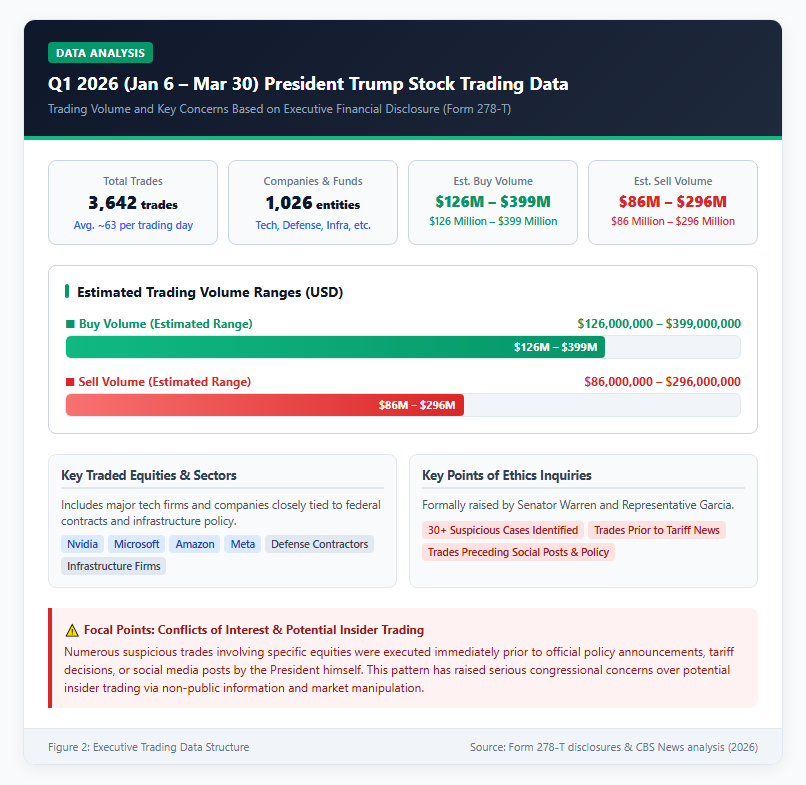
Although the administration contends that investments are managed independently by third-party financial advisors, concerns over personal enrichment via confidential executive information continue to spark anxiety across the business community regarding market fairness.
Future Outlook: The 2026 Midterm Elections and the Fate of Congressional Oversight
The converging demands for investigation and ongoing ethics scandals are poised to exert a decisive influence on the November 3, 2026 midterm elections. With administration approval ratings hovering around 39% due to economic affordability pressures and voters’ frustration over the conflict in Iran, the opposition Democratic Party holds a distinct advantage in the House of Representatives. Should Democrats regain the House majority, extensive subpoena issuance and high-profile public hearings targeting the Trump family’s foreign business ventures, DoD procurement contracts, and executive stock trading are expected to gain rapid momentum, exposing the administration to severe lameduck status and potential impeachment inquiries. Meanwhile, in the Senate, if vulnerable Republicans in competitive states distance themselves from the White House, the legislative balance of power could shift dramatically. As illustrated by Trump Media’s (DJT) recent petitions for investigations into unusual trading activity, the intersection of political maneuvering and stock market volatility remains volatile, making policy shifts and corporate governance risks paramount for businesses and investors. The upcoming exercise of congressional oversight and the midterm election outcomes will represent a critical watershed defining the trajectory of U.S. political and economic governance ahead of the 2028 presidential race.
Reference Pages
- [U.S. Office of Government Ethics (OGE) Executive Financial Disclosure (Form 278-T) – President Donald J. Trump] https://extapps2.oge.gov/201/Presiden.nsf/PAS+Index/405E4EC4E27BE8D185258DF7002DD1C0/\$FILE/Trump%2C%20Donald%20J.-05.08.2026-278T(2).pdf
- [U.S. Senate Public Letter on Trump Stock Trades – Sen. Warren & Rep. Garcia] https://www.warren.senate.gov/wp-content/uploads/2026/08/2026.8.12-Letter-to-Trump-re-Stock-Trades-final.pdf
【#USPolitics #TrumpFamily #GOP #EthicsProbe #2026Midterms】


コメント