
The Japanese government has revealed plans to launch full-scale research into integrating AI-powered humanoid robots into national defense. This initiative aims to address a severe personnel shortage in the Japan Self-Defense Forces by streamlining and automating logistical support tasks, including base security and cargo transportation.
- Government Considerations and Strategic Background
- Specific Missions for Automation and ATLA’s Vision
- U.S.-China Competition in Military and Industrial Humanoids
- Governance and Ethical Risks in Military AI Operations
- LAWS Regulation Debates and “Human-in-the-Loop” Oversight
- Implementation Hurdles in Japan and Key Points to Watch
Government Considerations and Strategic Background
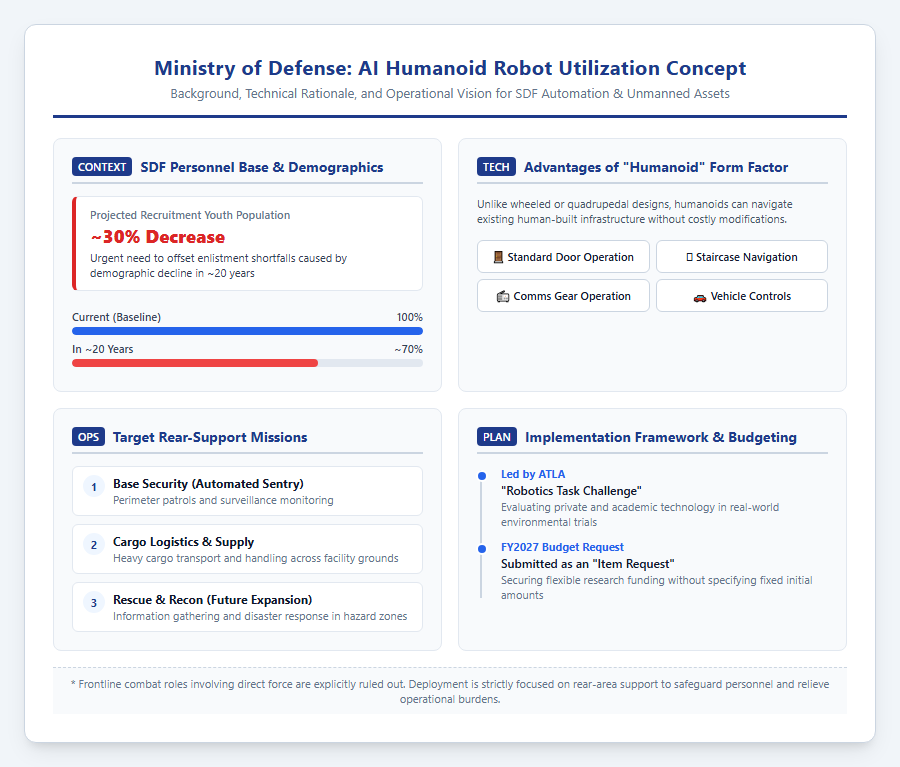
According to government and ruling party officials on September 22, 2026, the Ministry of Defense has entered formal consideration to begin comprehensive research on incorporating artificial intelligence-equipped humanoid robots into defense operations. This initiative leverages “Physical AI” technology—enabling autonomous object recognition and motion planning through advanced AI algorithms—targeting rear-area support missions such as base security and logistics transport across the Ground and Air Self-Defense Forces. The primary driver behind the Ministry’s push is a chronic enlistment shortfall and an impending contraction of Japan’s military demographic. Projections indicate that the youth population eligible for recruitment will shrink by approximately 30 percent over the next two decades. Consequently, supplementing and substituting human personnel with unmanned assets and robotics has become essential to sustain national defense capabilities. Notably, deployment to frontline combat roles involving direct force is explicitly ruled out; the operational framework is strictly focused on rear support to protect service members and alleviate operational burdens.
Specific Missions for Automation and ATLA’s Vision
Initial operational roles envisaged under the program include automated sentry units patrolling Self-Defense Forces (SDF) base perimeters and heavy cargo transport and handling within expansive military facilities. Long-term applications encompass reconnaissance and disaster response in hazardous environments or disaster zones unfit for human entry. Development is led by the Acquisition, Technology & Logistics Agency (ATLA), which plans to host a “Robotics Task Challenge.” This competition will bring together existing humanoids and core component technologies developed by private enterprises and research universities to test mobility and autonomy under realistic environmental conditions. To secure flexible funding, the Ministry of Defense intends to submit these research costs as an unspecified “item request” in its FY2027 budget proposal. The technical rationale for choosing a two-legged, two-armed humanoid form factor—rather than wheeled or quadrupedal designs—lies in its high adaptability. Humanoids can seamlessly navigate existing human infrastructure, operating doors, staircases, communications gear, and vehicle controls without requiring costly modifications. The following diagram illustrates the conceptual framework for unmanned asset operations within SDF defense innovation.
Acceleration of Global Military AI and Robotics Development
U.S.-China Competition in Military and Industrial Humanoids
Japan’s venture into defense robotics is part of a rapidly escalating global competition. China, in particular, has accelerated military application studies through defense-linked institutions. Following its 2024 Defense Technology Forum, the PLA National Defence University hosted the “Lunji Cup” in June 2025, simulating behind-the-lines infiltration and base security operations. In August 2025, Chinese researchers published studies combining humanoid robots, quadrupedal machines, and unmanned vehicles alongside human soldiers for urban building sweeps. Furthermore, in June 2026, a budget of approximately \$300,000 was allocated for autonomous robot navigation data collection systems. Concurrently, the commercial sector is driving mass-production capabilities: Tesla is pushing plans to scale Optimus production to 100,000 units annually in 2026, while Figure AI completed pilot operations at BMW facilities. The rapid evolution of global Physical AI platforms is exerting direct influence on defense strategies worldwide.
Governance and Ethical Risks in Military AI Operations
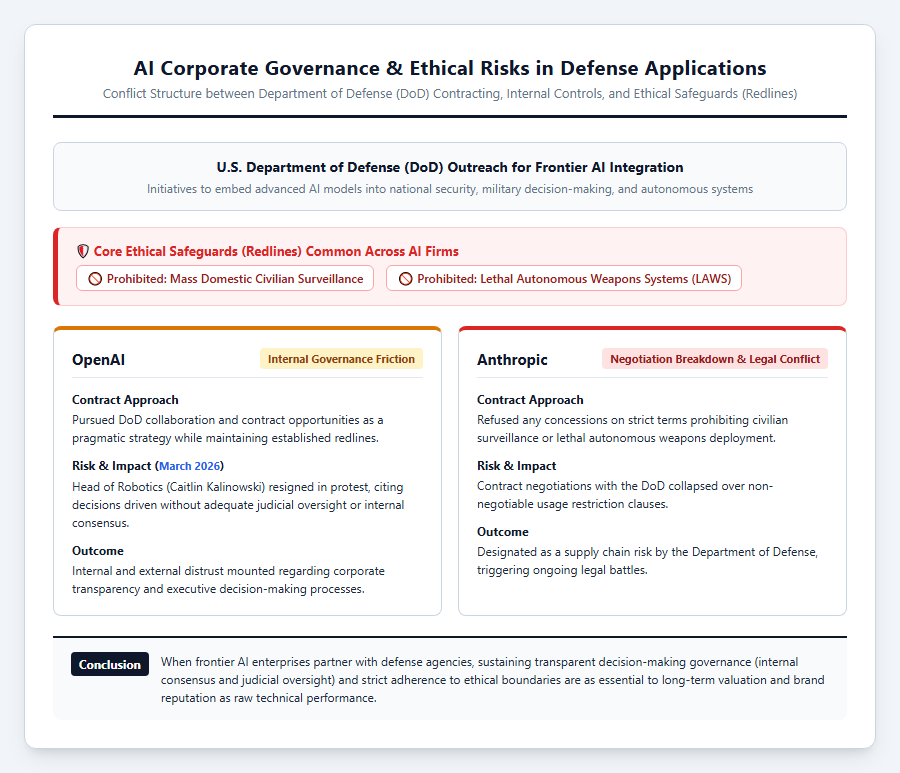
As the integration of commercial frontier AI into defense sectors accelerates, friction surrounding corporate governance and ethical safeguards has come to the fore. In March 2026, Caitlin Kalinowski, head of robotics at OpenAI, resigned in protest over Department of Defense (DoD) contracting decisions, citing a lack of judicial oversight and internal consensus. Although OpenAI maintained that it established clear redlines against mass domestic surveillance and autonomous weapons systems, the controversy eroded trust internally and externally. Meanwhile, rival firm Anthropic stood firm on its prohibitions against civilian surveillance and lethal autonomous weapons, leading to a breakdown in contract negotiations with the DoD, subsequent designation as a supply chain risk, and ongoing legal battles. These developments underscore that when frontier AI companies partner with national security agencies, maintaining transparent governance and ethical boundaries is as crucial as technical performance. The following diagram outlines the corporate governance structure surrounding AI defense applications.
Challenges and Future Outlook for Defense Innovation
LAWS Regulation Debates and “Human-in-the-Loop” Oversight
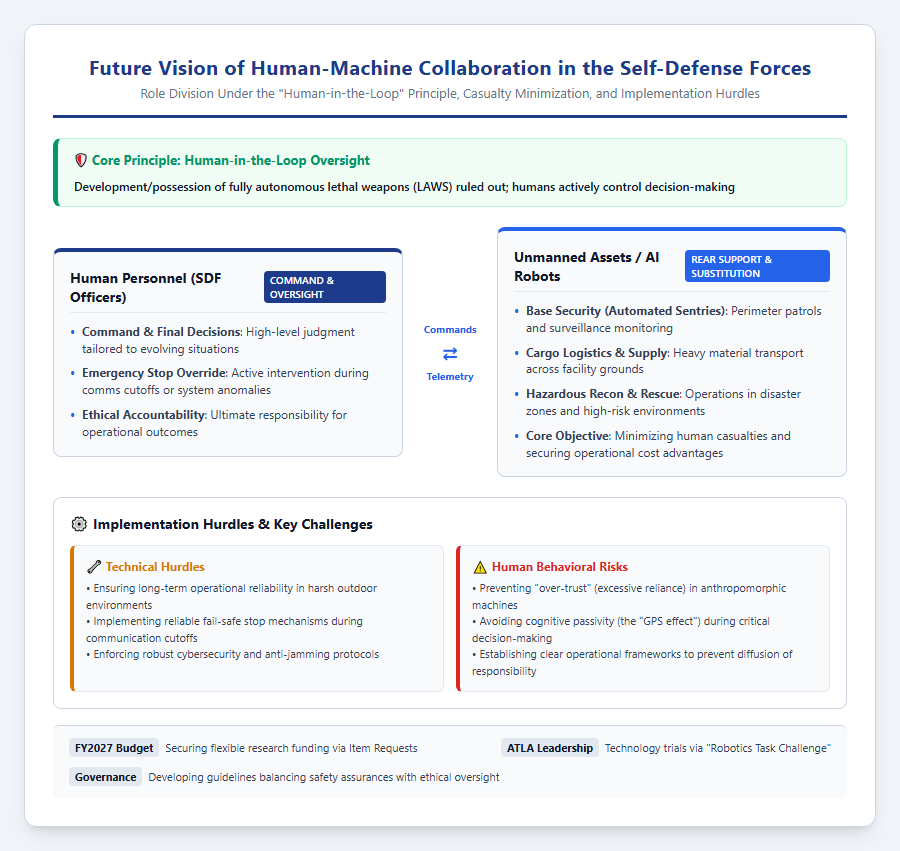
The proliferation of military AI robotics has intensified global concern regarding Lethal Autonomous Weapons Systems (LAWS), which select and engage targets without human intervention. On August 25, 2026, UN Secretary-General António Guterres and ICRC President Mirjana Spoljaric issued a joint statement urging the rapid drafting of a legally binding international treaty to ban fully autonomous weapons and strictly regulate semi-autonomous systems, preventing the loss of human control over life-and-death decisions. While major powers like the United States and Russia remain cautious about formal legal prohibitions—citing technological superiority and the sufficiency of existing international law—international rule-making discussions have reached a critical juncture. In response, the Japanese government has reaffirmed its stance that it has no intention of developing or possessing fully autonomous lethal weapons, adhering strictly to the principle of “Human-in-the-loop” oversight in defense technology deployment.
Implementation Hurdles in Japan and Key Points to Watch
Under its “Budget for Defense Capability Transformation,” the Ministry of Defense is advancing the adoption of unmanned assets, aiming to evolve into an organization that maximizes unmanned operational efficiency to minimize casualties and secure cost advantages. However, transitioning humanoid robots to operational readiness within the SDF presents formidable technical hurdles: ensuring long-term operational reliability in harsh outdoor environments, implementing fail-safe stop mechanisms during communication cutoffs, and enforcing robust cybersecurity protocols. Behavioral risks also loom large, including human over-reliance on anthropomorphic machines and cognitive passivity (the “GPS effect”) during decision-making. Key benchmarks to monitor include progress in ATLA’s “Robotics Task Challenge” under the FY2027 budget request, technical validation results, and the establishment of operational guidelines that balance safety assurances with ethical oversight. The following concept map illustrates the future vision of human-machine collaboration in the Self-Defense Forces.
Reference Pages
- 【Ministry of Defense】https://www.mod.go.jp/
【#AI #HumanoidRobots #MinistryOfDefense #PhysicalAI #NationalSecurity #JSDF #MilitaryAI】


コメント