As tensions surrounding Iran escalated at the end of February 2026, multiple surveys revealed that over 70% of Japanese companies are feeling the impact on their business operations. In addition to growing procurement uncertainty for crude oil, naphtha, and other petrochemical products, a widening disparity in companies’ ability to pass on rising raw material and logistics costs to customers is becoming increasingly severe.
- Key Points of the Event: Why Over 70% of Companies Feel the Impact
- Disruption Risks in the Strait of Hormuz and Supply Uncertainty for Crude Oil and Naphtha
- Procurement Bottlenecks in Chemical Processing Materials and Distribution Imbalances
- Surging Procurement Costs and Disparities in Price Pass-Through Capabilities
- Risks of Prolonged Supply Anxiety and Government/Municipal Support Measures
- Future Outlook and Key Focus Areas: Supply Chain Reconfiguration and BCP Enhancement
Key Points of the Event: Why Over 70% of Companies Feel the Impact
Military action against Iran by the United States and Israel on February 28, 2026, triggered a sharp rise in geopolitical risk across the Middle East. Iran’s de facto blockade and transit ban in the Strait of Hormuz paralyzed global energy supply routes. This dealt a heavy blow to the Japanese economy, which relies on the Middle East for approximately 94% of its crude oil imports. According to a May 2026 survey by Teikoku Databank (4,604 valid responses), 32.6% of surveyed companies reported that the impact on business operations was “strengthening,” while 36.8% answered “somewhat strengthening,” combining for 69.4%—nearly 70%—of firms feeling an intensified impact. Similarly, a joint survey conducted in August 2026 by 22 Chambers of Commerce and Industry in Aichi Prefecture (2,325 valid responses) showed that 71.5% of enterprises experienced some degree of impact. Immediately following the onset of the crisis in March 2026, the Nikkei Stock Average plunged by more than 4,000 yen, causing widespread panic in equity markets. Corporate distress has since progressed beyond initial panic, worsening into a tangible drag on the real economy characterized by broad-based procurement cost spikes and constrained supply capabilities.
Disruption Risks in the Strait of Hormuz and Supply Uncertainty for Crude Oil and Naphtha
Japan depends on petroleum for approximately 36% of its primary energy, with its reliance on Middle Eastern crude reaching 94%. Because roughly 90% of that oil passes through the Strait of Hormuz, dysfunction in the waterway directly threatens Japan’s energy security. In March 2026, Dubai crude oil prices surged to a record high of \$169.80 per barrel. The Japanese government released a total of roughly 71 days’ worth of private and national petroleum reserves and implemented emergency price mitigation subsidies to cap retail gasoline prices around 170 yen per liter. Furthermore, starting in May, measures were enacted to raise the proportion of alternative procurement from the United States and Latin America to over 50%. However, a far more critical challenge lies beyond fuel oil volume alone: the supply uncertainty surrounding “naphtha,” the essential feedstock for petrochemical products. Import prices for naphtha soared to roughly 1.9 times their previous levels, driving up domestic corporate goods prices sharply in naphtha-related categories. The following diagram illustrates the structure of energy security
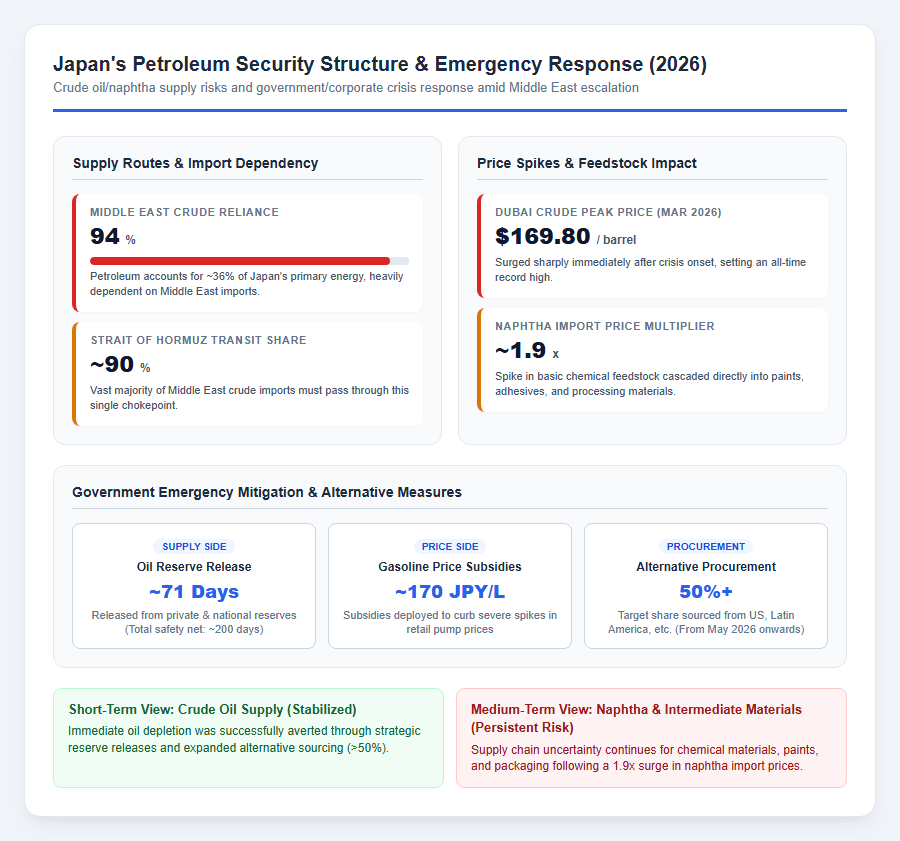
. According to estimates by the Nippon Mirai Ken research institute, while reserve releases have averted an immediate depletion of petroleum, supply uncertainty for intermediate materials continues to persist.
Supply Chain Clogging and Cost Structure Realignment
Procurement Bottlenecks in Chemical Processing Materials and Distribution Imbalances
The surge in crude oil and naphtha prices resulting from deteriorating Middle East conditions has extended far beyond fuel shortages, directly striking component and processing material supply chains deep within industrial sectors. In the Teikoku Databank survey, “chemical processing materials”—such as paints, adhesives, and thinners—ranked highest as the material experiencing procurement disruptions, cited by 29.6% of companies. This was followed by “packaging and logistics materials” such as adhesive tapes and plastic containers at 20.2%, and equipment, construction, and electronic components at 13.9%. While upstream basic chemicals have not vanished completely from the market, inventory holding periods in the midstream processing and distribution stages stand at just 39 days, proving insufficient to absorb demand fluctuations. Among downstream industries, the construction sector—which relies heavily on customized site specifications—maintains a precarious average inventory of just 24 days, leading to a wave of project schedule revisions caused by arrival delays of housing equipment and paints. Specific disruptions materialized in forms such as shipping restrictions on paint thinners and temporary order suspensions by major housing equipment manufacturers. Rather than a total supply halt, inventory imbalances across distribution channels are obstructing production in targeted industries.
Surging Procurement Costs and Disparities in Price Pass-Through Capabilities
Compounded by a historically weak yen alongside skyrocketing crude oil and naphtha prices, Japanese enterprises are bearing a “double blow” of import costs. Simultaneous increases in raw material, energy, and logistics expenses severely compress corporate profit margins. According to Teikoku Databank’s analysis, “rising procurement costs for raw materials and components” was cited by 83.9% of companies as a specific impact on business operations, followed by “procurement instability or unavailability” at 73.0% and “rising logistics, transportation, and packaging costs” at 48.9%. The following diagram depicts the transformation of international logistics and the structure of cost increases
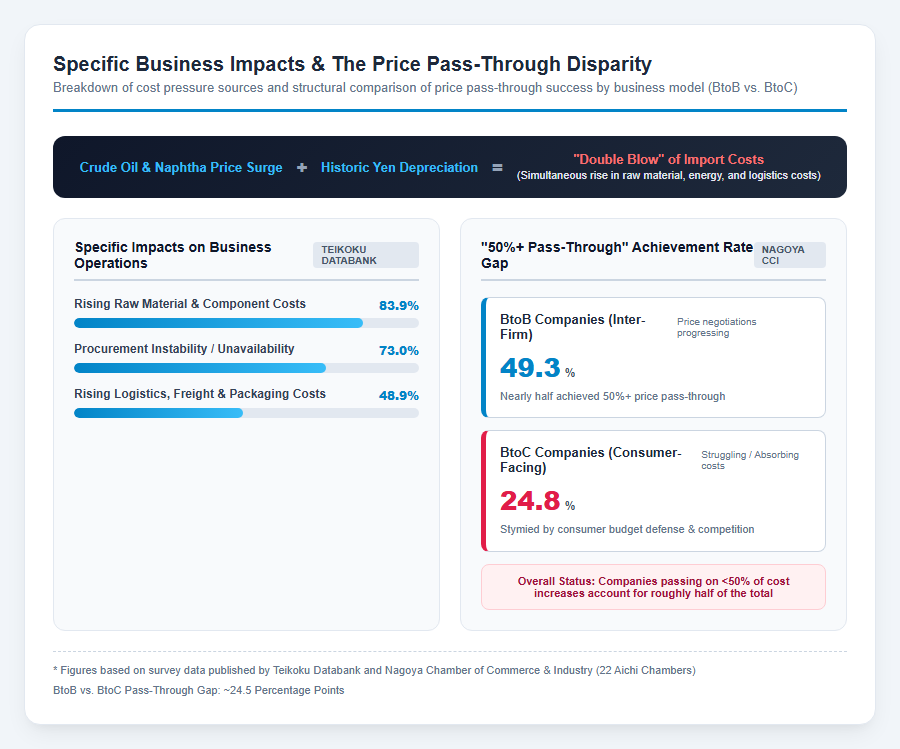
. In response to rising costs, a survey by the Nagoya Chamber of Commerce and Industry noted that the proportion of companies able to “pass on 50% or more of cost increases” rose by 13.3 percentage points compared to the previous survey, signaling progress in price negotiations primarily within BtoB markets. However, companies achieving a pass-through rate below 50% still account for roughly half of the total. A sharp divide exists between business models: while 49.3% of BtoB-focused firms achieved a pass-through rate of 50% or more, only 24.8% of BtoC companies interacting directly with final consumers did so. Hindered by consumer budget defense and competitive risks, small business operators in particular face immense strain as they absorb cost burdens internally.
Future Market Outlook and Strategic Corporate Responses
Risks of Prolonged Supply Anxiety and Government/Municipal Support Measures
Uncertainty regarding when Middle East tensions will subside continues to cast a shadow over corporate management. According to scenario analysis by Sumitomo Mitsui DS Asset Management, an optimistic scenario with crude oil prices stabilizing around \$75 per barrel would sustain Japan’s economic recovery trend. Conversely, a risk scenario in which prices remain elevated between \$100 and \$120 per barrel for over six months risks pushing Japan’s 2026 GDP into zero growth due to global demand deterioration and reignited inflation. In response, the Japanese government has implemented emergency support measures, including subsidies for gasoline and diesel fuel, phased releases of national petroleum reserves, and special consultation windows and interest rate reductions through public financial institutions like the Japan Finance Corporation. Additionally, the Ministry of Economy, Trade and Industry is promoting direct sales schemes by primary distributors to critical infrastructure operators and enforcing same-volume-as-prior-year supply rules to alleviate distribution bottlenecks. Local chambers of commerce across regions are also strengthening financial and managerial counseling frameworks. For business leaders, swiftly leveraging these public relief measures and subsidy programs is essential to prevent cash flow deterioration and maintain short-term operational continuity.
Future Outlook and Key Focus Areas: Supply Chain Reconfiguration and BCP Enhancement
Anticipating prolonged Middle East instability, Japanese enterprises must pursue structural reform beyond emergency fixes. The first key focus area is “supply chain visibility and diversification.” Rather than merely increasing the number of immediate suppliers, companies must map supply networks down to tier-2 and tier-3 vendors to identify and address hidden dependencies on specific petrochemical manufacturers or geographic hubs. The second focus area is the “rebuilding of actionable Business Continuity Plans (BCPs).” Case studies highlighted by Biz Easy show that during the initial escalation in February 2026, companies equipped with practical BCPs completed initial emergency responses within an average of two days, whereas firms without prepared plans suffered delays of two to three weeks, resulting in long-term losses of customer trust and market share. Establishing real-time inventory and commercial flow management leveraging digital technology and ERP systems is considered an urgent priority. The third focus area is accelerating investment in decarbonization and energy-saving technologies. Transitioning away from excessive reliance on Middle Eastern crude oil and naphtha toward recycled or alternative materials represents a structural defense against geopolitical risks and a crucial driver of long-term corporate value.
References
- [Ministry of Economy, Trade and Industry] Trends in Fuel Procurement and Stable Power/Gas Supply
https://www.meti.go.jp/shingikai/enecho/denryoku_gas/jisedai_kiban/pdf/005_07_00.pdf - [Nagoya Chamber of Commerce and Industry] Results of the 58th Periodic Business Survey and Joint Survey of 22 Chambers in Aichi Prefecture
https://www.nagoya-cci.or.jp/action/file/survey58_report.pdf - [Teikoku Databank] Survey on the Impact of Middle East Tensions on the Supply Status of Naphtha and Petroleum Products
中東情勢に伴うナフサなど石油製品供給状況に関する影響調査|株式会社 帝国データバンク[TDB]帝国データバンクによる、注目の経済・経営トピックに関するレポートです。国内83拠点の調査網、国内最大級の企業データベース、対象約2万社のインターネット調査を駆使し、独自のビジネスレポートを発表しています。www.tdb.co.jp

【#MiddleEastTensions #JapaneseEconomy #CrudeOilPrices #SupplyChain #Inflation #PricePassThrough #BCP】


コメント