Nissan Motor and Quemix, a startup focused on quantum computing, announced that they have begun joint research on June 1, 2026, to conduct vehicle aerodynamic simulations using quantum computation. This technological development has the potential to dramatically reduce traditional computation times and accelerate the development speed of next-generation vehicles.
- Launching collaborative research that can turn a day into minutes
- The birth of a new algorithm for handling complex vehicle shapes
- The Role of Digital Development in Accelerating Structural Reforms
- Contribution to achieving carbon neutrality
- Parallel Expansion to the Three Automakers and Industry Standards
- Future Outlook and Challenges for Practical Application
Launching collaborative research that can turn a day into minutes
On June 1, 2026, Nissan Motor and Quemix Inc. began joint research and development of next-generation aerodynamic analysis software utilizing quantum computers. In automotive development, aerodynamic performance is an extremely important factor directly linked to fuel efficiency, electricity consumption, and driving range, but analyzing it involves an enormous computational load. Traditional simulations using classical supercomputers typically required a single computation to take several hours to about a day. The goal of this joint research is to dramatically reduce this “one-day calculation” to “minutes.” If this acceleration is achieved, it will be possible to significantly increase the number of design fine-tuning and simulation iterations, bringing a paradigm shift to the vehicle development process.
The birth of a new algorithm for handling complex vehicle shapes
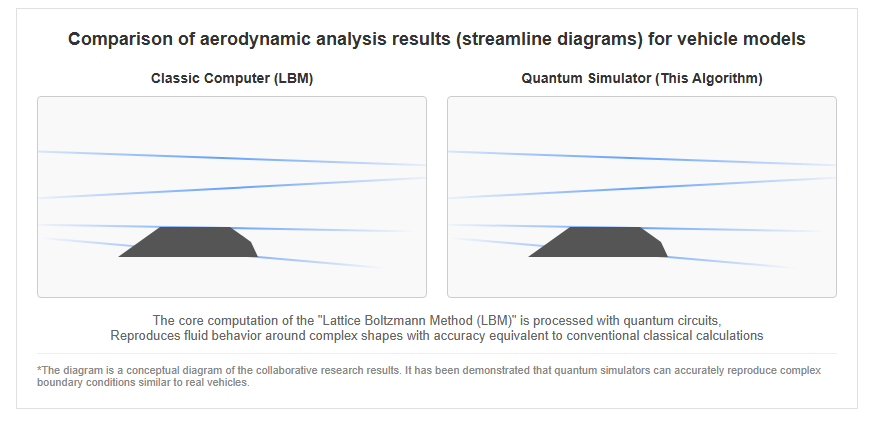
The technical core of this announcement is the successful development of a “quantum-classical hybrid algorithm” capable of efficiently handling complex vehicle shapes and boundary conditions. Based on the “Lattice Boltzmann Method (LBM)” commonly used in fluid analysis, we constructed a mechanism in which the quantum computer handles the main computational parts and the classical computer handles the processing of peripheral asymmetric terms. Traditional quantum algorithms tended to be limited to shapes like simple cubes, but new technologies overcome the barriers of incorporating complex curved surfaces into quantum circuits, much like real vehicles. Verification on a quantum simulator confirmed that classical computer analysis results can be reproduced with high precision, and a joint patent application was completed. Please refer to the diagram below.
。
The Intersection of Technical Capability and Management Strategy
The Role of Digital Development in Accelerating Structural Reforms
Nissan’s increased investment in the cutting-edge field of quantum technology is driven by ongoing business restructuring plans and targets to reduce development costs. Nissan has set a goal to reduce costs by a total of 500 billion yen (250 billion yen each for fixed and variable costs) from fiscal year 2024 to the end of fiscal year 2026, and achieving this requires thorough digitalization of the development process. Additionally, we are pursuing a strategy to significantly reduce the number of global platforms from the current 13 to 7 by fiscal year 2032, thereby improving development efficiency. Accelerating quantum computer simulations is key to optimizing initial R&D costs and upfront investments, as part of TdC (Total Delivery Cost) reduction efforts that have previously assigned thousands of engineers, enabling faster market launch of more competitive products.
Contribution to achieving carbon neutrality
Improving aerodynamic performance is an unavoidable challenge to achieve carbon neutrality, especially to extend the driving range of electric vehicles (EVs). Nissan is accelerating its electrification strategy, including launching the plug-in hybrid Rogue in the latter half of fiscal 2025 and the Rogue equipped with e-POWER in fiscal 2026. Reducing aerodynamic resistance effectively extends driving range without increasing battery capacity, so high-precision analysis using quantum computing directly contributes to product competitiveness. The government has also positioned quantum technology as one of its ’17 strategic areas,’ and has set a goal to increase the production value of quantum technology to 50 trillion yen by 2030, supporting investment. Nissan’s efforts align with this national strategy.
The Future of Industry Envisioned by Quantum SaaS
Parallel Expansion to the Three Automakers and Industry Standards
It has been revealed that Quemix is conducting demonstrations of quantum algorithms with both Honda and Toyota around the same time as its partnership with Nissan. Specifically, we provide technologies tailored to each company’s needs, such as accelerating density functional calculations with Honda, strongly correlated electronic calculations with Toyota and Mitsui Mining & Smelting, and aerodynamic analysis using the lattice Boltzmann method with Nissan. The reason we can conduct joint research in parallel with these three competing automakers is that Quemix adopts a business model that provides “algorithms” in a SaaS format. Design data itself is completed within the customer’s environment to maintain confidentiality, while aiming to establish the de facto standard for analytical methods. This move signals a spillover not only to the automotive industry but also to all industries requiring fluid analysis, including aircraft, energy, and construction.
Future Outlook and Challenges for Practical Application
Details of these results are scheduled to be presented at the international conference “Q2B 2026 Tokyo” to be held in June 2026. However, there are still hurdles before full practical application. Currently, we are at the stage where successful demonstrations have been made on simulators, and it is generally believed that before full-scale operation on actual hardware (actual machines), error correction technology (QEC) will need to be established in the 2030s. Additionally, to avoid a ‘quantum winter’ caused by excessive expectations (hyps), researchers are required to practice responsible innovation and maintain honest accountability. Nissan and Quemix aim to use this achievement as a foundation to further accelerate research for application in actual vehicle development processes and drive a paradigm shift in computing technology in industry.
[#日産自動車 #Quemix #量子コンピュータ #空力解析 #CAE #DX #自動車開発 #構造改革]

コメント