Cuon Co., Ltd., a subsidiary of TeraSky Co., Ltd., announced that it will launch “Private AI Appliance”—an on-premises AI solution designed for securely operating local LLMs—on November 1, 2026. The launch comes amidst escalating security risks associated with traditional cloud-based LLMs, such as confidential data leaks and credential exposure.
- Announcement Overview and Core Architecture of Private AI Appliance
- Cloud-Based LLM Security Risks and the Need for On-Premises Solutions
- Defense Against Unauthorized Access via Sandbox Isolation
- Credential Protection through Credential Separation and Gateway Proxying
- Operational Efficiency via Cloud Management and Comprehensive Support
- Anticipated Use Cases and Future Market Outlook
Announcement Overview and Core Architecture of Private AI Appliance
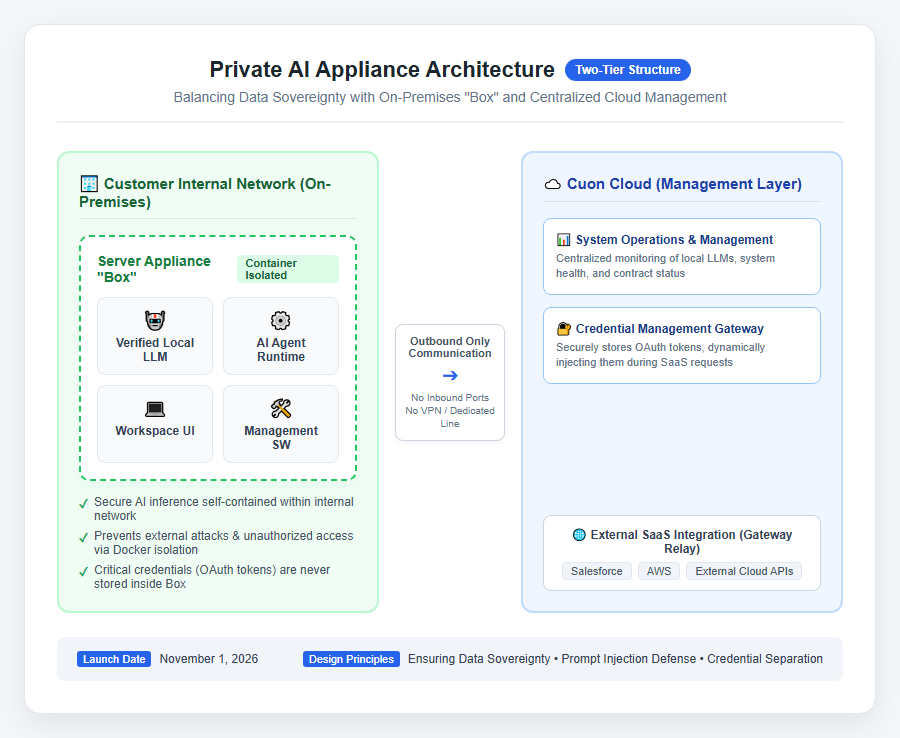
On September 24, 2026, Cuon Co., Ltd., a group company of TeraSky Co., Ltd., announced that it will begin offering Private AI Appliance on November 1, 2026, enabling enterprises to safely leverage local LLMs by deploying a dedicated appliance on-premises. The solution features a two-tier architecture: “Box,” a server appliance installed directly within the client’s internal network, and “Cuon Cloud,” which handles system monitoring and contract management. The Box appliance comes pre-loaded with verified LLMs, an AI agent execution environment, a workspace UI, and management software, allowing all AI processing to remain completely isolated within the corporate network. Meanwhile, operational monitoring and update management are centrally conducted via Cuon Cloud. Built on the core principle of ensuring data sovereignty—where enterprises maintain complete administrative authority over their critical data and models—the system has drawn strong interest as a platform that balances generative AI convenience with robust security. The diagram below illustrates the overall product architecture.
Cloud-Based LLM Security Risks and the Need for On-Premises Solutions
In recent years, enterprises have increasingly adopted AI agents and automated business processes. However, leveraging large language models hosted on public clouds poses persistent concerns regarding the potential leakage of proprietary internal information and customer data. In the past, notable incidents occurred at high-profile companies where employees entered source code and meeting transcripts into public AI platforms, resulting in data exposure and highlighting deficiencies in corporate guidelines and technical defenses. Furthermore, industry research on cloud computing indicates that between 70% and 80% of enterprises undertake data repatriation annually, shifting workloads back to on-premises environments due to security and cost considerations. Against this backdrop, the need for an on-premises infrastructure that guarantees strict security while enabling companies to operate AI models locally—without transmitting sensitive data to external SaaS applications or third-party servers—is growing rapidly.
Multi-Layered Defense Architecture to Ensure Data Sovereignty and Security
Defense Against Unauthorized Access via Sandbox Isolation
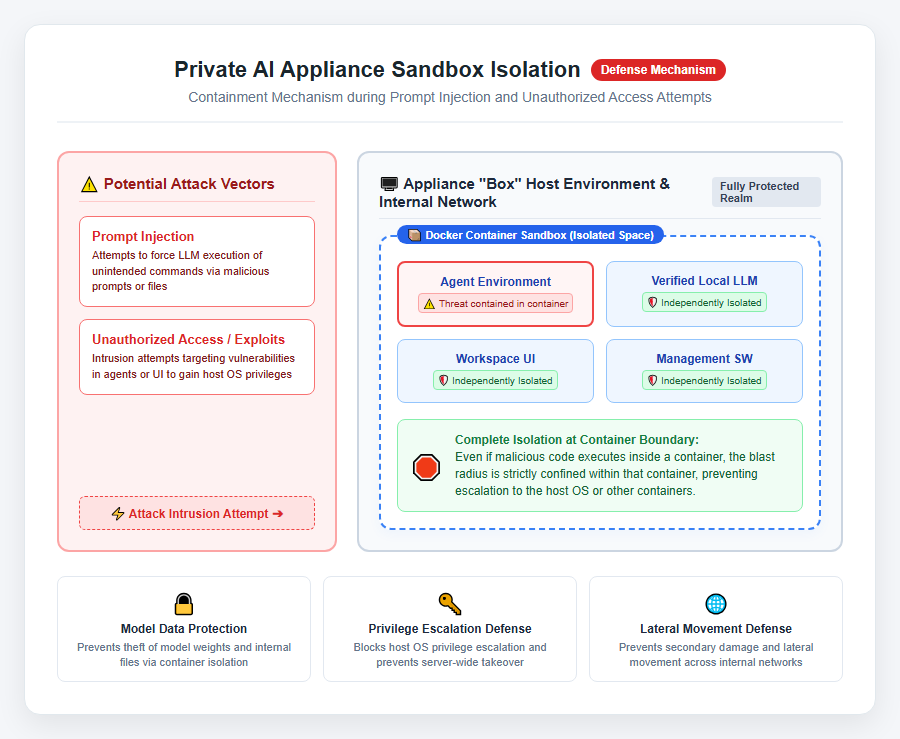
One of the defining technical features of Private AI Appliance is its multi-layered security defense powered by an advanced sandbox environment. All functional components running inside the Box appliance—including local LLMs, agent runtimes, and user interfaces—operate as isolated Docker containers. Consequently, even if an attacker attempts a prompt injection attack using malicious files or inputs, or tries to breach the host operating system, the blast radius is strictly confined within the specific container. This robust structure prevents the theft of LLM weights and the compromise of server-level administrative privileges, blocking secondary damage to internal corporate networks and host environments. The conceptual diagram below shows how the container isolation mechanism works.
Credential Protection through Credential Separation and Gateway Proxying
When AI agents integrate with external SaaS solutions to execute complex automated tasks, the potential exposure of third-party authentication credentials represents a major challenge. Private AI Appliance addresses this vulnerability through an architectural design based on credential separation. Critical authentication credentials, such as OAuth tokens required for accessing external SaaS tools, are stored and managed exclusively within Cuon Cloud’s Gateway and are never retained inside the on-premises Box appliance. When an AI agent on the Box requests access to an external SaaS, the request routes through the Cuon Cloud Gateway, where credentials are dynamically attached in transit. Additionally, communication between the Box and Cuon Cloud relies strictly on outbound connections initiated by the Box, eliminating the need to open inbound ports or set up external VPN connections, thereby minimizing potential cyberattack vectors.
Operational Convenience in Enterprise Adoption and Future Outlook
Operational Efficiency via Cloud Management and Comprehensive Support
In on-premises AI deployments, infrastructure maintenance and a shortage of specialized MLOps personnel often act as major barriers to implementation. Private AI Appliance overcomes this by offering a secure, self-contained inference environment while allowing administrators to monitor model operational status, contract details, and overall system health centrally via Cuon Cloud. As a result, enterprises can simultaneously enjoy the robustness of on-premises infrastructure and the management convenience typical of cloud services. During deployment, clients benefit not only from Cuon’s system development expertise but also from integrated support across the entire TeraSky Group. TeraSky (specializing in Salesforce and DX consulting), Libersky (handling CDP and security), and BeeX (excelling in AWS infrastructure) collaborate to provide seamless implementation tailored to each customer’s existing IT environment and data management requirements.
Anticipated Use Cases and Future Market Outlook
Private AI Appliance is designed for a broad spectrum of enterprise scenarios, particularly in highly regulated industries such as manufacturing, finance, and healthcare, as well as for operating AI agents inside closed networks and embedding LLMs into software development pipelines. As of 2026, hybrid AI configurations—where sensitive, routine workloads are processed on-premises while temporary, massive computing tasks are delegated to the cloud—are becoming the industry standard. Moreover, the importance of AI sovereignty, which guarantees corporate control over data and AI models, continues to rise annually, driving up the strategic value of local AI platforms for regulatory compliance and data leakage prevention. Following its official release on November 1, 2026, Private AI Appliance is expected to establish itself as a de facto standard for secure enterprise AI adoption, making significant contributions to the deepening of AI integration and business transformation across domestic companies.
References
- [Cuon Launches On-Premises Solution “Private AI Appliance” for Local LLMs Starting November 1, 2026] https://prtimes.jp/main/html/rd/p/000000286.000009955.html
- [Private AI Appliance – Cuon Co., Ltd.] https://cuon.co.jp/service/paia
【#GenerativeAI #OnPremise #LocalLLM #DataSovereignty #Security #Cuon #AIAgents】

コメント