On July 1, 2026, Language Understanding Institute (ILU), a group company of Sansan Corporation, launched the RAG (Search Augmented Generation) system “Manufacturing Site Knowledge AI,” specialized for utilizing documents in manufacturing sites. This system organizes and structures the complex document structures and proprietary technical terms unique to manufacturing sites using advanced natural language processing technology, enabling accurate knowledge search and answers that were difficult for conventional large language models (LLMs).
- ILU Launches Provision of ‘Manufacturing Site Knowledge AI’
- The aim is to turn the ‘tacit knowledge’ of skilled workers into digital assets
- Structural mismatches and lack of “context” in the data
- The reality that “2 out of 3 RAG implementations fail”
- Advanced structuring to maintain complex document flows
- A dedicated dictionary function unique to the workplace to eliminate ‘word fluctuation’
- Ensuring Reliability with ‘Evidence Links’ and Visualizing Answers
- Small Start and Gradual Deployment of ‘Starting from the First Line’
- The courage to “first” organize data can determine success or failure
- International AI Regulations and Responding to ‘Cyber Resilience’
- “Mythos-level” cyberattacks and AI utilization as countermeasures
ILU Launches Provision of ‘Manufacturing Site Knowledge AI’
The “Manufacturing Site Knowledge AI,” announced by Language Understanding Research Institute (ILU) on July 1, 2026, is a RAG system designed so that generative AI can correctly understand and utilize technical documents, manuals, and troubleshooting histories accumulated on the manufacturing floor. While manuals are becoming more digital in manufacturing sites, a long-standing issue has been pointed out that there is no established environment for quick access to necessary information from vast amounts of documents. Unlike simple keyword searches, this service structures information based on the meaning and relationships of documents, providing immediately useful answers for equipment troubles and quality control situations. The initial fee is 8 million yen, and the monthly fee starts at 150,000 yen, supporting flexible configurations tailored to your company’s existing cloud environments (Azure, AWS, Google Cloud, etc.). Leveraging ILU’s strengths as the largest linguistic asset in Japan, we aim to spread it as a “trusted AI” that allows field staff to make decisions while verifying the basis of the original documents.
The aim is to turn the ‘tacit knowledge’ of skilled workers into digital assets
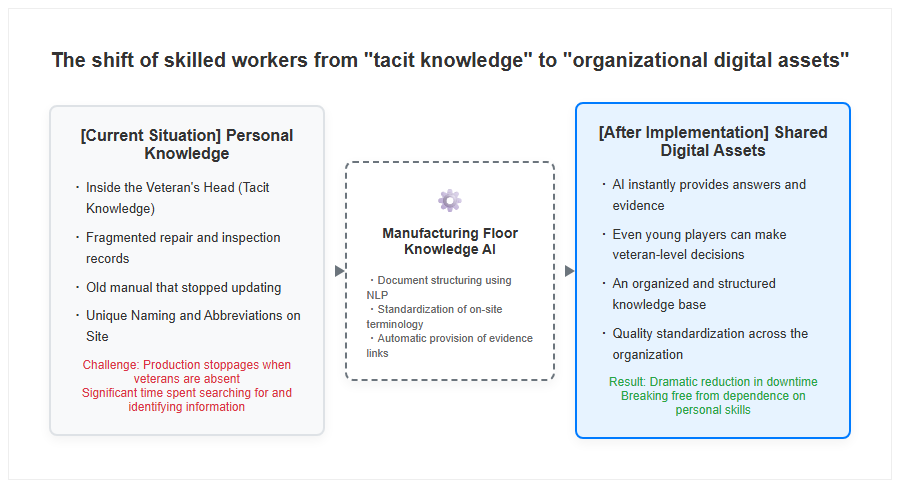
One of the serious challenges facing the manufacturing industry is the passing on of knowledge among skilled workers as the baby boomer generation retires. Veterans possess know-how in their heads, and documents such as vast past inspection records and repair daily reports are valuable assets for organizations, but there are many cases where these are left unorganized. When younger employees encounter troubles, there is always a risk of prolonged production line downtime by searching for veterans who know the solution or mistakenly referring to outdated manuals. Manufacturing Floor Knowledge AI converts this scattered knowledge into a “readable form for AI,” creating a state where anyone can receive answers close to veteran judgment standards when needed. This enables the elimination of reliance on individual skills and enables improvements in overall productivity and quality throughout the factory. Please refer to the diagram below.
[Industry Challenges] Why is general-purpose AI stuck at ‘PoC’ in manufacturing sites?
Structural mismatches and lack of “context” in the data
In the use of AI in manufacturing, data shows that about 70% of cases where Proof of Concept (PoC) achieve certain results but do not reach production deployment in “PoC deaths.” The fundamental cause is not the lack of accuracy of the AI models themselves, but rather the “structural mismatch” between the judgments required for business operations and the state of the data at hand. Factory data is not just a string of numbers or text; it contains a rich context (context) of “which process,” “which material lot was used,” and “under what equipment conditions” it occurred. At the PoC stage, analysts supplement these missing contexts with human-based work, but if this support is removed in actual operation, AI cannot respond to even slight fluctuations in conditions and is criticized by the field as “unusable.” With general-purpose RAG, it is difficult to process data while maintaining the unique connections of manufacturing sites, making information disconnections more likely.
The reality that “2 out of 3 RAG implementations fail”
According to Canon IT Solutions’ survey of 228 RAG implementation cases, only 33% achieved the expected results. Analyzing the factors behind failure revealed that 46% were due to response quality issues and 42% to challenges related to data integration, revealing that the biggest bottleneck hindering success is inadequate data organization, rather than the technology itself. Especially in manufacturing sites, the “garbage data problem” is serious, where procedure manuals are stored in different formats by department and it is difficult to extract text from scanned PDF images. Additionally, the same work procedure may exist in slightly different content across IT systems, manufacturing, and quality control departments, often lacking governance over which information AI should correctly reference. Forcing AI into such environments can cause “hallucinations,” which produce incorrect information to sound plausible, resulting in a loss of trust in the field.
[Proprietary Technology] Overcoming the Barriers to Precision with ‘Structured Design’ and ‘Terminology Standardization’
Advanced structuring to maintain complex document flows
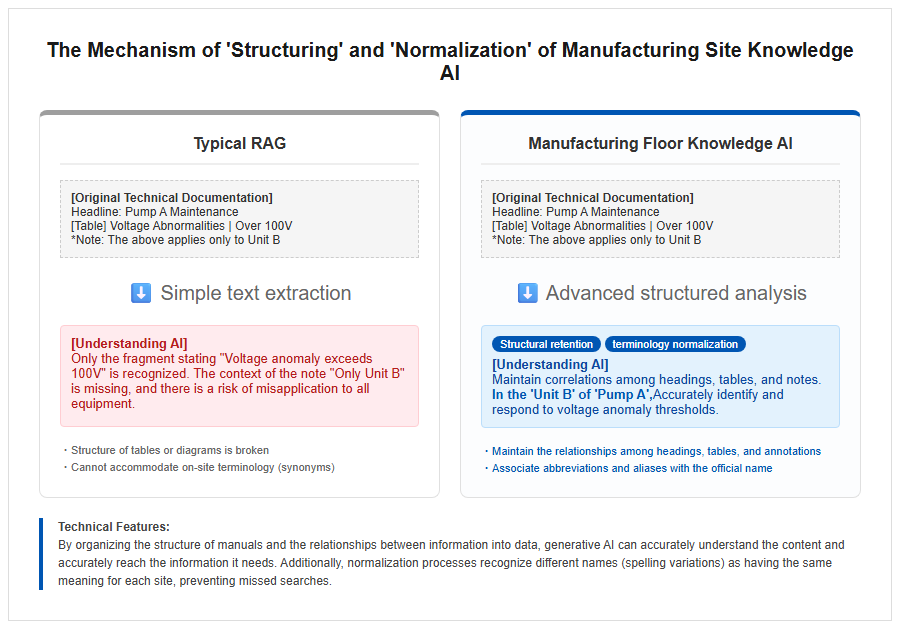
The biggest feature that sets Manufacturing Site Knowledge AI apart from general-purpose RAG is its “advanced structured design” using ILU’s proprietary natural language processing technology. Technical documents and trouble reports on the manufacturing floor often use complex headings, nested tables, annotations to diagrams, and references to other documents, and simply extracting these as text disrupts the semantic connections of information. In this system, by converting documents into data while preserving the heading structure and relationships between items, AI can accurately grasp the flow of documents and identify the appropriate parts for questions. This allows AI to accurately recognize which equipment the table refers to, even if a table contains descriptions of “voltage anomalies under specific conditions.” Please refer to the diagram below.
A dedicated dictionary function unique to the workplace to eliminate ‘word fluctuation’
On manufacturing sites, even for the same equipment or parts, unique terminations, abbreviations, or unique spellings mixing Japanese and the alphabet frequently occur separately from the official names. General-purpose AI could not determine that “A Pump” and “No. 1 Water Pump” referred to the same thing, which caused missed searches. Manufacturing Site Knowledge AI builds individual “specialized dictionaries” and “synonym maps” that link on-site terminology and abbreviations to official names based on Japan’s largest language assets. This allows the AI to normalize questions in familiar terms even when workers ask questions, ensuring they are properly terminated and extracting all necessary information from past failure histories and maintenance manuals. This approach to breaking through the “language barrier” forms the foundation that supports the high search accuracy required in manufacturing operations.
Ensuring Reliability with ‘Evidence Links’ and Visualizing Answers
Because trusting AI responses directly on site carries safety risks, Manufacturing Site Knowledge AI always provides a “source link” to the source material for every response. Right next to the AI-generated cause candidates and response steps, links to the original text of the manual or the original text of the source of the information are displayed. Field staff do not simply take AI’s answers at face value; instead, they can personally review the diagrams and detailed notes in the source materials before making a final decision. By clarifying the division of roles where “AI narrows down and humans make decisions,” we prevent misjudgments caused by hallucination and position AI as a powerful “partner” supporting decision-making. Additionally, the package includes a loop that prepares evaluation Q&A in advance and continuously verifies and improves the accuracy of responses to questions expected in actual sites.
[The Reality of Implementation] Specific process to break through PoC walls
Small Start and Gradual Deployment of ‘Starting from the First Line’
To successfully implement AI company-wide, the key rule is not to build a large-scale system right away, but to narrow down the scope and create a ‘model’ with a small start. When introducing manufacturing site knowledge AI, it is recommended to start a PoC limited to tasks at a specific factory or production line (e.g., equipment maintenance or quality control). In this phase, rather than aiming for the high difficulty of having AI perform automatic identification, setting realistic use cases for humans to conduct investigations is key, for example, by setting realistic use cases. In the initial value verification phase, the shortest route to avoid stopping PoC is to draw a five-stage roadmap that gradually expands horizontally to other lines and bases after meeting the “graduation conditions,” such as being able to continue production operations for more than three months without additional manpower.
The courage to “first” organize data can determine success or failure
A common failure pattern for many companies is to build the system first and then organize the data later. In implementing AI for manufacturing, 90% of the results depend on the quality of the data loaded. With ILU’s solutions, time is spent on thorough data inventory and preprocessing during the initial stages of implementation. Specifically, we organize disorganized formats, eliminated outdated versions, and registered synonyms for field terminology, building a data infrastructure that is “AI Ready” for AI. If you rush company-wide deployment without neglecting this first phase, AI will not be able to absorb the differences in equipment conditions and material lots at each factory, and there is a risk that losses and troubles will escalate the moment you scale up. Steady data layer development is what creates the “bloodflow” that supports horizontal deployment.
[Future Outlook] On-site assets to be protected amid regulations and threats
International AI Regulations and Responding to ‘Cyber Resilience’
From 2026 onward, international legal regulations on digital products and AI systems, such as Europe’s Cyber Resilience Act (CRA) and the comprehensive AI Act, are intensifying. As a result, manufacturers are now required to prove the safety of their production processes, which is beginning to have a significant impact on Japanese export companies and their entire supply chains. When introducing systems like manufacturing site knowledge AI, it is essential to ensure governance that is mindful of international standards (such as IEC 62443) and to ensure transparency that allows humans to explain and control AI’s decisions. Additionally, by paying attention to the attack risks that exploit AI vulnerabilities and incorporating safety assurance mechanisms from the development process, the “security by design” approach will be the only way to ensure sustainable growth in future factory operations.
“Mythos-level” cyberattacks and AI utilization as countermeasures
On the cyber threat front, AI autonomously discovers vulnerabilities in target sites and assembles attack scenarios overnight, enabling “Mythos-level” attacks to become a reality. Unlike previous phishing emails in unnatural Japanese, targeted attacks exploiting generative AI are extremely natural, making it difficult for manufacturing workers to detect them. To counter such advanced AI attacks, defenders must also leverage AI to detect abnormal behavior in real time and establish systems that can respond immediately. Manufacturing Site Knowledge The structured knowledge accumulated by AI is expected to serve not only as a tool for operational efficiency but also as a “shield” by enabling rapid recovery procedures during incidents and analyzing and sharing attack patterns. In the AI era, manufacturing sites are transitioning to a stage where they coexist with AI both technologically and threatwise, firmly protecting their knowledge assets.
[#製造業 #生成AI #RAG #ナレッジマネジメント #技術継承 #デジタルトランスフォーメーション #製造現場ナレッジAI]

コメント