
Awareness of Regional Infrastructure Group Management (“Gun-Mane”), promoted by Japan’s Ministry of Land, Infrastructure, Transport and Tourism (MLIT), has jumped to 34% over the past two years. In response to structural challenges like aging infrastructure and a shortage of technical personnel in local municipalities, this regional cooperation approach—managing infrastructure integratedly as “groups”—is rapidly gaining traction among local governments and the construction industry nationwide.
- Key Highlights of the 34% Surge in Awareness Over Two Years
- The Aging Infrastructure Crisis: Facing the 50-Year Post-Construction Threshold
- A New Management Approach Based on “Bundles” and Its 8 Core Components
- Lessons from Road Collapse Incidents and the Expansion into “Human Capital Bundling”
- Shifting to Preventive Maintenance and Stabilizing Local Business Operations
- Key Challenges and Future Focus Areas for Nationwide Rollout
Key Highlights of the 34% Surge in Awareness Over Two Years
Attention and awareness surrounding Regional Infrastructure Group Management (commonly known as “Gun-Mane”), an initiative spearheaded by the Ministry of Land, Infrastructure, Transport and Tourism (MLIT), have surged to 34% over the last two years. Gun-Mane represents a shift away from traditional methods that manage individual infrastructure assets in isolation. Instead, it treats facilities across wide geographical areas and multiple sectors as a collective “group” to carry out efficient, effective maintenance, management, and renewal. Since the Technical Subcommittee of MLIT’s Social Infrastructure Development Council and Transport Policy Council issued their recommendations in December 2022, concrete frameworks for the system have steadily progressed. A major turning point occurred in October 2025, when MLIT finalized and published “Gun-Mane Guidelines Ver. 1” and launched a dedicated portal on its official website. This triggered full-scale adoption studies among prefectures and municipalities nationwide, driving a substantial rise in awareness. At the root of this movement is an increasingly acute shortage of specialized technical personnel responsible for managing roads, sewerage, and other civil infrastructure in local governments. As traditional standalone procurement makes maintaining regular maintenance cycles difficult, Gun-Mane—which enables inter-municipal collaboration and comprehensive cross-sectoral contracting—is widely recognized as a game-changer for sustainable regional infrastructure management.
The Aging Infrastructure Crisis: Facing the 50-Year Post-Construction Threshold
The primary driver behind the surge in interest in Gun-Mane is the “aging wave,” as social infrastructure heavily built during Japan’s high-growth economic era passes 50 years since construction. According to MLIT aggregations, the proportion of critical infrastructure—such as road bridges and tunnels—over 50 years old is accelerating rapidly. Projection data from FY2018 indicates that even under preventive maintenance regimes, maintenance and renewal costs for sectors like roads and sewerage will continue rising until around 2035, remaining at elevated levels long thereafter. Please refer to the diagram below.
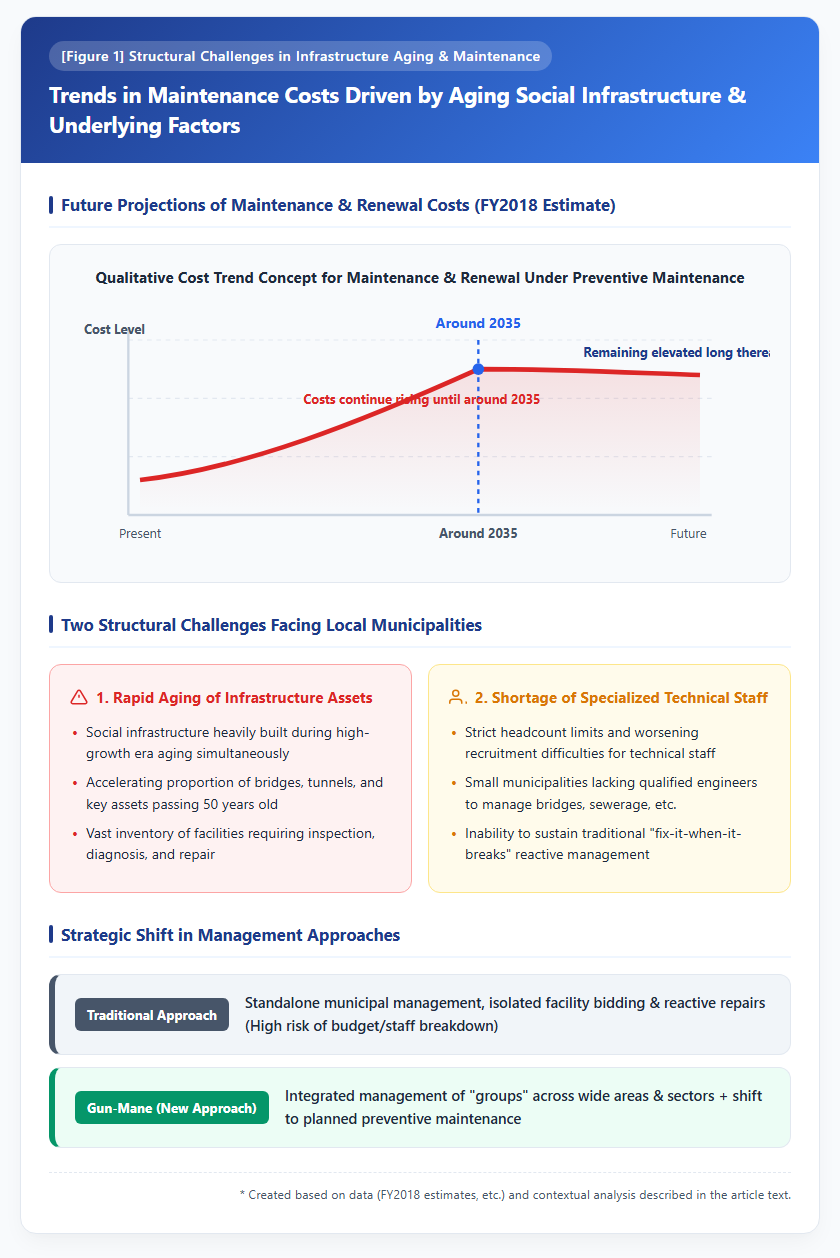
While holding vast infrastructure assets, local governments face strict limits on technical staff headcounts, creating a high risk of budgetary and operational breakdown under traditional “fix-it-when-it-breaks” reactive maintenance. Small municipalities are particularly vulnerable, often lacking qualified engineers to inspect or diagnose bridges and sewer systems. This shared sense of crisis across municipalities has dismantled traditional jurisdictional and sectoral boundaries, providing strong momentum for transitioning to Gun-Mane to manage regional infrastructure holistically.
Limitations of Traditional Maintenance and the Structural Reforms Brought by “Gun-Mane”
A New Management Approach Based on “Bundles” and Its 8 Core Components
At the heart of Gun-Mane lies the concept of “bundling”—grouping diverse infrastructure maintenance elements together. Guidelines published by MLIT outline “Eight Bundles” as the foundation for establishing effective infrastructure maintenance: the “Bundle of Municipalities” (bringing multiple local governments together), “Bundle of Contractors” (contractor collaboration), “Bundle of Engineers” (sharing technical talent), “Bundle of Processes” (linking inspection, diagnosis, and repair), “Bundle of Time Horizons” (transitioning from single-year to multi-year contracts), “Bundle of Data” (centralizing and sharing inspection data), “Bundle of Academia” (partnering with universities and research institutions), and “Bundle of Residents” (gaining community understanding and cooperation). Moving beyond conventional comprehensive private outsourcing, neighboring municipalities can jointly bundle contracts for managing roads, sewerage, parks, and other facilities, or enter long-term multi-year agreements, thereby generating economies of scale. This facilitates planned inspections and repairs, simultaneously achieving higher operational efficiency and lower costs.
Lessons from Road Collapse Incidents and the Expansion into “Human Capital Bundling”
A major catalyst that heightened the urgency of infrastructure management was a January 2025 road collapse in Yashio City, Saitama Prefecture, caused by a damaged sewer pipe. Following the incident, MLIT established the “Committee on Measures for Large-Scale Road Collapse Caused by Sewerage Systems,” which released its 3rd Recommendation (Strategic Shift in Management for Reliable Infrastructure) in December 2025. The recommendation explicitly identified the vigorous promotion of Gun-Mane as a pillar for restoring infrastructure safety. Notably, it emphasized “Human Capital Bundling” (Human Gun-Mane)—a framework where municipalities share, complement, and second scarce technical staff among themselves. By sharing technical expertise as a collective “human group” across wider regions, municipalities can enhance both emergency response capabilities and everyday preventive maintenance precision. Furthermore, on January 30, 2026, MLIT convened the 1st Infrastructure Management Strategy Subcommittee, initiating full-fledged discussions on targeted financial support for preventive maintenance and wide-area institutional strengthening.
Impact on Regional Construction Industries and Outlook for Sustainable Maintenance
Shifting to Preventive Maintenance and Stabilizing Local Business Operations
The widespread adoption of Gun-Mane benefits not only public sector cost-cutting and efficiency, but also private contractors (regional construction companies) handling actual execution and inspection. Under traditional fragmented, single-year, single-facility bidding, contractors faced unpredictable order volumes, making staffing, equipment procurement, and capital investment forecasting difficult. In contrast, Gun-Mane introduces broad-area, multi-sector comprehensive procurement and multi-year contracting, providing contractors with long-term, stable workloads. Smoothing out business cycles improves productivity and profitability, fostering employment stability, young engineer cultivation, and equipment investments in regional construction industries. Consequently, the business foundations of the construction sector supporting local economies are strengthened, creating a positive feedback loop toward a “sustainable and attractive maintenance industry.” Shifting from reactive repairs to a planned preventive maintenance cycle significantly suppresses overall infrastructure lifecycle costs, easing financial burdens on future generations.
Key Challenges and Future Focus Areas for Nationwide Rollout
Several critical issues must be addressed to entrench and expand Gun-Mane across municipalities nationwide. Please refer to the diagram below.
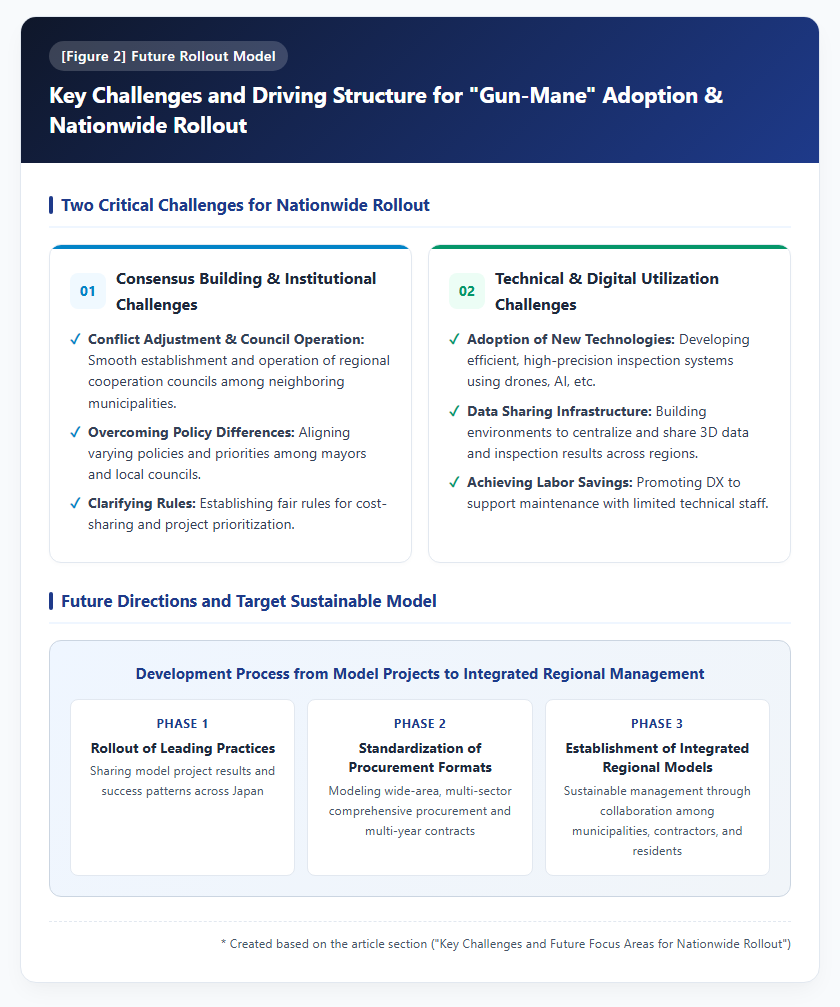
The first challenge involves consensus-building among neighboring municipalities and the smooth operation of regional cooperation councils. Establishing fair rules for regional prioritization and cost-sharing while overcoming differing policies among mayors and local councils remains essential. The second challenge is promoting digital and advanced technologies. Incorporating tools like drones and AI for efficient, high-precision inspections and sharing 3D data within the Gun-Mane framework will be crucial for balancing labor savings with inspection quality. Looking ahead, successful models and leading practices from across Japan are expected to be rolled out nationally, alongside standardized procurement formats for regional infrastructure maintenance. A unified approach uniting municipalities, private enterprises, and local residents to safeguard community safety will dictate the future success of Japan’s social infrastructure stewardship.
Reference Pages
- 【MLIT Gun-Mane Special Portal】https://www.mlit.go.jp/sogoseisaku/maintenance/gunmane.html
- 【MLIT Social Infrastructure Development Council / Transport Policy Council Joint Subcommittee Recommendations】https://www.mlit.go.jp/policy/shingikai/s201_menntenannsu01.html
- 【MLIT Social Infrastructure Aging Countermeasures Information Portal】https://www.mlit.go.jp/sogoseisaku/maintenance/02research/index.html
- 【MLIT Committee on Measures for Large-Scale Road Collapse Caused by Sewerage Systems】https://www.mlit.go.jp/mizukokudo/sewerage/mizukokudo_sewerage_tk_000987.html
【#RegionalInfrastructureGroupManagement #GunMane #MLIT #InfrastructureMaintenance #PreventiveMaintenance #LocalGovernment】

コメント