
On September 24, 2026, the Japan Society of Civil Engineers (JSCE) announced the designation of 20 newly selected Civil Engineering Heritage Sites for fiscal year 2026. This initiative to reevaluate, preserve, and actively utilize historical civil engineering structures aims to balance the maintenance of aging social infrastructure with regional revitalization.
- 20 Newly Designated Civil Engineering Heritage Sites Announced in September 2026 and Recent Trends
- Diverse Features of Designated Structures Spanning Japan and Overseas
- Objectives Established in FY2000 and 26 Years of Progress
- Heritage Value and “Preservation Through Continued Use” Amid Aging Infrastructure
- Infrastructure Preservation Through Relocation, Restoration, and Civic Engagement
- Promoting Infrastructure Tourism and Key Focus Areas for Passing Heritage to Future Generations
20 Newly Designated Civil Engineering Heritage Sites Announced in September 2026 and Recent Trends
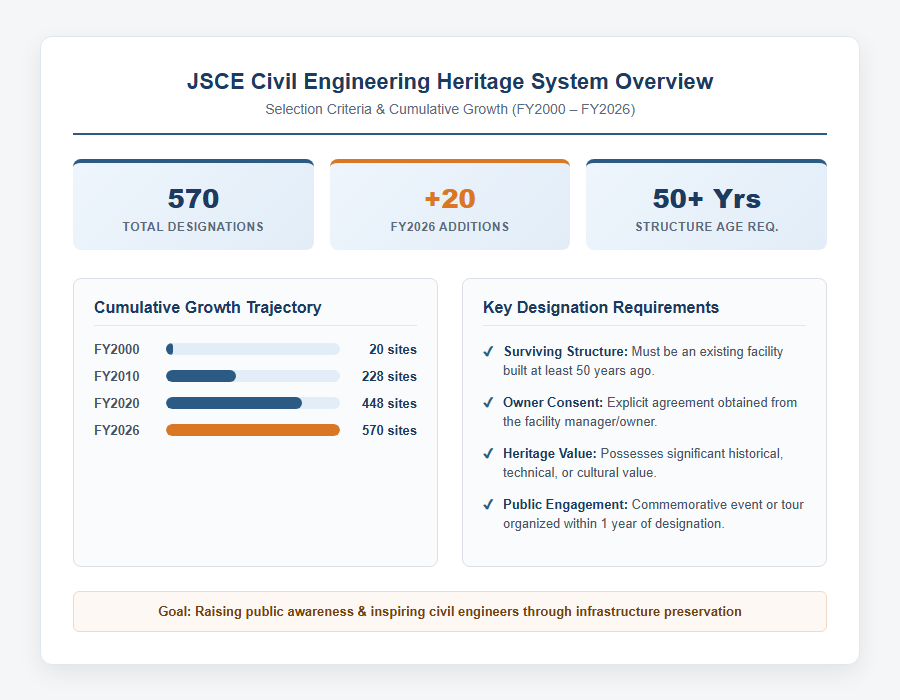
On September 24, 2026, the Japan Society of Civil Engineers (JSCE) officially announced the designation of 20 civil engineering structures as Civil Engineering Heritage Sites for FY2026. With these additions, the cumulative number of designated sites has reached 570 over the 26 years since the system’s establishment in FY2000. The designations span a wide range of fields, including transportation, flood control, water supply, and energy, meticulously selecting surviving structures over 50 years old that possess exceptional historical significance. Highlights of this year’s announcement include landmark structures across Japan, such as Hokkaido’s Kanno Bridge (completed in 1963), the oldest surviving full-scale cable-stayed bridge in the region, and the Nagaike Mitsuke Bridge (originally built in 1913 and relocated/restored in 1993), which brought Tokyo’s former Yotsuya Mitsuke Bridge to Hachioji City. Publicly nominated sites were also chosen, including Toyama Prefecture’s Sakura Bridge (built in 1935), as well as international entries like Taiwan’s Erfeng Irrigation Canal and Lilikang Irrigation Canal (built in 1923 and 1926), which showcase outstanding subsurface water intake engineering. The diagram below illustrates the selection criteria and the cumulative growth of designated heritage sites.
Through these designations, JSCE aims to promote the historical achievements of these civil engineering assets to the public and enhance social recognition.
Diverse Features of Designated Structures Spanning Japan and Overseas
The 20 civil engineering heritage sites designated for FY2026 showcase remarkable diversity, ranging from large-scale infrastructure projects to everyday structures deeply integrated into local life. Geographically, selections were made through recommendations from JSCE regional branches and public nominations across Japan, including Hokkaido’s Ikushunbetsu Bridge (built in 1926), Saitama’s Chichibu Bridge (built in 1931), Osaka’s Omiya Bridge (built in 1874 and relocated in 1931), and Kagoshima’s Torigoe Tunnel (built around 1898). From a structural and engineering perspective, many designated sites represent invaluable landmarks in technical history, such as Omiya Bridge, recognized as Japan’s oldest surviving iron bridge, the Brick Structure Group of Former National Route 42 (built 1905–1909), which reflects the evolution of brick arch and stone masonry techniques, and the Otani-kuzuri Groundsill Group (initiated in 1916). Furthermore, the designations honor modern historical assets preserving war memories, such as the Kowa Seaplane Base Slipway in Aichi Prefecture (built 1942–1944), alongside tourism-supporting thoroughfares like the Yanamami Highway bridging Oita and Kumamoto Prefectures (built in 1964). All selected facilities remain in existence with the explicit consent of their managers, holding immense promise as local assets that continue to support community landscapes and daily life.
Background and Historical Significance of the Heritage Designation System
Objectives Established in FY2000 and 26 Years of Progress
The JSCE Civil Engineering Heritage designation system was established in FY2000 to honor and preserve historical civil engineering structures. Prior to its creation, civil engineering projects focused primarily on new construction and regional development. However, a growing need emerged to raise public appreciation for past engineering achievements and historical infrastructure. The system serves four main objectives: first, to highlight cultural value to the general public; second, to inspire civil engineers by honoring predecessors’ achievements and fostering professional responsibility; third, to utilize historical structures as central assets in urban planning and community development; and fourth, to rescue heritage sites at risk of loss due to aging or demolition. Operating continuously for 26 years, the program carefully selects approximately 20 active or surviving structures over 50 years old annually. Through close collaboration among JSCE, local governments, and facility managers, civil engineering outreach activities aimed at protecting historical structures and fostering public understanding have firmly taken root nationwide.
Heritage Value and “Preservation Through Continued Use” Amid Aging Infrastructure
In contemporary Japan, while new public works starts are declining, the aging of infrastructure built during and after the rapid economic growth era has become a critical challenge. Under these circumstances, the significance of civil engineering heritage extends far beyond physical life extension or structural maintenance. According to cultural property specialists, structures that have coexisted with local communities for decades possess distinct heritage value that shapes urban character and collective memory. In fact, between one-half and three-quarters of all civil engineering structures designated as Important Cultural Properties or Civil Engineering Heritage Sites remain active, operational facilities today. Rather than relying excessively on complete demolition and replacement, there is a compelling need to perform appropriate inspection and maintenance while honoring historical design and technical value—embracing a philosophy of “preservation through continued use.” The diagram below illustrates the management framework balancing operational function with cultural heritage preservation for active facilities.
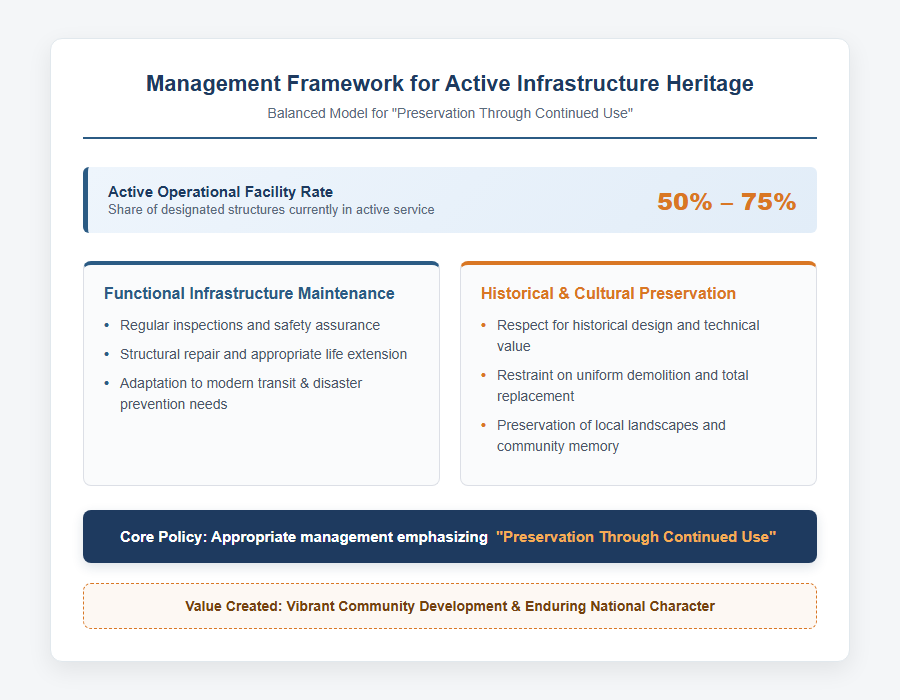
By moving away from rigid, uniform maintenance standards and customizing preservation to each structure’s unique attributes, infrastructure management can drive attractive urban development and help cultivate a national landscape with enduring character.
Case Studies of Preservation and Future Outlook for Infrastructure Tourism
Infrastructure Preservation Through Relocation, Restoration, and Civic Engagement
Successful preservation and utilization of civil engineering heritage depend heavily on proactive initiatives driven by citizens alongside governments and operators. A prime example is the Nagaike Mitsuke Bridge in Hachioji City, designated for FY2026. Originally constructed in 1913 as the Yotsuya Mitsuke Bridge on Shinjuku Avenue, the historic bridge was slated for replacement during road widening. Recognizing its cultural value, the Tokyo Metropolitan Government, the Housing and Urban Development Corporation, and Hachioji City collaborated to relocate and restore the bridge at Nagaike Park in 1993. Today, it serves as an iconic landscape feature and a beloved venue for community events and social gatherings. Similarly, at the Matsumuro Bridge in Shunan City, Yamaguchi Prefecture (completed in 1920 and designated for FY2026), a volunteer group called the “Shu-Nyan Bridgekeepers” conducts regular cleaning and basic inspection activities across public, private, academic, and civic sectors—earning national praise including the Minister of Land, Infrastructure, Transport and Tourism Award at the Infrastructure Maintenance Awards. Such relocation-restoration projects and citizen-led volunteer preservation efforts (“bridgekeeper” activities) reduce administrative financial burdens while inspiring local residents to take pride in their civic infrastructure.
Promoting Infrastructure Tourism and Key Focus Areas for Passing Heritage to Future Generations
In recent years, infrastructure tourism and heritage tourism—where people visit and appreciate dams, bridges, tunnels, and other engineering works as cultural resources—have gained momentum nationwide. JSCE actively organizes experiential tours, such as the “Civil Engineering Heritage Walk.” On February 26, 2026, a guided walk through the Minami-Senju and Machiya areas took participants to historic sites like the Former Mikawashima Sewage Treatment Plant Pumping Station Facilities and Senju Ohashi Bridge, attracting enthusiastic turnout. Studies indicate that the primary appeal of infrastructure tourism lies in accessing off-limits areas like control rooms, experiencing the immense scale of heavy engineering works, and enjoying extraordinary technical landscapes. Going forward, the focus will shift from simple architectural observation to developing integrated educational programs that combine local history, culture, and disaster preparedness. The announcement of the FY2026 Civil Engineering Heritage Sites will trigger commemorative public events and tours within a year of designation across the country, creating sustainable tourism and educational models that pass the value of local infrastructure to future generations.
Reference Pages
- 【JSCE Official Note】https://note.com/jsce/n/nf58448391219
- 【JSCE Civil Engineering Heritage Committee】https://committees.jsce.or.jp/doboku_isan/
- 【Hachioji City Press Release】https://www.city.hachioji.tokyo.jp/shisei/001/001/009/001/p033364_d/fil/080924r.pdf
【#JSCECivilEngineeringHeritage #CivilEngineeringHeritage #InfrastructureTourism #UrbanPlanning #HistoricalStructures #InfrastructureMaintenance】


コメント