The Japanese yen tumbled to the 159 level against the US dollar in foreign exchange markets, touching its lowest point in roughly three weeks. The sharp decline was driven by stronger-than-expected US economic indicators, rising crude oil prices that renewed expectations for additional Federal Reserve interest rate hikes, and an accelerating wave of dollar buying fueled by widening interest rate differentials between Japan and the United States.
- Rapid Decline to the 159 Yen Level and a Three-Week Low
- Upbeat US Economic Indicators and Hawkish Fed Commentary
- Geopolitical Friction in the Middle East, Crude Oil Spikes, and Inflation Risks
- Breakout Above the Moving Average and Heightened Intervention Vigilance
- Structural Interest Rate Differentials and Limits of Record Currency Intervention
- Central Bank Trajectories and Key Watchpoints Ahead
Rapid Decline to the 159 Yen Level and a Three-Week Low
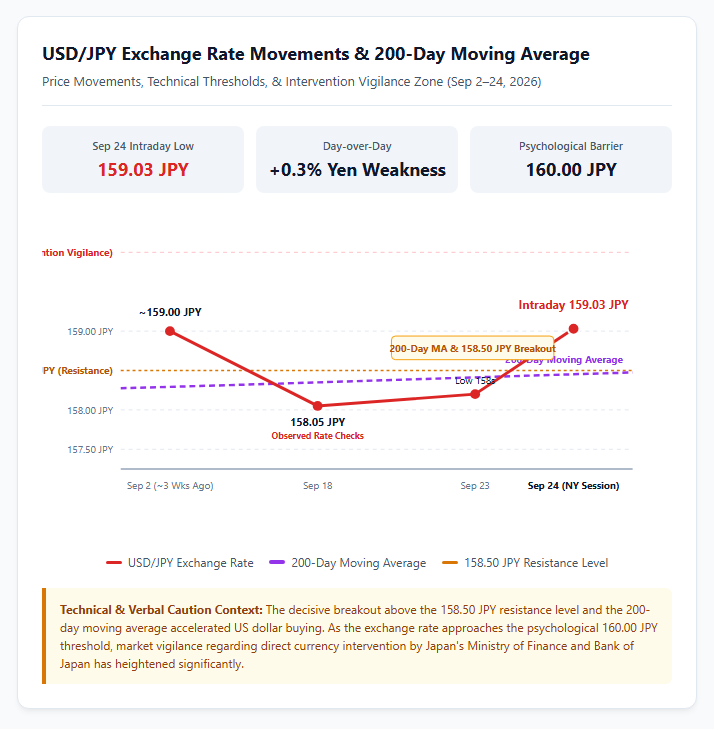
On September 24, 2026, during the New York foreign exchange trading session, the Japanese yen experienced a steep drop against the US dollar, briefly sliding to around 159.03 yen per dollar. This marks the weakest level for the yen since September 2, 2026, hitting a three-week low. On a closing basis, the yen weakened by approximately 0.3% compared to the previous trading day. From a technical analysis standpoint, the currency pair’s decisive breakout above its 200-day moving average—widely regarded as a key long-term trend indicator—has established market technicals that heavily favor accelerated dollar buying and yen selling.
Although the trading day began quietly with the rate fluctuating in the lower 158 yen range, dollar-buying momentum gained significant strength as trading transitioned into overseas markets. Market participants grew increasingly tense as the pair closed in on the psychological threshold of 160 yen. Crucially, breaking above key resistance near 158.50 yen into the 159 range triggered a flurry of buy orders from short-term traders executing stop-loss positions, fueling rapid intraday movement. The diagram below illustrates recent USD/JPY price movements alongside key moving average levels.
Upbeat US Economic Indicators and Hawkish Fed Commentary
The primary driver behind the rapid move toward 159 yen was a combination of robust economic data releases from the United States and decidedly hawkish remarks from Federal Reserve officials. The preliminary US Flash Composite Purchasing Managers’ Index (PMI) for September registered at 58.4, handily outperforming consensus forecasts to reach its highest level in nearly five years since July 2021. This unexpected resilience in the US economy propelled the benchmark 10-year US Treasury yield up to 5.13%, its highest level in approximately 19 years since July 2007.
This trend was reinforced by a firm monetary policy stance. Federal Reserve Governor Barr, a voting member on this year’s Federal Open Market Committee (FOMC), along with several other Fed officials, repeatedly hinted at the necessity of further rate hikes to return inflation to the 2% target. Consequently, market probabilities for an additional rate hike at the upcoming October FOMC meeting surged to approximately 70%. Expectations of sustained higher US interest rates and a widening rate gap between Japan and the US catalyzed a powerful surge in dollar-buying and yen-selling trades.
Compound Upward Pressures and Structural Market Shifts
Geopolitical Friction in the Middle East, Crude Oil Spikes, and Inflation Risks
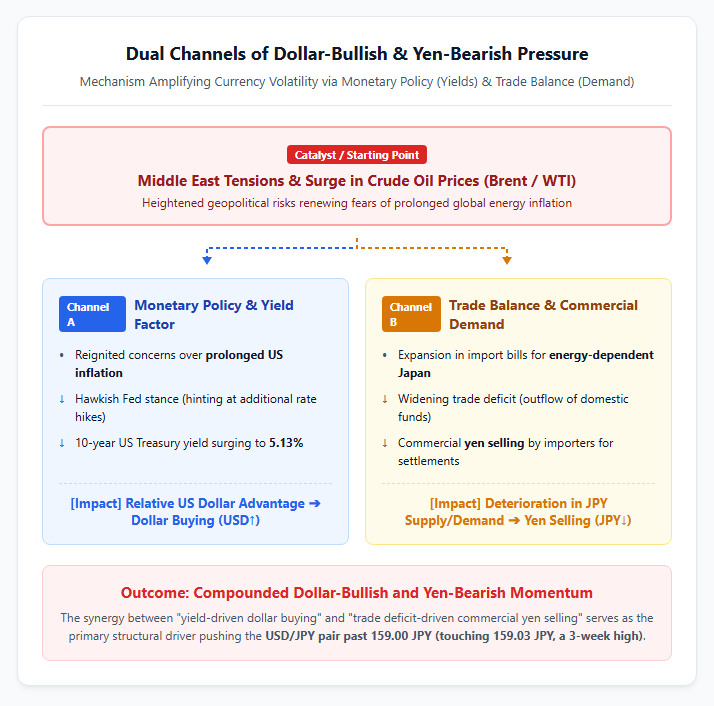
Beyond monetary policy dynamics, geopolitical developments in commodity markets are further magnifying dollar-buying and yen-selling pressures. Heightened anxiety over a prolonged conflict and potential expansion of hostilities in the Middle East—compounded by risk warnings from Iranian officials—drove a sharp rally in international crude oil futures. Spikes in Brent crude and NYMEX WTI crude futures revived global market concerns regarding sticky, long-term inflation driven by rebounding energy costs.
Rising oil prices reinforce market expectations that the Federal Reserve will maintain elevated policy rates for longer to curb inflation, pushing long-term US bond yields higher and boosting the dollar. Conversely, for Japan—which relies almost entirely on imports for its energy requirements—high crude prices represent a severe structural drag, inflating import values and expanding the national trade deficit (creating commercial, supply-demand yen-selling pressure). Higher crude oil acts through a dual channel—enhancing the relative strength of the US dollar while deteriorating the trade balance of the Japanese yen—solidifying the broader dollar-bullish, yen-bearish environment.
Breakout Above the Moving Average and Heightened Intervention Vigilance
The tug-of-war surrounding technical chart breakouts and potential government intervention is reaching a crucial phase. The USD/JPY pair’s clean move above its 200-day moving average triggered algorithmic buying signals for systematic traders and speculators focused on technical chart patterns. Furthermore, the persistent yield gap continues to provide a lucrative background for carry trades, encouraging market participants to build short-yen positions.
Conversely, as the exchange rate pushes deeper into the 159 range, market vigilance regarding direct currency intervention by Japanese authorities has reached maximum sensitivity. On September 18, 2026, market sources reported that the Bank of Japan conducted rate checks near 158.05 yen, while Minister of Finance Satsuki Katayama reiterated the government’s stance against excessive market volatility following prior joint intervention efforts. Official Ministry of Finance figures reveal that Japan spent a record-breaking 15.3993 trillion yen on yen-buying intervention between July 30 and August 26, 2026—the largest monthly intervention figure on record. As the rate approaches 160 yen, intense resistance is unfolding as intervention fears act as a psychological cap on further upside moves.
Medium- to Long-Term Outlook and Key Focus Areas
Structural Interest Rate Differentials and Limits of Record Currency Intervention
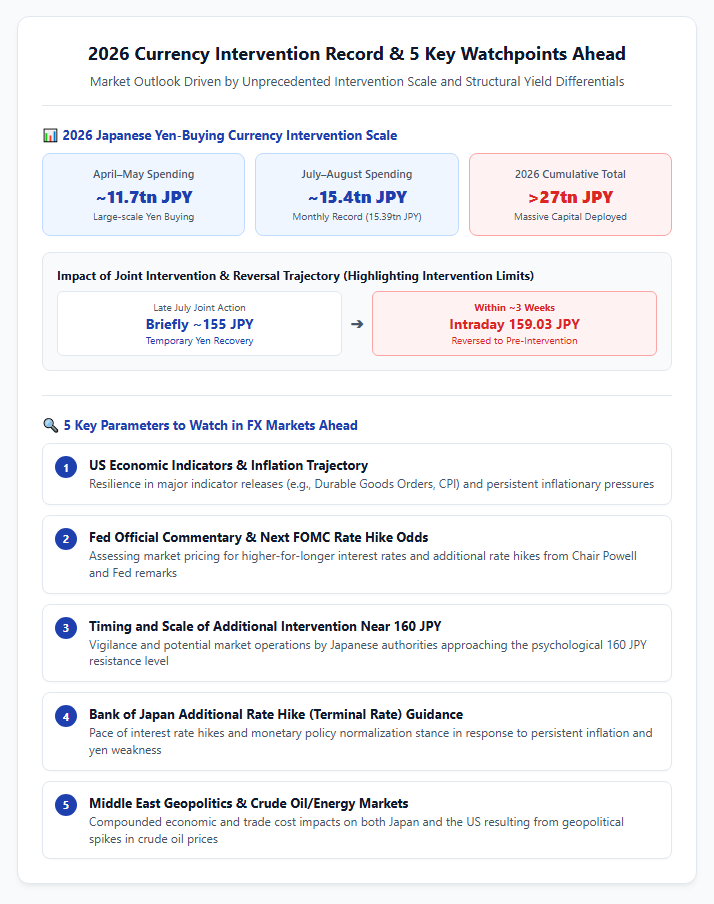
The yen’s return to the 159 level highlights the fundamental limitations of direct currency intervention amid structural macroeconomic imbalances. Since the start of 2026, the Japanese government and Bank of Japan have committed massive financial resources to support the yen, deploying approximately 11.7 trillion yen between April and May, and an additional 15.4 trillion yen between July and August, bringing the cumulative annual intervention total above 27 trillion yen. Although an extraordinary joint intervention effort with US authorities in late July temporarily pushed the exchange rate back to the 155 yen level, those gains were completely erased within just three weeks.
The core reason behind this market behavior is that currency intervention serves only as a temporary supply-demand smoothing mechanism; it does not eliminate the fundamental driver of currency weakness—the wide interest rate differential between Japan and the US. As long as US interest rates remain elevated while Bank of Japan policy rate increases proceed at a gradual pace, curbing yield-seeking capital outflows and commercial dollar demand from Japanese importers will remain an uphill battle.
Central Bank Trajectories and Key Watchpoints Ahead
The primary factor determining the future direction of the USD/JPY pair and the broader Japanese economy remains the monetary policy paths of the Federal Reserve and the Bank of Japan. Market focus is firmly fixed on how long the Fed will maintain high interest rates to tame inflation, and at what pace the Bank of Japan will proceed with further rate hikes to counter inflation and currency depreciation. Key parameters to monitor in the coming period include:
- Trends in major US economic releases, such as Durable Goods Orders and the Consumer Price Index (CPI), alongside inflation indicators
- Remarks from Fed officials and Chair Powell to assess rate hike probabilities for the next FOMC meeting
- The timing, trigger level, and scale of potential Ministry of Finance intervention as the rate tests 160 yen
- Shifts in the Bank of Japan’s guidance regarding policy rate hikes and the terminal interest rate
- Geopolitical developments in the Middle East and their cascading effects on crude oil futures and Japanese energy import costs
As these interconnected factors unfold, whether authorities can prevent 160 yen from becoming a structural floor will serve as a defining milestone for foreign exchange markets.
Reference Pages
- [Gaitame.com Research Institute] https://www.gaitame.com/media/entry/2026/09/25/082135
【#ForeignExchange #USDJPY #YenDepreciation #CrudeOil #InterestRateDiff #CurrencyIntervention #Fed #EconomicNews】

コメント