According to key economic indicators for August released by China’s National Bureau of Statistics on September 15, 2026, industrial production accelerated to a 5.2% year-on-year increase, driven by solid expansion in high-tech sectors, while retail sales growth slowed to just 0.4% year-on-year, highlighting a sharp chill in domestic demand. Behind this trend lies a deep structural imbalance: while growth continues to be led by supply and foreign demand—centered on exports and high-tech investment—demand and domestic consumption remain severely depressed due to a lingering property slump and job market uncertainty.
- High-Tech Sector Drives Industrial Production Acceleration
- Slowing Retail Sales and Deepening Domestic Demand Slump
- Prolonged Real Estate Slump and Fixed-Asset Investment Decline
- Growing Reliance on Foreign Demand and Emerging Export Markets
- Fiscal and Monetary Support vs. Structural Adjustment
- Economic Growth Scenarios and the K-Shaped Recovery Challenge
High-Tech Sector Drives Industrial Production Acceleration
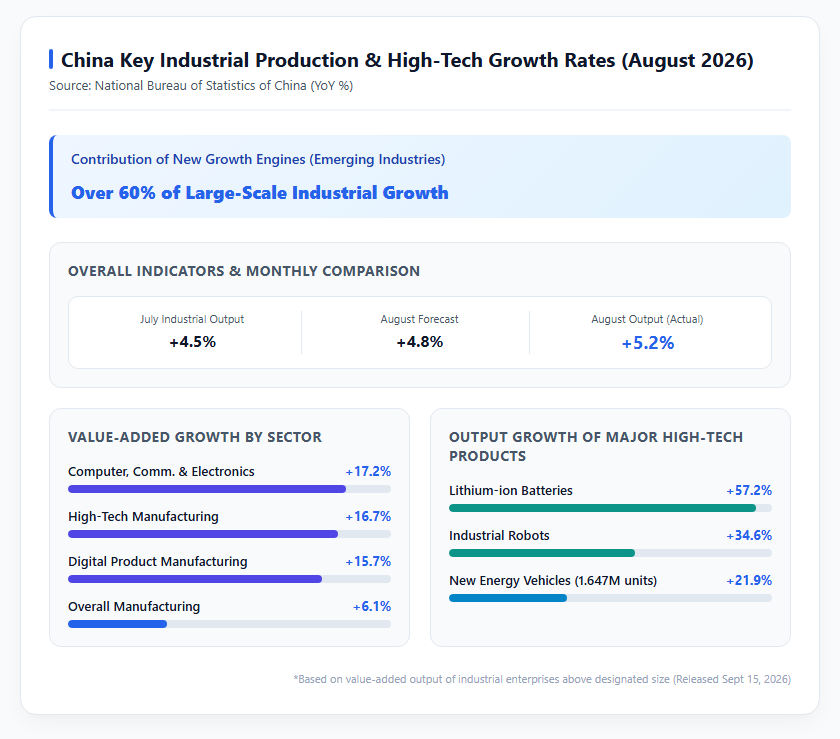
On September 15, 2026, China’s National Bureau of Statistics released major economic indicators for August, revealing that value-added industrial output among large-scale industrial enterprises rose 5.2% year-on-year. This growth rate marked a 0.7 percentage point acceleration from July’s 4.5% increase, beating market expectations of 4.8%. On a month-on-month basis, output grew 0.54%, while cumulative growth for the January–August period reached 5.3% year-on-year. Across the three main industrial categories, manufacturing led overall momentum with a robust 6.1% year-on-year gain. High-tech manufacturing, propelled by technological innovation, recorded a remarkable 16.7% increase, while digital product manufacturing rose 15.7% and computer, communications, and electronic equipment manufacturing jumped 17.2%. In terms of specific product lines, new energy vehicle production reached 1.647 million units—a 21.9% year-on-year surge—while lithium-ion batteries jumped 57.2% and industrial robots surged 34.6%. According to Fu Linghui, spokesperson for the National Bureau of Statistics, these new growth engines centered on emerging industries contributed over 60% of the August gain for large-scale industrial output, confirming a steady upgrading of the industrial structure. Please refer to the figure below illustrating industrial output trends.
Slowing Retail Sales and Deepening Domestic Demand Slump
While industrial production posted solid growth, consumer spending—the core pillar of domestic demand—slowed significantly. In August 2026, total retail sales of consumer goods rose just 0.4% year-on-year, decelerating further from 0.6% in July. This result fell short of market analysts’ consensus forecast of 0.8%. The persistent weakness in consumption stems from household belt-tightening and employment instability amidst broader economic uncertainty. The job market for young adults remains particularly severe: unemployment among 16-to-24-year-olds stood at 16.3%, while the rate for 25-to-29-year-olds reached 7.4%, dampening purchasing power due to anxiety over future income prospects. Furthermore, the fading impact of government trade-in subsidies for durable goods, such as home appliances and automobiles, added to consumer headwinds. Sales at department stores and specialty shops remained sluggish as consumers increasingly shifted toward budget-conscious spending. With final demand failing to keep pace with expanding factory output, an autonomous, consumption-led economic recovery remains distant.
Two-Speed Industrial Structure and Weak Investment
Prolonged Real Estate Slump and Fixed-Asset Investment Decline
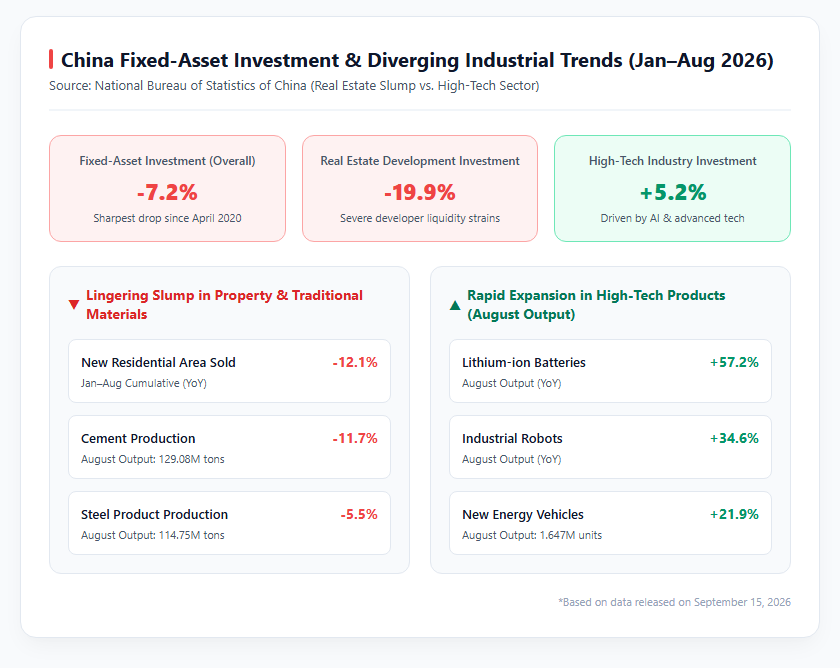
Fixed-asset investment for the January–August 2026 period declined 7.2% year-on-year, recording the sharpest drop since April 2020. The primary catalyst for this contraction remains the lingering real estate downturn, which shows no clear sign of bottoming out. Real estate development investment plunged 19.9% year-on-year in the first eight months, while the floor area of new commercial residential buildings sold fell 12.1%. With new home prices continuing their downward trajectory, property developers face severe liquidity constraints, leading them to drastically curb new construction and development outlays. The real estate crisis has also rippled into heavy material industries: August cement production fell 11.7% year-on-year to 129.08 million tons, and steel product output dropped 5.5% to 114.75 million tons, underscoring the deep distress in traditional heavy industries. Conversely, supported by AI infrastructure investment and robust global demand for advanced technology products, high-tech industry investment grew 5.2% year-on-year during January–August. This divergence highlights the ongoing structural shift in China’s investment landscape from real estate toward high-tech manufacturing. Please refer to the figure below illustrating structural shifts in investment trends.
Growing Reliance on Foreign Demand and Emerging Export Markets
In contrast to chilly domestic consumption and investment, strong foreign demand continues to anchor China’s economic performance. Total foreign trade in goods surged 19.8% year-on-year in August 2026. From a structural perspective, shipments of green technology and high-tech products—led by new energy vehicles and lithium-ion batteries—rapidly expanded, tapping into global decarbonization trends. Geographically, trade volumes with emerging and developing economies in ASEAN, Africa, and Latin America grew substantially, demonstrating progress in diversifying trading partners beyond traditional Western markets. However, beneath this strong export surge lies a deeper domestic imbalance between supply and demand. With domestic supply severely exceeding local demand, Chinese manufacturers have been forced to aggressively push excess capacity into overseas markets. This export-reliant growth structure continually carries the risk of triggering trade friction with major international trading partners.
Economic Policy Outlook and Key Areas to Watch
Fiscal and Monetary Support vs. Structural Adjustment
Faced with cooling domestic demand and a stagnant property sector, policymakers in Beijing face mounting pressure to deploy additional economic stimulus. In response, the government has accelerated the issuance of special treasury bonds and expanded interest rate subsidies on loans aimed at small and medium-sized private enterprises and consumers. While the People’s Bank of China has signaled an accommodating monetary stance, central bank officials remain cautious regarding aggressive benchmark rate cuts or reserve requirement ratio (RRR) reductions. This restraint reflects Beijing’s strategic priority to direct national resources toward technological self-reliance and manufacturing quality upgrades rather than short-term quantitative expansion. Furthermore, explicit directives from President Xi Jinping—such as those issued at the Central Economic Work Conference in December 2025 prohibiting local officials from inflating statistical data and banning destructive price wars (“involution”) in sectors like electric vehicles—have exerted a strong influence. The leadership is prioritizing the phase-out of low-efficiency enterprises and structural reform over quick-fix consumer stimulus.
Economic Growth Scenarios and the K-Shaped Recovery Challenge
Looking ahead, the Chinese economy is poised to see an intensifying “K-shaped” trajectory, marked by a widening divide between thriving sectors—such as high-tech manufacturing and export industries—and struggling domestic-focused sectors burdened by real estate distress and cautious consumer spending. Second-quarter 2026 GDP growth slowed to 4.3% year-on-year, dipping below the bottom end of the government’s official annual target range of 4.5% to 5.0%. Analysts warn that without more decisive consumer-oriented stimulus from policymakers, economic expansion could remain sluggish through the second half of the year. In particular, if structural youth unemployment is left unaddressed, the resulting long-term erosion of household income and purchasing power poses a serious threat to China’s potential growth rate. Balancing technological leadership in industrial manufacturing with the urgent need to address domestic demand deficits and real estate imbalances remains the single most critical task for sustaining long-term economic momentum.
References
- 【China Economic Outlook – The Japan Research Institute】https://www.jri.co.jp/report/medium/china/
【#ChinaEconomy #IndustrialProduction #SluggishConsumption #HighTechIndustry #PropertySlump #EconomicStatistics】

コメント