
At its September 2026 meeting, the European Central Bank unanimously decided to raise interest rates further in response to inflationary pressures driven by geopolitical risks. Despite facing headwinds such as high energy prices, the European economy is exhibiting greater resilience and tolerance to rising rates than expected, supported by defense and infrastructure spending alongside robust corporate fundamentals.
- Where the Eurozone Economy Stands Amid Rate Hikes
- Growth Driven by Defense, Infrastructure, and AI Investments
- The Decision to Hike Rates by 25 bps at the September 2026 ECB Meeting
- Prolonged Geopolitical Risks and the Shadow of Soaring Energy Prices
- JPMorgan’s Analysis of Equity Market Resilience to Rising Rates
- Downside Risk Factors and Medium-Term Economic Outlook
Where the Eurozone Economy Stands Amid Rate Hikes
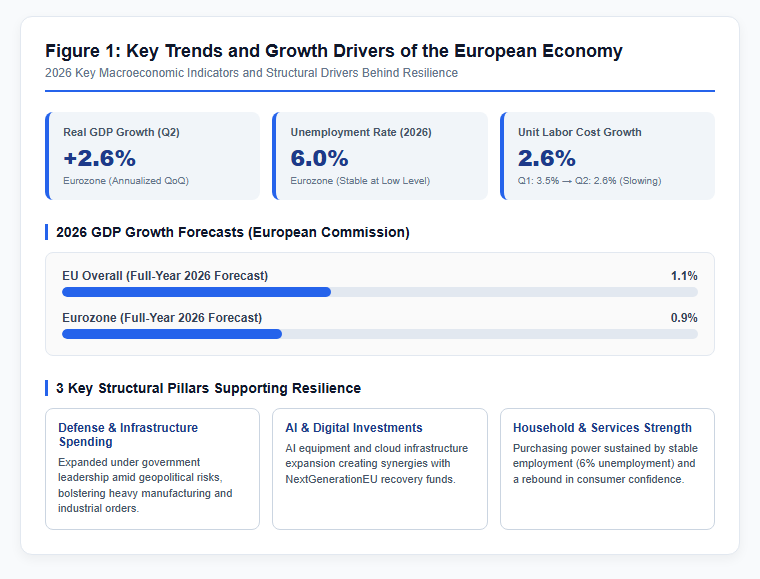
In 2026, as geopolitical risks such as Middle East tensions and volatile energy prices unsettle the global economy, the Eurozone economy is showing remarkable underlying strength, outperforming market forecasts. In the second quarter of 2026 (April–June), annualized real GDP growth in the Eurozone reached +2.6%, accelerating sharply from the stagnation of the previous quarter. Furthermore, in its Spring 2026 Economic Forecast released in May, the European Commission projected full-year GDP growth of 0.9% for the Eurozone and 1.1% for the EU as a whole.
This economic resilience is underpinned by a recovery in private consumption and a stable labor market. The unemployment rate in the Eurozone held steady at a historically low level around 6.0% in 2026, with labor market strength bolstering household purchasing power. In addition, improved corporate labor productivity helped slow the growth rate of unit labor costs from 3.5% in Q1 2026 to 2.6% in Q2, confirming that cost pressures remain under control even amidst rapid inflation. The European economy is proving to be more than a temporary rebound; it is displaying structural durability that resists the tightening interest rate environment.
The following graphic illustrates key trends and structural growth drivers in the European economy.
Growth Driven by Defense, Infrastructure, and AI Investments
The concrete drivers behind Europe’s economic firmness are government-led structural spending increases in manufacturing and business investments in technological innovation across the digital domain. In response to prolonged geopolitical tensions, European governments have significantly expanded defense-related budgets and large-scale infrastructure investments from a national security perspective. This has sustained stable orders and production activity in heavy industrial and manufacturing sectors, including machinery, electrical equipment, and chemicals.
In addition, the rapid expansion of digital services accompanying the societal implementation of artificial intelligence (AI) technology, along with related capital expenditures and surging exports for cloud infrastructure, serves as another powerful growth engine. Heightened AI investments by private enterprises are creating synergies with public support programs like the NextGenerationEU recovery fund, further incentivizing capital allocation. In the services sector, business sentiment remains favorable due to a rebound in consumer confidence, forging a balanced growth model where manufacturing and services reinforce each other. The presence of these growth engines acts as an effective cushion, offsetting the adverse effects of higher borrowing costs.
Monetary Policy Decisions and Inflationary Pressures
The Decision to Hike Rates by 25 bps at the September 2026 ECB Meeting
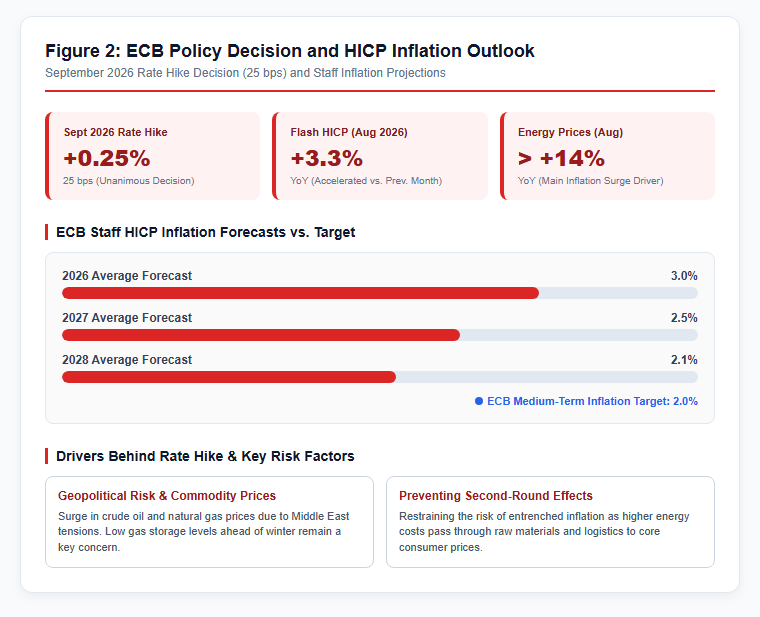
At its Governing Council meeting on September 10, 2026, the European Central Bank (ECB) unanimously agreed to raise its key policy rates by 0.25% (25 basis points). This move resumed the rate-hiking cycle initiated in June 2026, bringing interest rates into the upper range of what is considered neutral for economic activity. According to the updated economic projections presented by ECB staff in September 2026, the average Harmonised Index of Consumer Prices (HICP) inflation forecast was set at 3.0% for 2026, 2.5% for 2027, and 2.1% for 2028.
The prospect of inflation persisting above the ECB’s medium-term target of 2.0% motivated the unanimous vote for further monetary tightening. In her press conference, President Christine Lagarde reiterated a firm commitment to ensuring that inflation returns decisively to the target over the medium term through monetary policy. At the same time, the central bank maintained a data-dependent, meeting-by-meeting approach, refusing to pre-commit to a specific rate path. This decision by the ECB represents a clear intention to prioritize preventing inflation from becoming entrenched, while remaining mindful of risks to economic growth.
The following graphic shows the trajectory of the ECB’s policy interest rate and inflation rate.
Prolonged Geopolitical Risks and the Shadow of Soaring Energy Prices
The primary catalyst compelling the ECB to enact an additional rate hike was the lingering conflict in the Middle East and the resulting supply shocks to the energy sector. Heightened instability in the Middle East renewed upward pressure on crude oil and natural gas prices, causing flash Eurozone HICP inflation to accelerate to +3.3% year-on-year in August 2026. The energy component in particular surged by more than +14% year-on-year, serving as the main driver pushing up headline inflation.
Because Europe relies heavily on energy imports, it remains extremely vulnerable to direct and secondary disruptions, such as potential transport bottlenecks in the Strait of Hormuz or supply chain shocks in liquid natural gas (LNG). Compounding these concerns, gas storage levels ahead of the winter heating season remain lower than in typical years. If energy price spikes endure, higher raw material and logistics costs will pass through to core inflation and consumer goods, raising the risk of second-round inflationary effects becoming embedded. Consequently, the ECB has heightened its vigilance against upside risks to inflation, including potential trade spats and weather-related food price increases.
Financial Market Resilience and Corporate Outlook
JPMorgan’s Analysis of Equity Market Resilience to Rising Rates
Addressing concerns over whether stock markets and the broader financial system can withstand elevated interest rates and continued monetary tightening, strategists at JPMorgan Chase have presented a constructive outlook. According to a report published on September 21, 2026, global equity markets are well-positioned to digest and absorb higher bond yields. The central pillar supporting this view is the exceptional strength of corporate balance sheets and high profit margins.
Specifically, over 80% of companies globally are expected to deliver positive earnings per share (EPS) growth in 2026. Furthermore, corporate net debt-to-equity ratios remain 20% to 40% below historical averages, and average debt maturities (durations) stand at a comfortable 5 to 6 years. As a result, corporations are shielded from immediate refinancing cost shocks even as rates rise. Market strategists emphasize that recent market volatility represents a temporary digestion of oil and rate shocks rather than a breakdown in corporate earnings, pointing to a medium-to-long-term return to solid market fundamentals.
Downside Risk Factors and Medium-Term Economic Outlook
In assessing the future trajectory of the European economy and financial markets, several downside risks warrant close attention despite underlying resilience. The critical variable hinges on developments in the Middle East and the stabilization of energy supplies. Should crude oil prices breach \$100 per barrel and natural gas prices exceed €100 per megawatt-hour on a sustained basis, corporate margins would suffer, household purchasing power would erode, and the threat of stagflation—simultaneous economic stagnation and high inflation—would intensify.
In the financial sphere, increased sovereign bond issuance to fund rising national defense budgets, combined with higher yields, raises debt servicing costs for member states with high debt ratios. While the European banking sector maintains solid health with strong capital and liquidity buffers, prolonged high interest rates require careful monitoring regarding potential defaults on small-business loans and softness in the real estate sector. Market participants will be watching closely to see how the ECB balances economic stabilization with inflation control as it calibrates the pace of further rate hikes through late 2026 and into 2027.
Reference Pages
- 【European Central Bank Press Conference Statement (September 2026)】https://www.ecb.europa.eu/press/press_conference/monetary-policy-statement/2026/html/ecb.is260910~6a45359cfc.en.html
- 【European Commission Spring Economic Forecast (May 2026)】https://ec.europa.eu/commission/presscorner/detail/en/ip_26_1120
【#EuropeanEconomy #ECB #RateHikes #Inflation #MonetaryPolicy #GeopoliticalRisk】

コメント