On September 25, 2026, Microsoft significantly overhauled its AI assistant, “Microsoft Copilot,” transforming it from a conversational chatbot into a business operating system integrated with autonomous AI agent capabilities. The backdrop includes sluggish corporate adoption rates for traditional “assistant”-type AI and fierce competition for dominance in the market for AI agents that autonomously complete tasks.
- Moving Beyond Mere Conversational AI and Transitioning to a “New OS for Work”
- The 3.3% Paid Usage Rate Barrier and the “Assistant” Limitation Theory
- Direct integration between “Home”, which serves as the starting point for work, and Office applications.
- “Code,” which develops apps using natural language, and “Autopilot,” which operates autonomously
- Introduction of Context Sharing and Usage-Based Billing (UBB) via “Microsoft IQ”
- Future Outlook and the Direction of Competition in the AI Agent OS Market
Moving Beyond Mere Conversational AI and Transitioning to a “New OS for Work”
On September 25, 2026, Microsoft officially announced a major application overhaul of its AI assistant, “Microsoft Copilot.” Chief Executive Officer (CEO) Satya Nadella has stated that Copilot is being redefined not merely as a Q&A chatbot, but as a “new OS for work.” Traditional Copilot was limited to an auxiliary tool that summarized text or created drafts in response to user prompts. However, with this revamp, conversational processing, natural language-based application development, and autonomous agent capabilities that operate continuously in the background without waiting for user instructions have been integrated into a single environment. Entering 2026, the company has shifted its strategy away from the fierce development race with competitors in the consumer chatbot market, concentrating its resources on the enterprise business platform sector. The following figure is an image of the newly presented integrated application environment.
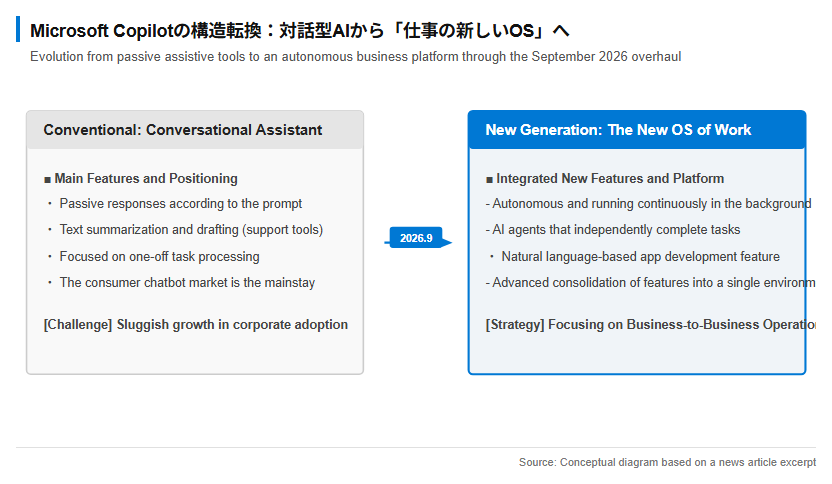
Just as Office in the PC era established the standard for desk work, it aims to define new ways of working in the AI era through Copilot.
The 3.3% Paid Usage Rate Barrier and the “Assistant” Limitation Theory
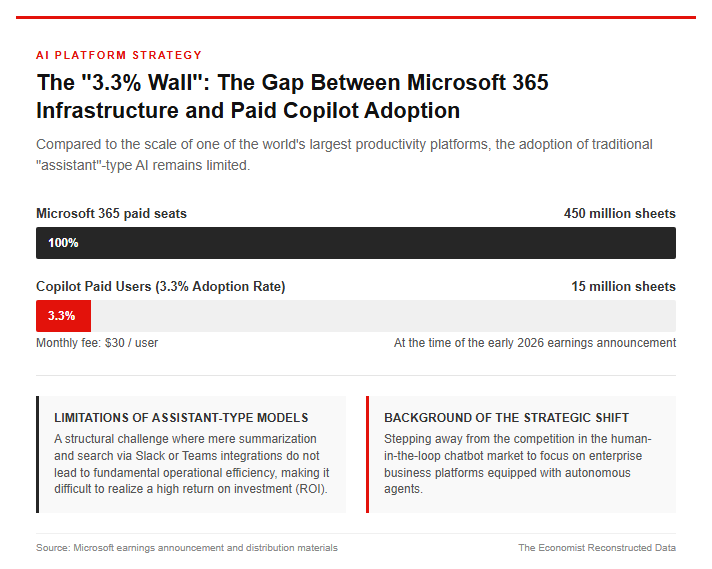
Behind this dramatic shift in strategy lies a clear business challenge that the conventional “assistant”-type AI has been facing. Microsoft operates “Microsoft 365,” one of the world’s largest productivity platforms, with paid seats reaching 450 million. However, paid Copilot users disclosed in the early 2026 financial results announcement remained at 15 million seats, with an adoption rate of only 3.3%. Despite paying a flat fee of $30 per user per month, there was persistent dissatisfaction that mere assistance with daily tasks made it difficult for companies to experience the expected productivity improvements or high return on investment (ROI). Furthermore, it was pointed out that search and simple summaries integrated with internal communication tools like Slack and Teams had limitations in fundamentally streamlining business processes. Moreover, as competing tools such as Salesforce’s Agentforce and Anthropic’s autonomous tools expanded their achievements in business automation, breaking away from the assistant model that constantly requires human intervention had become an urgent priority.
The 3 Core Functions Comprising the New Copilot
Direct integration between “Home”, which serves as the starting point for work, and Office applications.
The new Copilot application consists of three main sections organized by role. The first section, “Home,” is a portal screen that serves as the starting point for daily operations. It integrates traditional Q&A “Chat” with “Cowork,” which allows users to delegate complex, multi-step tasks all at once. For instance, users can delegate tasks such as drafting responses to Requests for Proposals (RFPs) and performing financial month-end closing procedures. One of its greatest features is the native integration with Office tools through “Office in Copilot.” Users can create and edit Word, Excel, and PowerPoint files without ever leaving the Copilot interface, with edits synchronizing in real-time to the actual Office applications. In Excel, it also offers features like data visualization, automatic suggestions for optimal charts, and explanations for the reasons behind changes, reducing the effort of switching between different tools.
“Code,” which develops apps using natural language, and “Autopilot,” which operates autonomously
The second section, “Code,” is a feature that allows frontline employees without programming knowledge to build custom apps, dashboards, and automated workflows using only natural language instructions. It leverages the underlying technology of GitHub Copilot, and the created apps are hosted in a secure execution environment within the corporate tenant, “Microsoft Copilot Managed Runtime,” and shared under the governance of the IT department. The figure below shows a screen where a workflow is being generated using natural language.
The third section, “Autopilot,” is an autonomous AI agent that renames and evolves the traditional development code name “Scout.” Adopting the open-source agent infrastructure “OpenClaw,” it functions as a “digital teammate” equipped with its own unique identification (ID), dedicated memory, and cloud-based computational resources. Once its name, role, and goals are set, it continuously and autonomously processes tasks in the background—such as monitoring channels, checking progress, and evaluating supplier processes—even at night or on holidays, without waiting for prompt instructions.
Infrastructure and New Pricing Structure to Accelerate Enterprise Adoption
Introduction of Context Sharing and Usage-Based Billing (UBB) via “Microsoft IQ”
For autonomous AI agents to make advanced decisions, an accurate understanding of data and business context scattered throughout the company is essential. As a common infrastructure to support this, Microsoft provides “Microsoft IQ.” Through “Fabric IQ,” which retrieves reliable information from the organization’s data infrastructure, and “Work IQ,” which integrates business data from Dynamics 365 and Power Platform, the context of past deal history and support tickets is automatically incorporated when sales representatives create customer proposals. In addition, alongside this renewal, the pricing structure has been significantly overhauled. While routine chat and AI usage within Office continue to be covered by user-based fixed-rate subscriptions (USL) as before, a consumption-based pricing model (UBB) has been introduced for the use of advanced autonomous agents like Code and Autopilot, as well as for calling frontier models. To prevent unexpected cost spikes for enterprises, new FinOps management features have also been added that allow administrators to adjust usage quotas and spending limits for each user.
Future Outlook and the Direction of Competition in the AI Agent OS Market
The rollout of the new Copilot will begin in phases starting in late September 2026 through the “Frontier” early access program. The “Today” command center feature, which proactively presents important tasks from emails, schedules, and communications, is scheduled for preview release in October 2026. The adoption of generative AI in enterprises has completely shifted from the stage of simply assisting with text and code generation to the deployment phase of agent capabilities that autonomously complete tasks under human supervision. Amid ongoing fierce market share competition with rival platforms like Google’s “Agentspace” and Salesforce’s “Agentforce,” Microsoft aims to build a solid ecosystem by leveraging its affinity with the existing Microsoft 365 environment and robust enterprise security as its greatest strengths. The future focus will be on whether true productivity innovation can be brought to corporate operations while establishing codes of conduct that keep AI under human control rather than granting it unlimited autonomy.
Reference page
- 【New Microsoft Copilot brings Home, Code and Autopilot together】https://news.microsoft.com/source/emea/2026/09/new-microsoft-copilot-brings-home-code-and-autopilot-together/
- 【AI at Work: September 2026 Marketing Moment】https://partner.microsoft.com/ja-JP/blog/article/ai-at-work-marketing-moment-sept-2026
【#Microsoft #Copilot #AutonomousAI #AIAgents #Microsoft365 #GenerativeAI #IT #BusinessEfficiency】

コメント