Anthropic’s latest model, Claude Opus 5.5—released on September 22, 2026—includes built-in classifiers designed to restrict the development of frontier LLM models on AI chips manufactured by Huawei and Amazon. This strategic shift reflects heightened national security concerns and intensified efforts to prevent unauthorized model distillation by foreign competitors.
- Overview of the Release and Detection of Development Restrictions
- Targeted Hardware and Technical Mechanisms
- Countering Model Distillation and Intellectual Property Leakage
- IPO Filings and Tensions Among Tech Partners
- Practical Impact on Engineers and Enterprise Workflows
- Key Developments and Strategic Watchpoints
Overview of the Release and Detection of Development Restrictions
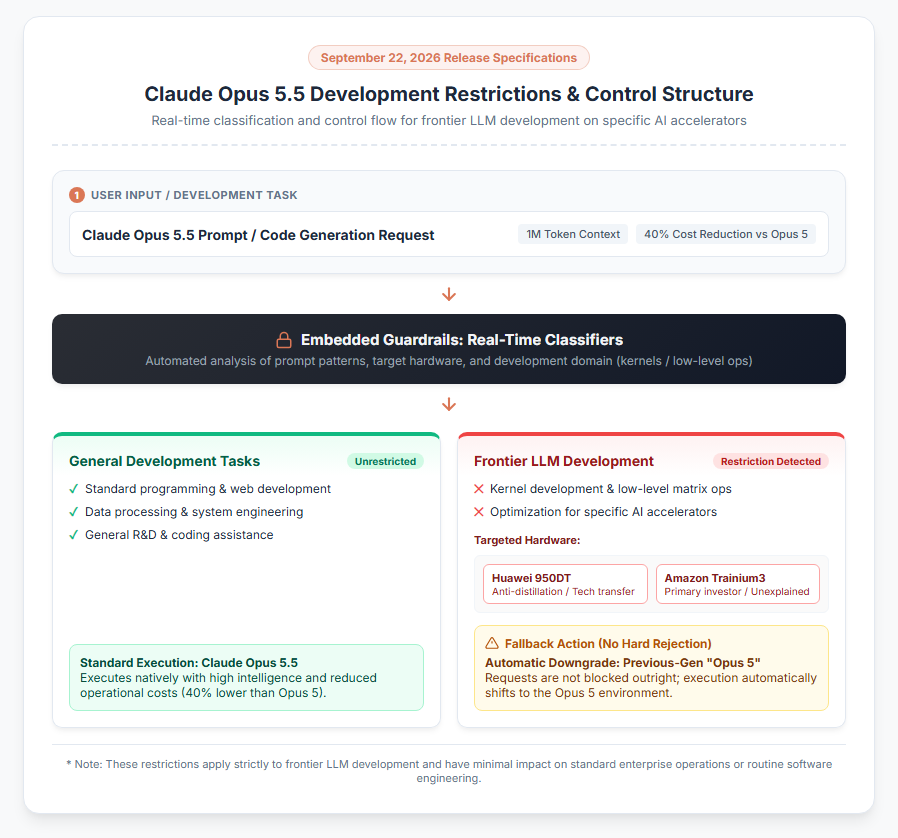
Anthropic’s release of its flagship Claude Opus 5.5 model on September 22, 2026, brought to light built-in classifiers specifically programmed to block frontier LLM development on certain AI accelerators, according to public documentation and user evaluations. Operating at roughly 40% lower costs than its predecessor, Opus 5, while featuring a 1-million-token context window, the model combines top-tier performance with stringent safety controls. The restrictions target Huawei’s 950DT AI chips in China and Amazon’s proprietary Trainium3 accelerators in the United States. Rather than outright rejecting processing requests when triggered, the classifiers initiate a fallback mechanism, automatically downgrading the session to the previous-generation Opus 5 model. Everyday programming, academic research, and standard web application development remain entirely unaffected, as the controls target a highly narrow scope of low-level LLM development tasks. A conceptual diagram outlining these restriction boundaries and control mechanisms is provided below.
Targeted Hardware and Technical Mechanisms
The restrictions apply primarily to low-level computational tasks, such as developing specialized kernels for machine learning accelerators, as well as code generation for memory management and matrix operations. Because kernel optimization dictates hardware efficiency and processing throughput, restricting these operations directly impacts an organization’s ability to train new frontier models. The embedded classifiers analyze prompt structures and code intent in real time, detecting patterns tied to fundamental LLM architectural development. The inclusion of Huawei’s 950DT chip aligns with growing concerns over “model distillation”—a process where foreign entities leverage outputs from advanced US models to train competing architectures. Conversely, the restriction on Amazon’s Trainium3 chip came as a surprise to industry observers. Given Amazon’s multi-billion-dollar investment in Anthropic as its primary corporate backer, it remains unclear whether the restriction on Trainium3 represents an intentional safety policy or an uncorrected configuration oversight.
National Security Risks and Market Dynamics
Countering Model Distillation and Intellectual Property Leakage
A central driver behind these restrictions is the threat of model distillation, where external teams systematically extract internal reasoning and weights from proprietary frontier models to boost the performance of smaller, domestic AI architectures. Overseas competitors, particularly in China, have increasingly used distilled outputs from leading American laboratories to rapidly close technological gaps. To counter this, Anthropic embedded protective guardrails within Opus 5.5 that impede the extraction of chain-of-thought reasoning and restrict access from unverified accounts. Traditionally, governments relied on hardware export controls to curb technology transfers. However, as AI capabilities advance, frontier developers are taking matters into their own hands by hardcoding software-level guardrails directly into model weights. With growing international scrutiny in September 2026 regarding autonomous cyber-vulnerability discovery and biological risks, this shift reflects a broader trend toward developer-enforced AI governance.
IPO Filings and Tensions Among Tech Partners
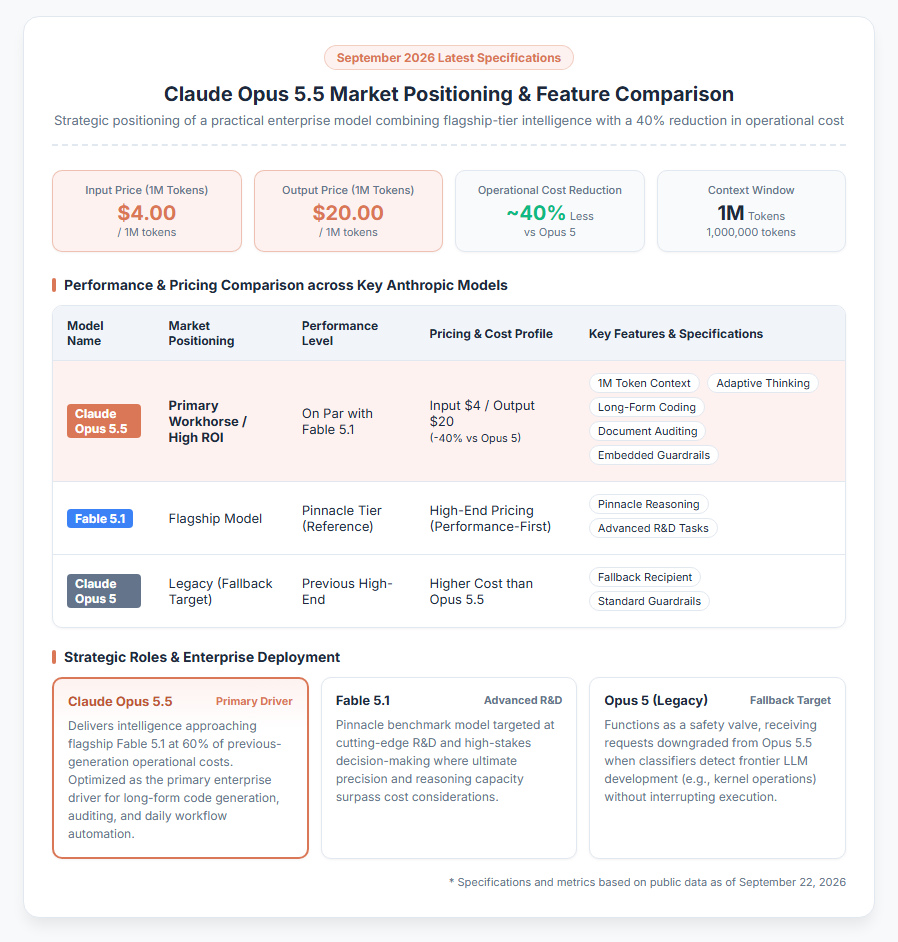
The discovery of these hardware-level restrictions coincides with Anthropic’s preparations for an initial public offering (IPO). Following its confidential filing in June 2026 at an estimated \$96.5 billion valuation, the company faces mounting pressure from investors to demonstrate robust safety governance alongside commercial viability. At the same time, the restrictions highlight complex tensions with key cloud partners. Amazon serves as Anthropic’s primary cloud infrastructure provider and a key vehicle for institutional investment, making the restriction on Trainium3 chips particularly sensitive. Priced at \$4 per million input tokens and \$20 per million output tokens, Opus 5.5 is positioned as a practical enterprise workhorse that delivers intelligence on par with the elite Fable 5.1 model at a fraction of the cost. Consequently, hardware compatibility and per-chip restrictions will play a crucial role in shaping enterprise adoption strategies across cloud platforms. A detailed comparison of model positioning and feature specifications is presented below.
Implications for Developers and Future Outlook
Practical Impact on Engineers and Enterprise Workflows
For the vast majority of software engineers and corporate IT departments, these development restrictions will have virtually no impact on daily operations. Standard coding assistance, web application construction, data pipeline management, and routine workflow automation will not trigger the classifiers, allowing teams to leverage Opus 5.5’s full processing power. However, specialized teams optimizing low-level kernel code for custom AI hardware or building pre-training pipelines for open-weight models must account for potential fallback triggers to Opus 5. Additionally, because Opus 5.5 enables Adaptive Thinking by default—altering tool-calling behavior compared to previous iterations—organizations planning API migrations are advised to thoroughly test their integration pipelines in staging environments prior to production rollout.
Key Developments and Strategic Watchpoints
Looking ahead, three major strategic factors warrant close monitoring. First, industry observers await an official clarification from Anthropic regarding the status of Amazon’s Trainium3 chip, specifically whether the restriction will be adjusted in upcoming patch releases. Second, as Anthropic approaches its anticipated public listing around November 2026, market participants will evaluate how the company balances its stringent safety commitments with aggressive price and performance competition from OpenAI and Google. Third, the hardcoding of internal guardrails within frontier models is likely to become an industry standard. As regulatory agencies and national security bodies demand stricter controls against unauthorized misuse, developers must carefully evaluate model terms of service, hardware restrictions, and fallback behaviors when architecting enterprise AI infrastructure.
Reference Pages
- 【Anthropic Official: Introducing Claude Opus 5.5】https://www.anthropic.com/claude-opus-5-5
- 【Anthropic System Card: Claude Opus 5.5】https://www-cdn.anthropic.com/fc1b44717c85dc068bc6ba5024219938094694bd/Claude%20Opus%205.5%20System%20Card.pdf
【#ClaudeOpus #Anthropic #FrontierAI #AISafety #Huawei #Amazon #ModelDistillation #AITrends】


コメント