At the Japan Growth Strategy Council meeting on October 1, 2026, Prime Minister Sanae Takaichi announced a policy to formulate an action plan within 2026 for the introduction and widespread adoption of high-performance AI. This move is driven by the aim to respond to the rapid rise of agentic AI and physical AI, and to strongly spearhead an AI transformation—the foundation of all strategic industries—under state leadership.
- Prime Minister Takaichi’s Action Plan Directives and the Positioning of AI in the Growth Strategy
- Industrial Structural Transformation and the Ripple Effects of AI Transformation Across 17 Strategic Sectors
- The Surge in Compute and Power Demand Driven by the Rise of Agentic AI and Physical AI
- Structural Differences Between Japan’s Unique Power Supply Constraints and the US AI Infrastructure Strategy
- Securing On-site Power Sources and Strategies for High-Efficiency AI Utilization in Enterprises
- Advancing Governance Frameworks and Key Focus Areas for “Trustworthy AI”
Prime Minister Takaichi’s Action Plan Directives and the Positioning of AI in the Growth Strategy
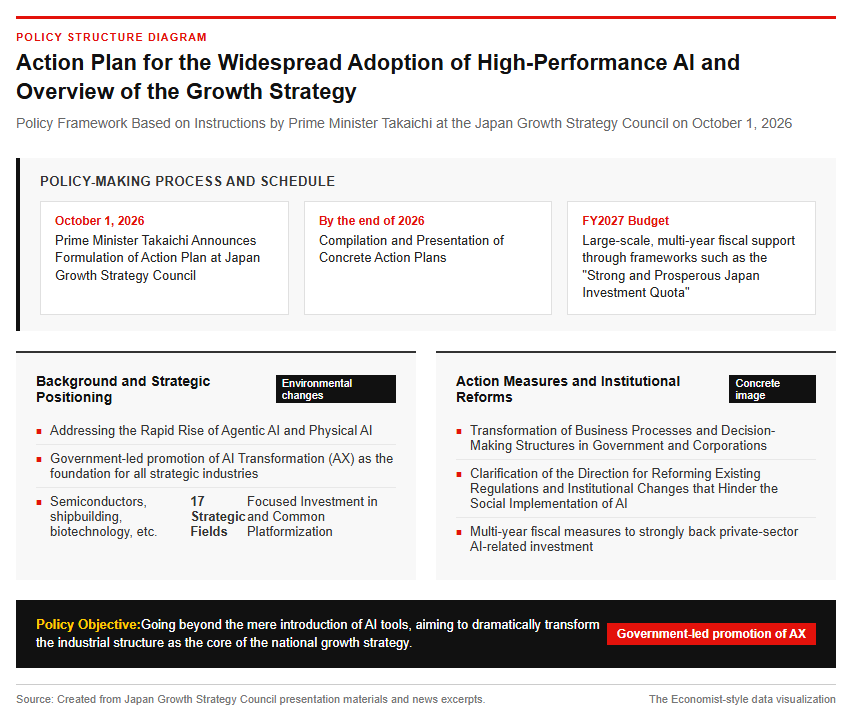
On October 1, 2026, Prime Minister Sanae Takaichi instructed relevant cabinet ministers at the Japan Growth Strategy Council held at the Prime Minister’s Office to formulate an action plan by the end of 2026 to accelerate the social implementation and widespread adoption of high-performance AI (artificial intelligence). At the beginning of the meeting, the Prime Minister emphasized that “the social implementation of high-performance AI is essential for realizing our country’s growth strategy,” clearly signaling her intent to drive a dramatic transformation of the industrial structure. The Japanese government has pledged intensive investment in 17 strategic fields, including semiconductors, shipbuilding, and biotechnology, and through this action plan, it plans to position AI transformation (AX) as a common foundation supporting the core of all 17 of these fields.
Specifically, going beyond the mere introduction of AI tools, a concrete vision to transform business processes and decision-making structures themselves in government and corporations will be presented during 2026. At the same time, the direction for regulatory and institutional reforms that hinder the social implementation of AI is scheduled to be clarified. The government is poised to strongly support proactive private-sector investment in AI by implementing large-scale, multi-year financial measures utilizing the “Strong and Prosperous Japan Investment Framework” and other measures scheduled to be newly established in the FY2027 budget. The following figure is an image illustrating the policy implementation framework and objectives.
Industrial Structural Transformation and the Ripple Effects of AI Transformation Across 17 Strategic Sectors
The defining feature of AX (AI Transformation) being promoted by the government is to integrate “trusted AI” with advanced processing capabilities throughout society, thereby boosting productivity in Japan’s manufacturing and service sectors, which are plagued by a chronic labor shortage. For instance, the Artificial Intelligence Basic Plan, approved by the Cabinet on July 14, 2026, highlights leading examples such as the large-scale rollout of the “Gennai” generative AI environment for 180,000 government officials, showing that the adoption of AI across both the public and private sectors is rapidly moving into full swing.
In particular, according to economic projections as of 2026, the further acceleration in the pace of AI adoption is expected to boost Japan’s total factor productivity (TFP) growth rate by approximately 0.2 percentage points. Furthermore, public-private investments in foundational fields such as physical AI, AI robots, and semiconductors are projected to reach a cumulative scale of tens of trillions of yen by fiscal 2040, generating massive economic ripple effects that transcend mere IT investment. In parallel, swift support measures for individual industries are also advancing—such as the compilation of new policy packages by the Ministry of Land, Infrastructure, Transport and Tourism and the Ministry of Economy, Trade and Industry to address labor shortages in the construction sector—building a framework that aims to balance the resolution of social challenges with economic growth.
The Technical Background Behind the Adoption of High-Performance AI and the Power Supply-Demand Challenges It Faces
The Surge in Compute and Power Demand Driven by the Rise of Agentic AI and Physical AI
Behind the formulation of this action plan is the technological trend in which AI technology itself is rapidly evolving from conventional writing assistance and interactive tools into “agent-based AI” that thinks autonomously to execute complex tasks, and “physical AI” that operates in physical spaces such as robotics and autonomous driving. While the widespread adoption of these next-generation AIs brings tremendous convenience to society, it is simultaneously causing an explosive increase in the computing resources required for data processing and the power consumption in data centers (DCs).
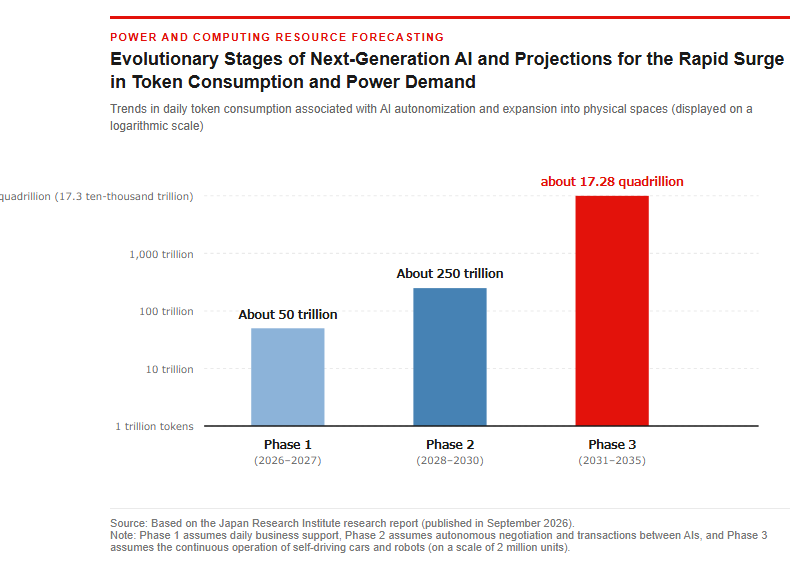
According to a research report published by the specialized research institution Japan Research Institute on September 28, 2026, token consumption will remain at around 50 trillion tokens per day in the first phase (2026–2027), where autonomous AI assists with daily tasks. However, it will surge to approximately 250 trillion tokens per day in the second phase (2028–2030), when AI agents autonomously negotiate and transact with one another. Furthermore, in the third phase (2031–2035), when autonomous vehicles and robots operate constantly on a scale of 2 million units, the number of consumed tokens is estimated to reach approximately 1.728 quadrillion tokens per day, predicting a sharp surge in electricity demand that far exceeds the framework of conventional IT infrastructure. The conceptual diagram below shows the transition of token consumption and power load.
Structural Differences Between Japan’s Unique Power Supply Constraints and the US AI Infrastructure Strategy
The greatest bottleneck in advancing the deployment of high-performance AI in society is the “power wall.” Japan not only has a low energy self-sufficiency rate and limited flat land suitable for large-scale wind or solar power generation, but also faces strict constraints on the construction of new thermal and nuclear power plants from the perspectives of site selection and regional coordination. Coupled with the prolonged wait times for grid connections to power transmission and distribution networks, there are growing concerns that the enhancement of power supply capacity will fail to keep pace with the expanding use of AI.
This supply and demand structure represents a striking difference from the United States, which leads in AI development. Although the U.S. also faces the challenge of grid connection delays, it possesses abundant natural gas resources and vast land, making it possible to continue its AI strategy of deploying massive computational resources in the medium to long term. In contrast, since it is difficult for Japan to rely on the unlimited expansion of power supply, it must shift toward an “energy-saving, high-efficiency AI strategy” that maximizes output from limited energy, while simultaneously working to expand its power infrastructure. There are concerns that if sufficient electricity cannot be secured and data center operations stall, it could lead to Japan-specific risks such as a widening service price gap with overseas markets and restrictions on the use of high-performance AI.
Solutions toward Social Implementation, Future Outlook, and Key Focus Areas
Securing On-site Power Sources and Strategies for High-Efficiency AI Utilization in Enterprises
To overcome the “power wall” and make the widespread adoption of high-performance AI a reality, new countermeasures are beginning to take shape from both policy and corporate operational perspectives. On the policy front, efforts are being promoted to guide facility locations by utilizing measures such as the introduction of “on-site power sources”—where power generation facilities like gas turbine generation, renewable energy, and storage batteries are directly co-located with the data centers themselves—and the “GX Strategic Region System,” which attracts data centers to regions with surplus supply capacity of decarbonized power sources. The aim is to reduce the supply load on the power grid, shorten the time required to expand transmission and distribution networks, and bring forward the operational timeline of the infrastructure.
On the other hand, private companies leveraging AI are also required to establish efficient frameworks. Since using cutting-edge massive models for all operations significantly increases costs and power consumption, routing design that automatically allocates models according to task difficulty is crucial. It is effective to implement a three-layer differentiated approach, such as using high-performance models for advanced strategy formulation, while applying small-to-medium-sized models or on-premise lightweight models (SLMs) for routine operational tasks. Furthermore, by introducing system controls that set upper limits on the number of AI agent reasoning loops (e.g., up to 5 times) and processing time, practical methods that maintain high productivity while curbing wasteful token consumption are becoming increasingly widespread.
Advancing Governance Frameworks and Key Focus Areas for “Trustworthy AI”
The biggest focus moving forward toward compiling the action plan is the embodiment of “responsible agile governance” that balances ensuring safety with promoting innovation. With the widespread adoption of high-performance AI, risks such as deepfakes, copyright infringement, and malicious use in cyberattacks are becoming increasingly sophisticated and complex. The government is poised to drastically strengthen the functions of the AI Safety Institute (AISI) to enhance its capabilities in AI model safety evaluation and vulnerability detection, while leading the establishment of international standards by driving the international framework known as the “Hiroshima AI Process.”
The action plan to be formulated toward the end of 2026 is expected to integrally incorporate multifaceted measures, ranging from infrastructure development, clarification of legal liabilities, and protection of human rights, to human resource development and reskilling support tailored for the AI era. Japan’s goal of establishing “Trustworthy AI” and achieving AI transformation across society as a whole is expected not only to resolve the domestic labor shortage, but also to serve as a new model case for overcoming universal social challenges shared globally. Whether the government and industry can work together to steadily execute this action plan will be the key that determines Japan’s future industrial competitiveness.
Reference Page
- [Cabinet Office AI Strategy Policy] https://www8.cao.go.jp/cstp/ai/index.html
[#AIActionPlan #PrimeMinisterTakaichi #AITransformation #DataCenters #PowerConstraints #PhysicalAI #GrowthStrategy]


コメント