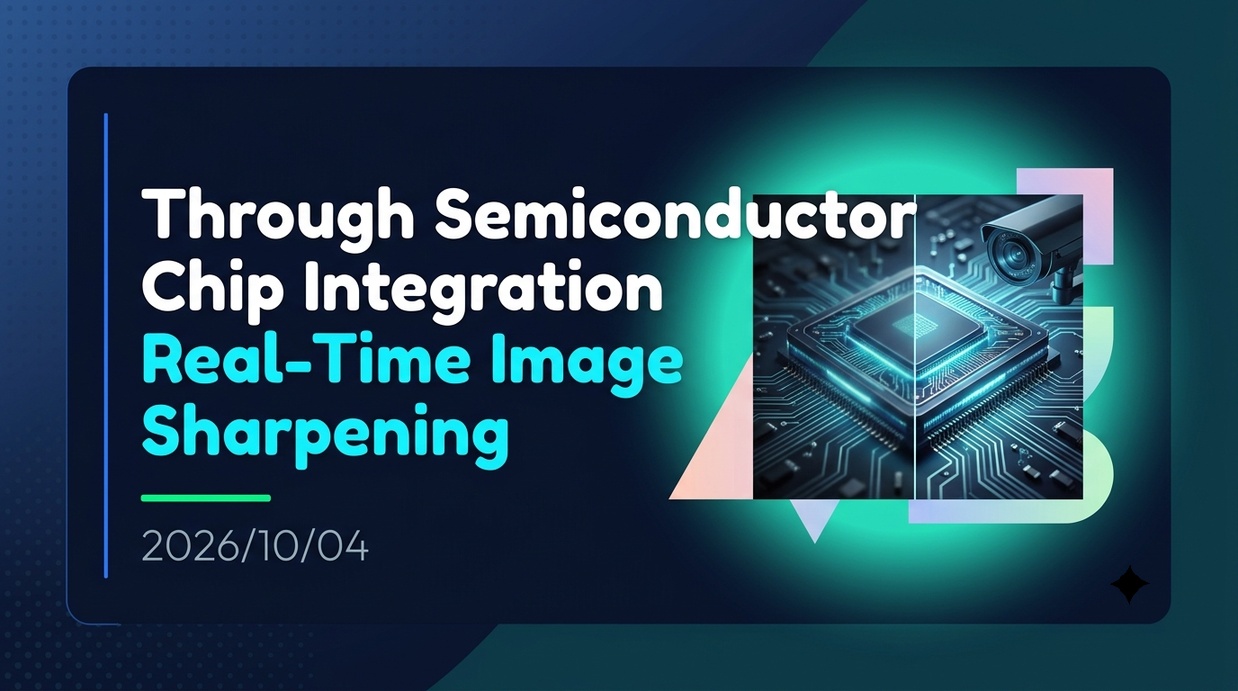
Logic & Design has become the first in the world to turn its proprietary image-sharpening algorithm, LISr, into a semiconductor chip, achieving high-precision video correction in real time. Behind this development is the growing demand for technologies that perform immediate processing and prevent the oversight of information due to poor visibility across a wide range of fields, such as security, infrastructure inspection, and defense.
- World’s First Dedicated LSI Integration and Real-Time Processing Achievement
- Clear Differentiation from Conventional AI Image Processing and General-Purpose Methods
- Dynamic Range Expansion and Pixel-Level Correction Mechanism
- Specific applications in crime prevention, police investigations, and infrastructure inspection
- Improving downstream AI analysis accuracy and integration with edge AI devices
- Expansion into the Broadcasting, Defense, and Robotics Markets and Future Vision
World’s First Dedicated LSI Integration and Real-Time Processing Achievement
Logic & Design has developed LISr, a proprietary core algorithm that sharpens images and restores them to high resolution without using AI. In October 2026, the company succeeded in integrating this technology into a semiconductor chip (ASIC/SoC) for the first time in the world. Sharpening processing, which traditionally relied on software or PC environments for post-processing, can now be completed by hardware alone, making it possible to perform real-time processing with minimized latency. The following figure shows an overview of the system configuration achieved by implementing this as a semiconductor chip.
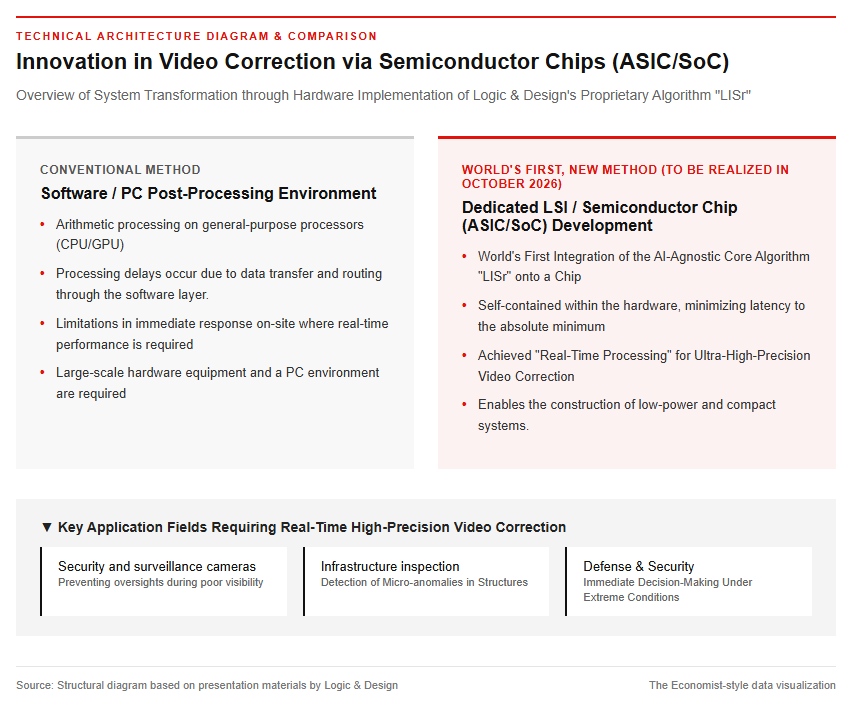
The main benefits of introducing this technology are as follows:
– Executing Ultra-Low Latency Video Conversion Processing
– Space-saving without the need for external PCs or high-performance GPUs
– Power-saving operation for field-installed cameras and mobile devices
In conventional systems, video footage captured by security cameras or infrastructure monitoring cameras had to be transferred to a server for analysis and correction, posing challenges such as time lags and increased communication costs. With the transition to semiconductor chips, input video can now be corrected on the spot at the camera’s edge and output immediately, dramatically improving the speed of decision-making in monitoring operations and investigation support.
Clear Differentiation from Conventional AI Image Processing and General-Purpose Methods
As a method for image enhancement, models utilizing AI such as deep learning have become widely used in recent years. However, AI-based image correction has the following notable disadvantages.
– The requirement for expensive, high-power GPU resources
– the risk that unnatural artifacts may occur in unseen environments due to its reliance on training data
– Long processing time per frame and a lack of real-time performance
In contrast, because LISr technology performs pixel-by-pixel calculations based on mathematical and physical algorithms, it does not require any prior training data like AI does. Furthermore, as a non-AI approach, it requires minimal computational resources for processing, and through chip integration, it achieves both overwhelmingly low power consumption and stable rendering performance.
Conventional contrast correction methods, such as tone mapping and standard histogram equalization (AHE), have had the problem of excessively enhancing even the noise components contained in video footage when brightening dark areas. However, LISr technology is equipped with a mechanism to accurately identify and separate signal components from noise components, setting it significantly apart in that it can clearly visualize only the target objects while suppressing the generation of noise.
Dynamic Range Expansion and Pixel-Level Correction Mechanism
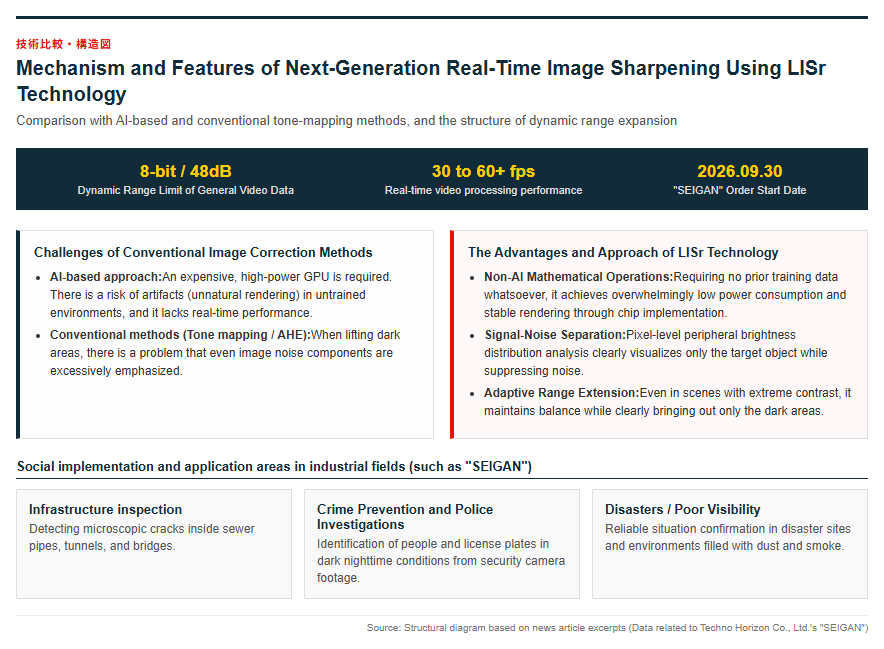
Generally, 8-bit video data has pixel brightness ranging from 0 to 255, which theoretically provides a dynamic range of 48 dB. However, in unclear images captured in environments such as nighttime, bad weather, or backlighting, the brightness data is skewed toward a specific, narrow range, failing to achieve the standard dynamic range.
The processing mechanism of the LISr algorithm is characterized by scanning images and performing real-time calculations on a pixel-by-pixel basis. It calculates the local dynamic range from the brightness distribution around the pixel of interest and adaptively determines the maximum brightness. The specific processing flow is as follows.
– Scans the entire image and analyzes the surrounding brightness distribution pixel by pixel.
– Calculates the dynamic range for each region and expands it to the optimal brightness
– Automatically determines signals and noise to remove unnecessary noise components
Through this pixel-by-pixel calculation, even in scenes where extremely bright and dark areas coexist, the balance is maintained, keeping bright areas natural while clearly bringing out only the dark areas. By instantaneously executing this series of calculations inside the semiconductor chip, it has become possible to sharpen even video at 30 to 60 frames per second or more without any breakdown.
Social Implementation in Industrial Fields and Future Outlook
Specific applications in crime prevention, police investigations, and infrastructure inspection
The birth of real-time image-sharpening chips is instantly bringing innovation to the fields of social security and infrastructure maintenance. On September 29, 2026, Techno Horizon Co., Ltd. announced the high-precision image-sharpening device “SEIGAN” and began accepting orders on September 30 of the same year. The product was unveiled at the “Risk/Crisis Management Exhibition (RISCON TOKYO) 2026,” and the following fields have been cited as actual use cases:
– Detection of micro-cracks inside sewage pipes, tunnels, and bridges
– Identification of People and License Plates in Dark Nighttime Areas in Security Camera Footage
– Situation assessment in disaster sites and poor visibility environments filled with dust and smoke
The following photo shows an on-site visualization concept using inspection equipment and dedicated controllers.
Particularly in Japan, where public infrastructure is increasingly aging, improving the efficiency of hammering tests and visual inspections of sewer pipes and structures is an urgent priority. Dedicated devices like “SEIGAN” offer the advantage of being able to intuitively sharpen video footage using only a jog dial and switch operations, without complex parameter settings, enabling even workers without specialized knowledge to detect hazardous areas without oversight.
Improving downstream AI analysis accuracy and integration with edge AI devices
One of the important roles of image sharpening chips is their use as a preprocessing solution for downstream AI image analysis systems. AI-based automated judgment models (such as defect detection and object recognition) experience a significant drop in recognition accuracy if the input images are too dark or contain excessive noise, which can lead to false detections.
By pre-correcting and sharpening input images through this chip, AI models can extract features more easily, significantly improving recognition accuracy and stability. Furthermore, integration is progressing with the next-generation edge AI semiconductor “Di1” and various embedded modules developed by Digital Media Professionals (DMP). The main technical scenarios are as follows.
– The sharpening chip performs noise reduction and dynamic range expansion on the input video.
– Transmitting the corrected, clear video data to the edge AI processor
– Edge AI instantly performs object recognition and autonomous driving decisions with ultra-high precision.
Through such phased hardware integration, an environment is coming together where advanced visual recognition—which previously could only be processed on high-performance servers in the cloud—is completely self-contained on edge devices.
Expansion into the Broadcasting, Defense, and Robotics Markets and Future Vision
The integration of real-time image sharpening technology into semiconductors is rapidly expanding its reach beyond industrial infrastructure into a wide range of markets, such as broadcasting, defense, and autonomous mobile robots (AMRs). For example, in April 2026, the adoption of edge AI and visual sensing is advancing in next-generation VTOL (vertical take-off and landing) drones developed by India’s ideaForge, with testing underway for advanced real-time obstacle avoidance and autonomous flight.
Key points for future market development can be summarized into the following three points.
– Real-Time Video Correction During Bad Weather in Broadcasting and Sports Coverage
– Enhancement of Visual Sensors for Autonomous Robots and Drones in Dark and Vapor-Filled Environments
– Instant Clarification of Long-Distance Surveillance Video in the Defense and Security Fields
Traditionally, acquiring visual information in harsh environments relied on expensive equipment such as thermal cameras and specialized sensors. However, by combining standard visible-light cameras with this sharpening chip, it becomes possible to secure high-quality visual information at low cost and with low power consumption. Moving forward, ecosystem development with camera manufacturers and semiconductor vendors both in Japan and overseas is expected to progress, firmly establishing it as a core technology that supports the infrastructure of competence in the physical AI era.
Reference Page
- 【Logic & Design Inc. Official Website】https://www.lad.co.jp/
- 【Techno Horizon Co., Ltd. Image Clarification Device SEIGAN】https://www.elmo.co.jp/product/image_processing/elmo-seigan/
[#Semiconductor #ImageSharpening #EdgeAI #LogicAndDesign #Seigan]


コメント